
Adrian Savage: Inside the future of email deliverability (Episode 14)
Is your list ruining your email deliverability? In this episode of Data Beats Opinion, learn how to make sure new leads actually see your emails.

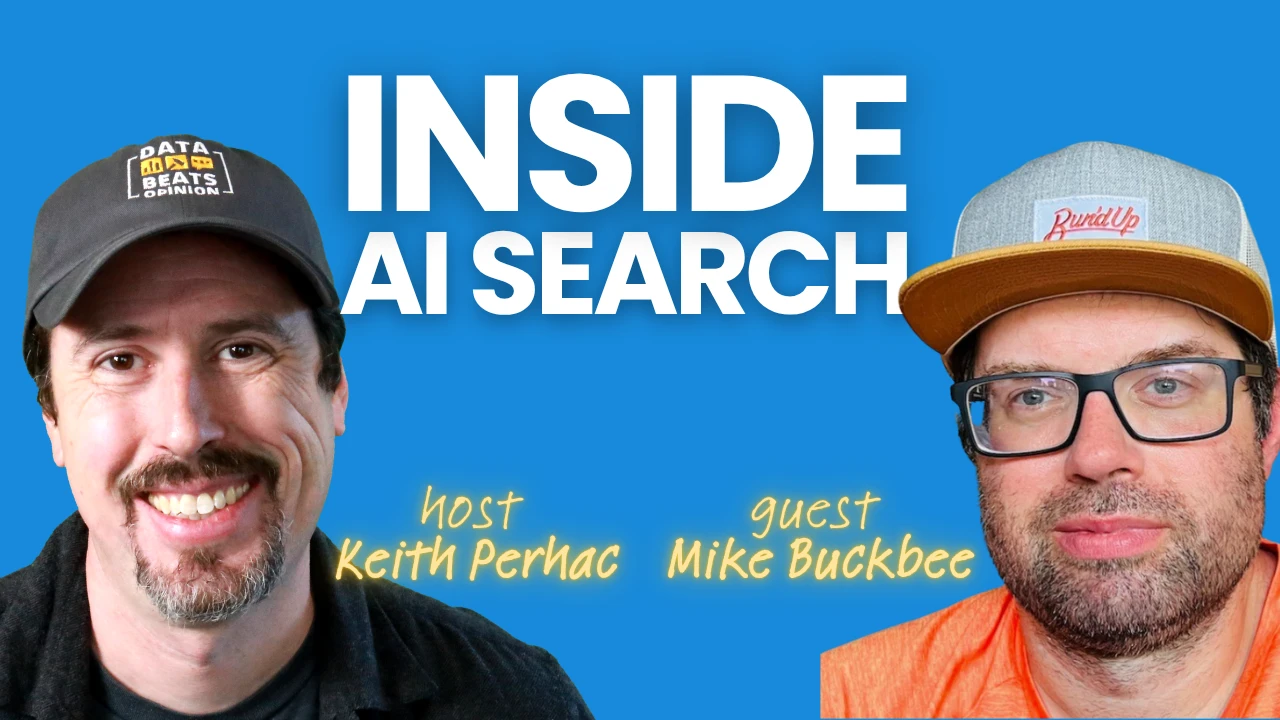
84% of Google searches now end without a single click, and AI chatbots are quietly becoming the new front door to your customers’ research.
So if you don’t show up when your customers ask, you don’t exist.
In this episode of Data Beats Opinion, we’re talking with Mike Buckbee, founder of Knowatoa, one of the first tools built to track how brands show up inside AI search. Mike breaks down why traditional SEO is now a lagging indicator, what actually earns you a spot in an AI’s answer, and how to build a strategy that holds up across Google, ChatGPT, and Claude alike.
Mike Buckbee is the founder of Knowatoa, a platform that tracks how brands show up across AI search tools like ChatGPT, Claude, Gemini, and Perplexity. Before Knowatoa, he spent nine years as Director of Demand Generation at a cybersecurity company and consulted for Y Combinator–backed startups, working at the intersection of software development and marketing. Today he helps companies treat AI visibility as a lagging indicator of their broader content strategy.
Connect with Mike on LinkedIn or learn more at Knowatoa.com.
[00:00] Intro
[02:57] How Google search has changed
[05:25] How Mike got into AI search tracking
[08:43] Why AI search is hard to track
[15:01] Marketers versus developers adopting AI
[19:36] HubSpot’s resignation letter and why you can’t out-SEO this
[22:02] What producers should actually do now
[25:37] Content planning and building leads from AI search
[29:45] What AI search reveals about your brand
[33:57] System prompts, ads, and the future of AI trust
[40:41] What Knowatoa is trying to do
[45:29] Free content and the page count arms race
[49:41] How Knowatoa surfaces citation opportunities
Data Beats Opinion is SegMetrics’ monthly podcast exploring what’s actually working in growth and marketing today. Host Keith Perhac, founder of SegMetrics, sits down with domain experts to uncover practical strategies you can implement — not just theory.
Want to see what is and isn’t working across all your growth channels — including outbound sales, paid ads, deal pipelines and content marketing? SegMetrics provides full-funnel, cross-platform, lifetime attribution so you can see what’s actually driving revenue, not just clicks. And you can test-drive it for free.
Start your 14-day free trial today.
Data beats opinion. Growth beats guesswork. 🚀
So ChatGPT just recommended three of your competitors and didn’t mention you at all. Google just answered your customer’s question before they even clicked a link. And somewhere out there, a six-year-old Reddit comment is quietly shaping what AI thinks about your business. This is the new reality of search.
And most marketers have no idea how quickly the landscape is changing or how they even stack up. In this episode of Data Beats Opinion, we’re talking with Mike Buckbee, founder of Knowatoa, one of a new wave of tools built specifically to track how your brand shows up across AI search engines. We’re going to get into why SEO, as you’ve known it, is actually a lagging indicator of everything else that you’re doing wrong.
We’re going to talk about what it actually takes to show up when buyers are asking ChatGPT and Claude who they should trust. If you’ve been ignoring AI search, this is your wake-up call.
Let’s start the show.
Keith: So Mike,
Mike: Right.
Keith: Super glad to have you on. Um, it is, yeah, it’s very apropos that you’ve come on now because, uh, the world is changing quickly, and you are kind of at the forefront of all of this AI, AEO, AI search, whatever the hell we’re calling it now. And—
Mike: Yeah.
Keith: Let’s do it. Throw down.
Mike: Um, I was gonna say, I think that’s actually an interesting place to start, which is that there is always this debate: is it SEO, is it AEO, is it GEO — all these acronyms. And, um, where we’ve come to is we just call it search now. That is just search marketing, because it’s such a blend across everything, and every bit of energy you spend trying to parse this out into something that’s gonna apply to everything just definitionally changes depending on who you speak with. It’s better just to consider it search, and—
Keith: Yeah.
Mike: I think that helps ground it. Then, as a marketer, I’m just trying to reach people. I’m just trying to answer the questions people are searching for, wherever they’re at, in a reasonable way — my content in a reasonable way. And our hypothesis is: if you do all those things, you end up in the right spots and you get business, and that’s the way to track this stuff.
Keith: Yeah. It really is interesting in a way, because it is kind of like SEO in the old days, where you were still trying to game an algorithm to a degree. But the things we used to do in SEO that stopped working because of the algorithm are now great for AI, right? And I think a lot of people are worried because they do feel it is something completely new. And while it has a lot of challenges, I think, like you’re saying, the overall strategy is really the same, which is to provide really good content that people — or in this case, AI — want to show to people who ask about it.
Mike: Yeah, and there’s less now than there was a year ago. A year ago, I think there were a lot more conversations about like, “Do I actually need to pay attention to this? Is this a flash in the pan?” If nothing else, we are certainly in a spot where Google has changed a lot of things in the last couple of years — it’s like they’re just ignoring everything else. You’d never know AI existed if you just looked at what Google is doing in terms of how they present search results, what they consider ranking factors, how all of those pieces happen. We’re looking at something where there are fewer — primary links is a nice way to put it—
Keith: Yeah.
Mike: —and there’s a lot more competition for those. I think there’s a lot less emphasis on informational traffic; they’re just sending less of that. And that needs to be a change we make in all of our content plans, our content strategies, and our distribution strategies, to respond to that. And then on top of that, there’s ChatGPT and Claude—
Keith: Right.
Mike: —that are coming in as well, taking, I think, more industry-by-industry chunks out of the overall search volume.
Keith: Yeah, I think so. Amanda at SparkToro just gave a talk at MicroComp this last week — which kind of dates the podcast — but she was talking specifically about two big stats. One was that clicks from a Google search — so Google searches that result in a click to a website — is… wait, what was it?
Searches from Google that don’t result in a click: 84%. I knew I’d get that number eventually. It’s up from 56% two years ago. The other stat she showed was that when you search on Google, the first thing is an ad, the second one is AI or some sort of overview thing, and—
Mike: Yeah.
Keith: Yeah. And then below the fold are the actual results. So now the actual search results from Google are below the fold, which was ostensibly the whole reason for Google, which is—
Mike: Yeah, ten blue links is far, far in the rearview mirror at this point, so.
Keith: Yeah.
Mike: Point being, so.
Keith: Yeah. And so I want to step back one real quick, which is: Mike, how’d you get into this?
Mike: Oh, okay. Um, yeah, so I was director of demand gen at a big cybersecurity company and worked there for, you know, nine years. I’ve done a bunch of other work — worked for YC companies — and it’s always been sort of on the boundary of software development and marketing.
Keith: Mm-hmm.
Mike: Putting together stuff that was very conversion-oriented, doing technical SEO, doing technical SEO content — you know, it’s hard to write about cybersecurity if you’re not a subject matter expert; you come off sounding real weird. So things like that. And, um, very much in the era of the skyscraper technique — very much in the era of “we should just write longer and more comprehensive articles about high-level topics that may be low intent.” We’ll get people to our site with these, we’ll then have some sort of CTA or sweetener, like, “Hey, you want a white paper on this topic? Hey, you want a webinar on this topic?” We’d get them into the funnel that way, and eventually turn them into leads, and a salesperson would pick those up. Very B2B.
Keith: Mm-hmm.
Mike: And that is a strategy we’re seeing become less and less effective now. And, you know, through my own interest in AI as a developer, and looking at what was happening, I was drawn to all these changes and thought there was a lot of opportunity there. So, for myself and a few of our friends, I’d written a script that hit ChatGPT’s API and just returned results about my company and their companies as a CSV.
I passed that out a couple of times, and then a couple weeks later, a couple of the people running essentially post-signup surveys — “Hey, how’d you hear about us?” — were like, “People keep saying they found us on ChatGPT. Can I get an update of that CSV, Mike?” So I’m like, alright, maybe there’s a business here. So that eventually led to having a full, professional SaaS product for this called Knowatoa, which tracks these results across the different services and helps you with your questions. And now it goes so far as to really treat search as a lagging indicator of the rest of your marketing.
That’s a central organizing principle we have, which is: if you’re doing good social media, if you’re doing good content, if you’re doing good distribution, all of that will result in showing up in search—
Keith: And—
Mike: —and that’s where we’re at today.
Keith: I think it’s interesting, because you touched on something there. Let’s refer to it as “search,” because I think that’s really what it is — that’s the intent behind it. We used to call it Google search, or organic search, or whatever; we always just called it search, but it’s the same thing. What’s interesting, though, is that because Google — and I guess DuckDuckGo and other search engines, but mainly Google — had a monopoly on what search was, it was really based on your website, and optimizing your website was the only way to get visible in search.
But AI is not limited to the website, right? Because it’s crawling you. You mentioned social — so now Reddit is a huge influx of data for AI. It crawls Twitter, it crawls all these systems. So it’s interesting, and I’d love your opinion on this: it feels like you can no longer just be on your website, right? It’s not just talking about the stuff you want to talk about on the website — you also have to be on Reddit, you have to be on these social platforms, you have to be everywhere in order for the AI to pick you up better. Or do you disagree with that?
Mike: Um, I think, you know, we have to start with a definition, so we agree on what we’re—
Keith: No.
Mike: —talking about. So much of search is treated as a monolith, where it’s all treated the same. And I think if we’re talking about essentially branded search — people asking direct questions about my company—
Keith: Mm-hmm.
Mike: —a lot of that is still your site. Some of it is on the edges, but for the most part that is your site. If you’re really trying to do stuff where you’re trying to find new people — people who haven’t heard of you, who are maybe problem-aware but not yet aware that you’re the solution to their problem—
Keith: Right.
Mike: —then it’s a different ballgame. And in that respect, I do think distribution matters a lot more. We do see some of these social sites disproportionately represented in the results. The one you didn’t mention was LinkedIn. I’d mention LinkedIn because we see it show up in a lot of results — so there’s actual data about this. But also, there’s a lot of press releases that let you read the tea leaves of where stuff is coming from. OpenAI has this multibillion-dollar, weird relationship with Microsoft. Part of that is they get training data off of LinkedIn, which is owned by Microsoft. A lot of people forget that. And GitHub, which a lot of people—
Keith: Also owned by Microsoft. Yeah.
Mike: —and, you know, so that’s a huge part of it. Those are very easy places for it to just pick up on. And there’s a tension to this, which is that what you think of as a search campaign is not usually what you post to your LinkedIn, is not usually what you post to your Twitter. So I think we’re seeing new patterns come out of this, and new strategies.
Keith: Yeah. And it is such a deep thing. So a lot of this, though, is a problem — you mentioned that when you were doing the CSV thing, people were saying on their feedback forms that they found you through ChatGPT, right? We actually introduced AI search tracking in SegMetrics, which I will say is kind of hit or miss, because a lot of AI results do have links in them that people will click and go to, but that is very rare. What we’re seeing a lot of, I think, is this removal of the ability to see where people came from in any sort of data-analytics-tracking way, because people are getting all of their information through a chatbot that isn’t tracked, that has nothing you can glom onto.
They’re doing all their research — you have no input on that research other than what you’re able to feed into the AI organically and track through Knowatoa. And then people come to a conclusion, and they open up six or seven tabs with the solutions they’ve found, they look at them a little bit, and then they go directly to the site, and they make a decision, right? And that’s — yeah.
Mike: Yeah, I think it might be interesting to talk about the mechanics of why some of the tracking just isn’t there.
Keith: Yeah.
Mike: So some of that is that a lot of times I think people equate search result links with AI citations, and the citations are more — footnotes is maybe a better way to think of them. They’re there for reference, but you’re not really expecting to click on them. So even showing up in a citation isn’t necessarily a sign that you’ve done a good marketing activity. It’s a sign, maybe, that you’re on the right track — it’s a positive, you’d rather be there than not — but in and of itself, getting a citation isn’t the end result we’re trying for.
Keith: Mm-hmm.
Mike: A couple things there. One, especially for very informational things — like, “What’s the average length of a giraffe’s neck?” — there’s not a good follow-on query for that.
Keith: Right.
Mike: There’s not a lot of follow-on to that. And there could be a hundred citations for that. Something we find is that even Google jumps around — sometimes they have ten citations, sometimes they have thirty.
Keith: Right.
Mike: So there’s a volatility to this that doesn’t even speak to the end result. And a lot of times, if you’re using something like ChatGPT or Claude, it’ll give you branded results separate from links. That was actually one of the first things we did — we separated it out so that, for a single term like SegMetrics, we can track segmetrics.com, SegMetrics—
Keith: Right.
Mike: —you know, seg space metrics, in case someone typed it in weird somewhere. All of that can be one entity, SegMetrics, that we track, and go, “Oh, you showed up in these places.” And a lot of that is — there’s friction to get from—
Keith: Right.
Mike: —the research phase to the action phase in a search journey, and so much of the search journey is now done for you by the AIs, or it’s just summarized into one thing, so you don’t need to open up five sites — like an AI overview does. So.
Keith: Yeah, I was looking — we were talking a little bit before we started about Aaron Francis’s new tool, and I was looking for a good, quick code editor that isn’t heavy. And I was like, “Claude, what’s out there in 2026? What have we got?” And it listed up seven or eight. I said, “Okay, what’s good and bad about all of these? I’m on a Mac,” blah, blah, blah. And it listed three or four. I said, “Okay,” and I just put them into Google, went to the first link, which was the thing, and boom, boom, boom — “Okay, this one looks good, download it.” I said, “This is crap,” uninstalled it, installed the second one, and said, “Yes, this works great.”
But at no point was I going through their documentation, or doing what I used to do on a website to show that I was interested in solving this problem. I don’t know where I’m going with that, but it’s just a whole different way of doing this.
Mike: My assumption is most of the people listening to this are pure marketers — not marketer-developers like us. I don’t know if that’s accurate, but, you know, most.
Keith: I’d say ninety-ten. Yeah.
Mike: Yeah, something. And something I’ve found is that, in a lot of ways, I think the software development world — and all the Claude Codes and all the massive changes that have happened in the software world — haven’t happened elsewhere yet. It feels like a very early-adopter phase to me. It just so happened that code was very tractable for all the AI tools, so it’s taken off there, and now, I think, the vast majority of developers are using AI code in some way — even if it’s just sprinkles of it. And we’ve seen a massive drop in the amount of search volume for programming and technical terms, which used to be huge.
Keith: Oh, Stack Overflow is dead. Just — yeah.
Mike: Well, Stack Overflow’s dead, but, you know, we have friends who had React blogs, who had businesses built around these things. There’s a company called Tailwind, which has front-end web components, that’s had a really interesting SEO journey, where people would search Google for documentation on how to use Tailwind, land on their doc site for some things, and there’d be a CTA there — “Hey, get the Pro version of this and we’ll give you these components.” And they’ve had a huge cratering of their traffic and their revenue. And that’s just something that’s happening in our particular niche, so I think we’re much more sensitive to it, but I do think it’s the canary in the coal mine for a lot of other places.
Keith: I think — yeah, I mean, I will push, not really push back, but, you know, I live and breathe in the marketing world, and the amount of adoption for agentic marketing is huge. People are either fully into it or they want to be fully into it — there’s just a lot of excitement. I think it started a little later than with developers, because, like you said, code is easy for AI to understand.
But what I think is interesting is I don’t know how much of the marketing side was based around what you’d consider SEO — traditional, like, “Hey, you have to go find this thing and then opt in and do whatever.” And I could be wrong on this, but I always feel like it’s much more community- and personality-based, right? It’s much more about—
Mike: Um—
Keith: —building an audience and growing through that, and joining other people’s audiences to build your own audience, and that kind of stuff — which is much more than the SaaS or dev-SEO focus. I could be wrong on that, but it’s kind of the feeling I get.
Mike: I think it’s very industry-specific. And I know—
Keith: I—
Mike: —where you’re coming from. I think, from your background, where you worked with people who were in a lot of course stuff and a lot of marketing, selling stuff — that was not the enterprise B2B SaaS world, which in a lot of ways — we had style guides that were basically trying to knock the personality out of anything we wrote, de-emphasizing the author, trying to do stuff like that. An interesting example is HubSpot, who I think — they—
Keith: We will have a talk about that in a second, but yes, go ahead.
Mike: Well, I guess HubSpot used to rank really well for the term “resignation letter.” They’re not a resignation-letter company, but it was like a vaguely professional term, and they’d rank number one and get a lot of traffic for it.
People would land on their site, and they’d be — and the search intent was, “I just want a resignation letter template so I can quit my job at McDonald’s,” or wherever—
Keith: Right.
Mike: —you know. And from an SEO standpoint, they’d have this hyper-optimized page: “What is a resignation letter? Who needs one? Some thoughts on a resignation letter from a recruiter” — because it has to have E-E-A-T for a resignation letter, which is its own whole weirdness. And then you’d click on the page, and it would take you to a form, which would then try to do a progressive input of all your data, and then finally, at the end of it, it would send you the letter. And now there’s an AI overview that just throws you right into a Google Doc, that—
Keith: Mm-hmm.
Mike: —you know. I bring this up mostly from the perspective that you can’t out-SEO these changes. It’s also, I think, good in a lot of ways — the user experience, the search intent, the search experience is much better if I type into Google and get a—
Keith: It is.
Mike: —than the super-optimized, weird SEO games we used to play.
Keith: Yeah.
Mike: I do think this is both an opportunity and a challenge for a content person, to work through these things.
Keith: Yeah, I think — for the end user, it is a better experience, to be honest. I like being able to just not go through all these sites — like you said, recipes are a great one; read eight hundred words of backstory before I get the recipe, right? I don’t want to have to opt in to get some of this. So from my perspective as a consumer, it’s great, but you’re exactly right — what do we use, what do we do as producers of all this stuff? From the tracking side, it reminds me a little bit of when Google took keywords away.
For people who don’t remember: when someone clicked on a Google link, it had the keywords they searched for in that link. So on your website, you could track exactly what keywords people used to find your site, and they took that away because they wanted to sell more ads. That was horrible — when that happened, we were all like, “Dear Lord, what are we gonna do? We don’t have any information anymore.” We’ll get used to this as well, but it’s still like — what do we even do with our marketing sites at that point, right? How do we do lead gen? How do we get people excited?
Mike: Well, I mean, this is a bit of a tangent, but every quarter Google releases something that says, “Hey, we’ve never had more quality queries on Google than we did last quarter — it was great.” And I always think, wow, there’s a lot of nuance in that — what’s considered quality, what do they consider bot traffic, what do they consider — there’s a lot of knobs they can turn.
Keith: Yeah. And who’s judging the quality? Quality for who — for the end user, for the end consumer, for Google?
Mike: Yeah. And so when you start to think about all the clicks and—
Keith: I—
Mike: —all of the traffic, the vast majority of it is navigational.
Keith: Mm-hmm.
Mike: You know, a lot of it is non-follow-up queries — like, “Giraffe, what’s the length of a giraffe’s neck?” Goofy stuff like that. The one that always gets me is people looking for login pages — all this stuff. And when you get down to it, there’s really only about ten, fifteen percent, depending on how you want to count it, of queries that are actually looking for new information, looking for solutions, looking for the answer to problems. And I do think you want to be in those conversations. So that’s really where I put a lot of the emphasis in strategy when I’m talking to people — you need to really think about that “hot” section. What are we going to do for this, versus traffic numbers, versus everything else — where I think the cards are stacked against you in those other categories.
Keith: Yeah.
Mike: Yeah.
Keith: I think there was always — one of the people I worked with phrased it really well. He said you always want to find what is the 2 a.m. question that people are asking about your services or your products — not the version you know as an expert, not the mental version, but “dear God, I woke up at 2 a.m.” He was in the health space, so it was like, “My stomach hurts, what is going on? What is the query you put into Google? What is the search you put in?” And that’s what you optimize for in SEO — that’s what you build the page for, that’s what you build the opt-in for and stuff. And I think those questions still stand — those are still the things you want to optimize for — but the end result of what you do with that is now different. Would you agree?
Mike: Yeah. So, in terms of our own content planning, or when we’re consulting, it’s become a lot more solutions-oriented — it’s almost one step up from the keyword or the actual question, into that buyer’s journey. It starts with, “What is the thing? Oh, this is how it’s actually defined. Here are the other alternatives for it. Okay, what are the problems with these? Okay, now that I know the problems, these don’t apply to me — so give me the filtered list.” And you want to make sure you’re in that.
So if you’re too precise in what you’re trying to do — “We are a solution for this one thing, for these people searching for this” — what you really need to do is make sure that anyone who’s searching for, say, digital marketing, needs to find us, Knowatoa. It’s not just SEOs, it’s not just people doing this, because there are a lot of different aspects of this that now feed into it.
Keith: Mm-hmm.
Mike: And that’s something we’re trying to do — if you’re looking for, “Hey, how do I increase the leads on my site?” — there are a lot of pieces to that. So we want to make sure that, as a general solution, we can be part of that conversation.
Keith: What do you see — I’m just trying to figure out — how do you see people building leads from AI in that case? Like, what’s the offer? I know how to do it on social, I know how to do it with the old SEO strategy, but when AI is answering all the things, what are you able to provide, seeing that maybe they can’t even get to your site? What’s the — I guess, how do you see that evolving now?
Mike: I think there’s a need to establish — a lot more of the guides, and use cases, and solutions — this is very much my SaaS brain coming out—
Keith: Mm-hmm.
Mike: —that’s becoming, I think, much more vital, where — at some level, all the—
Keith: Yeah.
Mike: —they’re just doing pattern recognition, like, “Hey, people asked for this, and this was the next thing that came out.” So really doing a good job of listing all of that — how it works, how it fits in — to get to that higher tier in the search journey, I think, makes a lot of sense.
One of the challenges we face as a company trying to help with this is that a lot of times it’s something very specific to that business, or that industry, or niche. So it’s not an easy thing, like, “Oh yeah, do this LLM-text thing, do this other little tweak.” It still takes a human who understands the industry, who can use these tools in the right way, and craft a narrative — craft a—
Keith: Yep.
Mike: —story of some kind. So, I’m trying not to talk about confidential clients, but there is stuff that fits very cleanly into that, where there are a lot of pieces that didn’t make as much sense before. That’s maybe more — I think we’re talking middle-of-funnel content.
Keith: Yeah.
Mike: That’s not definitional — it’s much more “how do I go from A to B” than it is “what’s an A,” you know—
Keith: Right.
Mike: —generic sort of thinking about it. So certainly I think that’s a hotbed of non-trackable content that makes a lot of sense. And then I think there’s a lot of very much bottom-of-the-funnel stuff, where we get into all the weird “best of” listicles and everything else. But there’s, I think, a spot below that — even below—
Keith: Below the bottom of the funnel.
Mike: Well, “bottom of the funnel” was a marketing term—
Keith: Mm-hmm.
Mike: —and something we don’t think about with search is that there’s a lot of, especially in B2B enterprise, internal sales documentation—
Keith: Yeah.
Mike: —battle cards, like, “How do we stack up against this other company? What do we do in these very precise circumstances?” And a lot of that never ended up on the website — because why would it, you know—
Keith: Yeah.
Mike: —it’s almost too much to have someone wade through all of it for this. We’re definitely seeing a change in the buyer’s journey, where not having that information can disqualify you from a sales perspective before marketing even takes place, which is—
Keith: Right.
Mike: —something to think about. But something that comes up a lot in the B2B space is regulations — like, “Oh, we’re a healthcare organization, we need a HIPAA-compliant email newsletter solution. Give me a list of those.”
Keith: Alright.
Mike: And if you don’t have that cleanly stated on your website, you’re not even going to make the list — you’re not even going to have any journey. And there are a lot of different aspects to that. “Do you do business in California?” You’re like, “Oh, well yeah, of course we do, we’re a SaaS.” Do you say that? Is that something we account for? I think those things are changing too. And the other piece is there’s a real opinion/perception aspect to this — I think people put too much personality into it, like, “Oh, ChatGPT likes my company,” or “ChatGPT doesn’t like my company.” But really it’s the collective opinion of everyone on the internet about your company, and—
Keith: That’s so much worse, like—
Mike: —which gets reflected in the results. And what I bring up is Wells Fargo. Wells Fargo, you know — biggest FTC fine of all time, all sorts of other stuff, where they were opening credit cards without people’s knowledge—
Keith: Yeah.
Mike: —for their bonuses. Not great stuff. If you do a Google search, it comes up with, “Oh yeah, where’s the nearest Wells Fargo ATM, where’s the nearest branch?” But if you ask, “Hey, ChatGPT, should I use my local credit union, or should I use Wells Fargo?” it’s like, “Well, maybe do an ethical survey of Wells Fargo before you work with them.” You’re like, whoa, what is this?
Keith: Yeah.
Mike: When we think about how the AI search results come about—
Keith: Okay.
Mike: —what’s happening is: you type a question into ChatGPT, and ChatGPT has a system prompt that changes oftentimes — like, “Oh, they’ve decided that Sam Altman wants to de-emphasize certain results or opinions, or—”
Keith: We really like Wells Fargo now.
Mike: “We really like Wells Fargo now.” Or, “Hey, anything that’s about these areas, we’re just going to say that’s controversial.” Or a lot of times it’s actually IP protections — like, “Hey, anything from an artist from the last hundred years, don’t make a new image based on—”
Keith: Right.
Mike: —that kind of thing. That’s in the system prompt. So there are things in there, such as, “Hey, don’t give financial advice.” Does that mean don’t include Wells Fargo? It doesn’t say that. So that’s one layer of it. Then there’s the actual model, and the model has all this training data, and maybe it’s picked up new things, and maybe it’s different than what it was before. And then occasionally it does a tool call — which is a technical term for AI stuff — that goes out to an actual web search index and brings up a whole bunch of results, and then it filters that through its perception of your company and your competitors, and it finds a hundred results and gives you five back. So you’re fighting through all the layers of that, below the bottom of the funnel.
Keith: Right.
Keith: And it’s interesting, because you talked about the system prompt and how that can change. And Anthropic, who has Claude, publishes their system prompt, so you can see what changes they’ve made — all that stuff. I don’t believe OpenAI does that — ironically, given they have “open” in the name—
Mike: They leak all the time.
Keith: They get leaked as well, yeah. But one of the things — OpenAI is now playing with the idea of ads in their AI, and I think they’re actually in a beta trial, or alpha trial, I can’t remember right now. I worry — I knew it was going to happen; they’ve been talking about it for a while, and we’ll start tracking it when they release the API. But the interesting thing there is I think having ads in there erodes trust in the advice, just like Google eroded trust in search results because there are so many ads. Whether or not an ad is actually showing up in the results and labeled as an ad, do we know they’re not influencing that on the backend?
And, you know, they used to do those — I think even in Idiocracy they had it, and there are all those cartoons where it’s like you’re talking to a friend and he’s wearing the Pepsi jacket and the Pepsi hat and everything, and it’s like, “You should drink Pepsi.” It kind of turns into that, because we have this kind of human-like, parasocial relationship with these chatbots to a degree, and we’re expecting them to be semi-objective. The idea that once there are ads in there — do we then trust that objectivity at all? Are they essentially ruining the whole thing at that point? That’s a huge, fascinating thing for me — our perception of it once ads enter the mix.
Mike: Yeah, I mean, I think we’re getting into really speculative territory. The thing I think would be amazing is if you asked how long a giraffe’s neck was and it said, “It’s fifty-seven—”
Keith: Pepsi cans.
Mike: “—Pepsi cans,” you know, that it just blends it in—
Keith: I would love that. That would be great.
Mike: Yeah, I’m gonna go patent that idea before you publish this, but—
Keith: All measurements are in Pepsi cans.
Mike: Well, I mean, that’s the kind of weird stuff that could happen — just slowly. Certainly I think there’s an erosion of trust with this, and certainly there are some companies that are a lot more open and predictable about what they’re doing with it. I do think Anthropic has been a lot more forward about the AI governance side — how they train, how they deal with copyright, how they’re trying to balance being respectful of that with also having actual training data.
Keith: Mm-hmm.
Mike: And it’s an interesting situation, so — yeah.
Keith: Yeah.
Mike: But absolutely we’re going to see ads in all sorts of things, and it’s a cycle — like it used to be in the news, you know, the old-timey newscasters would go, “Alright, let’s take a break — let me tell you about the—”
Keith: The core flesh.
Mike: “—of cigarettes. Nine out of ten doctors recommend these.” So—
Keith: Yep.
Mike: —there are always these interesting bounds around trust. But if we’re trying to really think about the future — how familiar are you with Character.AI?
Keith: Character — oh, the ones where you create an avatar and all that stuff. Yeah, yeah, we’ve done a lot of tests into that.
Mike: So do you recall how much Google paid for them?
Keith: No, no.
Mike: It was a billion dollars.
Keith: Holy — more. Alright, alright.
Mike: So, let’s just throw that out there — why would Google pay a billion dollars for something if not because it’s going to be a core part of this stuff in the future? And I do think that is the future. The reason I’m bringing it up now, since you’re asking about the erosion of trust — I think right now we still have a very arm’s-length relationship with AI, both as a society and in my own use. We’re not yet quite to the point of the sci-fi companion that’s always around — even just as, “I’m your marketing companion.” There are arguments for and against that.
We’ve actually named our agents in the application — our content-writing agent is named Connie, and part of that is to try to convey the value and make it easier for people to say, “Oh yeah, I’m giving direction to Connie about the tone of voice I want for my articles. I’m giving direction to Sam about the SEO tasks I want done.” And that’s different from, “The script that’s running, and I sort of vaguely do something with it.”
Keith: Right.
Mike: And I think there’s going to be a lot of the future in that — this is a younger-generation thing, but the generation younger than us has really taken to Character.AI and systems like that, where it’s an interesting mix of role-playing, like acting, and emotional support from a — perception-wise — objective source.
Keith: Like a therapist. Yeah.
Mike: Well, at the very least, if you’re a kid, you can speak to this AI thing, and it’s not going to be all over the—
Keith: Yeah.
Mike: —you know—
Keith: Yeah.
Mike: —or the cafeteria at school the next day. But whatever it is, there’s a lot of branding that happens in that — like, you could talk to the cast of Stranger Things. You’d go in and say, “I—”
Keith: Oh—
Mike: “—want to talk to Steve,” and Steve talks to you like, “How’s it going? You bought a Pepsi lately? They’re great. Back in the eighties.” So, um, but I think those things are coming — the interface is a lot more chosen for you in general, a lot more chat- and voice-driven, and a lot more personality-based. And a lot of the things we have now are going to be separate from that. How Knowatoa is trying to help people prepare for this — it’s kind of in our name — is really about knowledge. Make sure the right knowledge is out there about your company, make sure the right facts are out there, and then distribute them in a smart way. That’s just going to be the underlying context for whatever form this takes in the future.
And as a bonus, I think a lot of the marketing stuff that’s kind of formless — a lot of social media stuff, where people ask, “Oh, should we be bratty, like the Wendy’s Twitter account, or should we do something else?” — no, try to be helpful. Use it as a distribution platform for your content, use it as a springboard for those kinds of things. It’s not these random acts of marketing — it’s directed, it’s based on search, it’s based on real data about what people are trying to find out about you—
Keith: Hmm.
Mike: —and I think it’s a good short-term way of hedging your bets, to set up a bigger long-term return.
Keith: Yeah, definitely. I think the big thing about marketing has always been that people relate to people, not brands, right? Going back to the Wendy’s thing — Dave Thomas was the face of Wendy’s for so long, and people resonated with that. I think AI is interesting because it has that relationship kind of built in, when you have these agents that are named and have faces — cartoon faces, but still faces — and I’ve found myself doing this weird thing, like, “Hey, I’m just hanging out with Claude for the weekend” — not in a “what are you doing, Claude” kind of way, but I have things I want to work on and talk through, and there’s no one really to talk through these weird thoughts going through my head about mapping software and all this stuff, right? And I just want to talk through it. It was a little interesting, and a little bit scary at the same time — like, “What are you doing, Keith?” “Oh, I’m just chatting with Claude about what I’m building next.” So—
Mike: There’s something in software development called rubber duck debugging—
Keith: Yeah, rubber ducking. Yeah.
Mike: —so you get a rubber duck, put it on your desk, and talk to it. And of course, when you actually say the words out loud, you go, “Oh, of course, that was the thing — I should have thought of that in the first place.” But it wasn’t until part of your brain activated to get the words out of your brain, into your mouth, and into the—
Keith: Right.
Mike: —air that it happened. And that’s a powerful technique. I think we’re putting some of that into the AI, but it’s also reflecting a lot of the pieces of other stuff. There’s something with AI I’m thinking about — I’d be very curious about your take—
Keith: Yeah.
Mike: —I feel like AI tools in general raise the floor of quality—
Keith: Mm-hmm.
Mike: —but they don’t really raise the ceiling of it. By that I mean, you—
Keith: Yeah.
Mike: —scoop up the average — like, we’re talking about content marketing — they scoop up the average of all the different articles out there in the world and all the thoughts about—
Keith: Yeah.
Mike: —and you’ll get, by definition, a pretty average article—
Keith: Yeah.
Mike: —if you just ask ChatGPT about something. If you don’t have anything, maybe that’s better than nothing, but if you actually want to push things, succeed, and outcompete, I do think you need to put more into it.
Keith: Yeah.
Mike: And that’s a lot of how we’re developing this — we do generate articles, but we very explicitly call them drafts. This is something you should take as a first draft—
Keith: Right.
Mike: —you should put your own spin on it, and put in as much of your own voice as possible. It’s almost more that we’re trying to take the drudgery of a lot of the research out of this for you—
Keith: Yeah.
Mike: —going out and finding all the responses, analyzing them, and being like, “Here’s what the average is — how can you—”
Keith: I, yeah—
Mike: —do more.”
Keith: I fully agree. I think the floor has risen substantially, and there’s another part of that, which is the speed of implementation. And again, this gets into what the future’s going to look like — but it is so easy now to put out floor-level or average-level content — video, images, text, all of it — super easy to just pump out on a production line. Before, it used to be about the amount of content — I mean, it still had to be good, but the people who were pushing out a lot of content that was good enough rose to the top, to some degree. To get above that, you have to be better. But there was value in producing a lot of content, and now that content is essentially free — what does that look like? Because all the algorithms reward amount of content to a degree, but I think there’s going to be a huge change when content is essentially dirt cheap, right? All the content you’d want, a billion posts a day, is just a ChatGPT prompt away, right? So how does our attention economy change when generic content is worthless, right?
Mike: Yeah, so I think there are waves to this — some people are into it, some people aren’t, some people are adopting it in different ways. I think we’re currently in a wave where, separate from any quality metric, we see vast differences between companies that come use Knowatoa. Part of our onboarding is, “Hey, give us five of your competitors,” and they put in five of their competitor sites. We see huge differences, just in the number of pages on those websites.
Keith: Yeah.
Mike: Oftentimes by a factor of ten — you know—
Keith: Yeah.
Mike: —“Oh, you have a hundred pages, someone else has fifteen hundred pages.” Right now, I think we’re still in catch-up mode, which is — it’s pretty easy to look at that and think, “Well, there are fourteen hundred pages of some kind I should probably have.” That’s, I think, wave one: everyone getting to a baseline of, “Here’s all the stuff we need to cover, we’ve at least got some form of it that says, here’s our little spin on it, at least there’s something.” And then from there, what differentiates you is point of view — I think that differentiates you as a brand.
And what differentiates you is delivery method—
Keith: Mm-hmm.
Mike: —all of those are part of this. And search, I’d say, is a lagging metric — if you can win at those other things, you put this stuff back and win in search almost as a secondary effect. So.
Keith: Right. Do you think it’s going to be almost like a nuclear arms race — or is that just in the short term, where it’s like, “Well, that site has fifteen thousand pages, I only have a thousand, I need to get another fourteen thousand,” and then, “Oh, that site has fourteen thousand, we’re going up to thirty thousand”? Does it keep ratcheting up, or, like you’re saying, are we in that phase and then we’re going to hit a plateau where everyone’s the same, and we go, “Well, it’s not really doing anything to have fifteen thousand pages at this point”?
Mike: I think there’s — something you’ve said to us many times is “table stakes” — what’s table stakes? I think table stakes is having the 80/20 rule — the 80% of the content that covers the majority of the questions people are asking about your industry or your particular niche. You need to have that just as a baseline. I think from there, you need to have some point of view that elevates the content, and you need better distribution around it.
Keith: Hmm.
Mike: Which is — again — make more videos, more social, other pieces of that. And, you know, those are things we’re trying to help with too. Even when we say “YouTube,” or “video,” most people take that as YouTube, which is fair, but that could even be YouTube comments — it doesn’t have to be, “I’m going to go produce a thousand videos.”
Keith: Right.
Mike: You can do a comment on it. But surfacing all of that is tough, so that’s something we’re helping with — we have pages inside for, “Oh, these are the things that are cited.” That’s less like, “Make this thing,” and more like, “Start interacting with this channel, start building your own stuff along those lines.”
Keith: And then — you were showing me some of this stuff in Knowatoa a couple days ago, I think, and that’s what got me really excited about a lot of this — not just, “How am I showing up in these AI search engines,” but, “What the heck should I do about it, right? And where are those other places I need to be focusing that I might not have thought of, because I’m not on Reddit, I’m not on social, I’m not on blah blah blah,” right?
Mike: Yeah. So right now we’re trying to draw that out better. We have special citation views for Reddit and YouTube, and where we’re developing further is reviews — because reviews are very big for some of our customers. We’ve had a few people find that it makes a big difference. There’s the apocryphal sort of thing — like, “Oh yeah, there was one weird Reddit comment from six years ago that tanked my ChatGPT,” or, “There’s one weird Yelp review that was actually a duplicate” — one of our customers found it, and it was negative, but they were able to tell their Yelp rep, “Hey, we found this thing, can you get rid of it? Because it’s actually a duplicate.” And they were able to get rid of it, so that was a big win for them. So the more we can pull up those opportunities, and the more we can help frame the content that comes out, and the distribution of it — I keep repeating that—
Keith: Room.
Mike: —that that’s what matters. So — repeating.
Keith: It matters at the end because it’s what you said — it’s not what ChatGPT thinks about you, it’s not what the AI thinks about you, it’s what the internet as a whole is thinking about you. And when ChatGPT doesn’t like you, that makes it feel so much worse, somehow.
Awesome, Mike, thank you so much for talking through this and going through this. What should — I mean, what should people know? Where can they find you on the internet?
Mike: I’m on LinkedIn — you can hit me up there. I’m on Bluesky, but most of our stuff we do now is through our main channels. And if there’s an easy thing you want to try, it’s: go to Knowatoa, put in your site. We have a free action report that gives you a couple of questions, shows how you stand on them, and a couple of ideas based on those for some quick promotion stuff you can do. And then if you want to take it further, you can put in your credit card and do a free trial. But you can get that fun little quick report—
Keith: Hey.
Mike: —so.
Keith: Even the free report was super valuable. Highly recommend it for anyone who’s dipping their toes into AEO, or is worried about AEO — or, honestly, any of the… you shouldn’t be worried about it, but you should be very conscious of what’s going on here, because this is where it’s all going.
Mike: Well, I think the other thing is — whether you try us, try Knowatoa, or not — I do think it makes a lot of sense to start taking these actions now.
Keith: Yeah, yeah.
Mike: So much of what we’re seeing is that — there was even a report that the majority of the sites Google has in their top ten are from sites fifteen years or older, from domains registered more—
Keith: Right.
Mike: —years ago. And part of this is just sticking around. So the sooner you can do that, you’re building — you’re laying down the bricks for the wall. It’s going to be the foundation, as I mix my metaphors, for the next decade of—
Keith: Best time to plant a tree is on the moon, kind of thing. Yeah.
Mike: Exactly.
Keith: Well, Mike, thank you so much for joining us. We’ll have those links to Knowatoa and to the lead magnet, the opt-in test thing, in the—
Mike: It is—
Keith: —in the show notes.
Mike: It’s, it’s—
Keith: Oh, it’s just on the homepage. All right, even better. So check out Knowatoa.com, and we’ll go from there.
Mike: All—
Keith: Mike, thank you so much, man.
Mike: Bye.
Keith: Cheers.
Ryan Johnson is a content strategist and product marketing manager with over 15 years experience bringing brands and products to life with integrated editorial and sales collateral, value-based messaging, and GTM strategies.
Is your list ruining your email deliverability? In this episode of Data Beats Opinion, learn how to make sure new leads actually see your emails.

AI hasn’t just sped up business. It’s also rewritten the rules for whole industries. How will your business survive now that expertise is free?
AI is changing the game for e-commerce sites…but not necessarily in the ways you expect. How can you navigate the tricks and risks in this new era?

Start your 14-day free trial of SegMetrics today!