
Black Friday isn’t a 4-day event that requires a few weeks of preparation. It’s a 4-month season that demands strategic thinking, operational foresight and good old-fashioned project management.
Let’s walk through what needs to happen — and when – to run a successful BFCM promotion.
What you’ll learn in this lesson:
- Why BFCM planning must start in September, not November, to avoid critical bottlenecks
- The five major phases of the extended BFCM season and what happens in each
- How attention span realities and mobile behavior affect campaign timing
- The planning philosophy that lets you compete strategically rather than just react to noise
The BFCM Planning Calendar
Successful BFCM campaigns unfold across five distinct phases, each with specific objectives and to-dos:
- Strategic Planning (Aug-Sep)
- Creative & Operational Preparation (Oct)
- Pre-Launch Checks (Early Nov)
- Execution (BFCM Weekend)
- Follow-Up (Dec-Jan)

Understanding these phases prevents the last-minute panic that destroys so many potentially successful campaigns.
Strategic Planning (Aug-Sep)
Black Friday success starts in September. This might feel impossibly early, but that’s when most businesses should start their strategic planning. Some start as early as August, especially seasoned retailers for whom Black Friday is a make-or-break event for their bottomline.
Exactly how early to start depends on your operational chops, your team bandwidth in Q3 and Q4, and your expectations for BFCM. There is no right or wrong answer, but when it comes to BFCM, earlier is always better.
Key tasks during this phase:
- Determine your strategic framework (see Lesson 2)
- Set goals. Conduct any historical data analysis you need to set realistic goals.
- Determine your core offer (see Module 2) and how you’ll stand out.
- Start preparing your infrastructure and systems. (This includes website performance optimization, mobile readiness, and payment system improvements that can’t be rushed.)
- Also start planning ahead for any budget, team bandwidth and operational capacities you expect to need during BFCM.
- Assign leads for core roles in your BFCM promotion. This includes Campaign Manager (overall coordinator with final decision-making authority), Technical Lead (handling website performance, troubleshooting and systems monitoring), Customer Service Lead (managing the support team and queue volume), Marketing lead (handling all marketing execution and monitoring).
- Loop in any agencies you plan to work with during BFCM, if applicable.
Good strategic decisions can’t be rushed. And starting early gives you time to pivot if business or competitive changes arise.
Creative & Operational Preparation (Oct)
This is your heavy production and setup phase, when abstract strategic plans turn into concrete campaign elements. Roll up your sleeves. The work starts here.
We cover these tasks in Module 2 and 3.
Key tasks during this phase:
- All content creation and campaign development. Some of this will be brand new. Some will be adaptations of existing content to fit your BFCM offer and strategic approach.
- Building or customizing specific products, bundles, pricing and checkout flows.
- All the technical setup and automation required for email sequences, SMS flows and other systems. Including testing to ensure everything can handle increased traffic and complexity.
- Building your audience early with retargeting pixels and email list growth.
- Identify back-ups for each of your core roles and bring them up to speed on your BFCM plans.
Your strategic foundation work comes to life in Oct as all the pieces of your promotion get built. This is an exciting but busy phase.
Pre-Launch Checks (Early Nov)
Are you ready for BFCM? The clock is ticking. Use the first weeks of November to conduct your final systems check and execute any early engagement tasks. It’s always better to double-check ahead of time than deal with an urgent and costly problem during BFCM.
We cover these tasks in-depth in Module 3.
Key tasks during this phase:
- Final testing across all systems. This includes checkout flows, email sequences, customer service processes, and tracking systems to ensure analytics capture every customer interaction.
- Risk scenario planning and team coordination. Do you have contingency plans for potential failure modes and clear communication protocols?
- Ship early access campaigns for VIP customers. This can help generate momentum and prime the pump for social proof.
- Ensure you have overlap periods during support and tech shift changes to prevent coverage gaps.
- Build team-specific checklists to make sure any and all final tasks are complete. This includes ensuring that any marketing that is supposed to go out.
- Double-check contact information for any team leaders and core roles related to your BFCM promotion. You want to be sure you can reach decision-makers. This is especially true if your team works remotely, across multiple locations, or is partnering with agencies.
Don’t forget that early November is when consumer attention shifts toward holiday shopping. Ramping up your marketing can help capture some of this rising interest – and warm your audience for your upcoming BFCM deal.
Buffers are your BFCM bestie
Successful BFCM planning includes buffer time for every deadline. Need something by November 20? Set your internal deadline for November 15. Campaign launching Friday AM? Get everything ready by Wednesday PM. Buffers prevent last-minute scrambling, allow for hiccups and delays, and greatly reduce stress for the whole team.
Execution (BFCM Weekend)
Showtime! If you’ve completed everything from the first three phases, the actual BFCM weekend should be straightforward, even if busy. By planning ahead for surges in competition, traffic, orders, support requests and challenges, you’ll be ready for whatever happens.
Breathe. You’ve got this. 🙂
Key tasks during this phase:
- Pause any “regularly scheduled” campaigns that you have running. BFCM already brings an increase in marketing volume, you don’t want to annoy your customers with double-volume emails from automated funnels you forgot about.
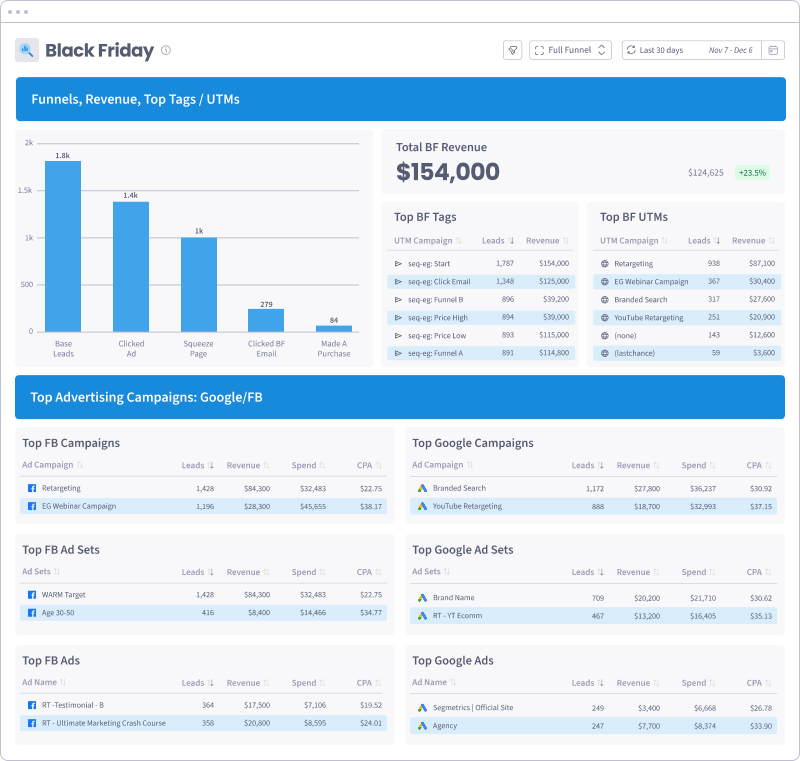
- Real-time performance monitoring. Focus on leading indicators like traffic sources, conversion rates by channel, and customer acquisition costs that allow for immediate optimization.
- Active campaign management. This includes checking that content that is supposed to be shipped is actually shipped. Also, competitive monitoring, A/B testing of key elements, and tactical adjustments based on live performance data.
- Technical performance oversight to ensure infrastructure handles increased load without degrading customer experience.
- Real-time optimization opportunities. You can make tactical adjustments based on actual customer behavior — adjust ad spend, tweak email send times, or pivot on messaging based on what’s resonating.
We’ve built a custom Black Friday dashboard that gives you an accurate, transparent, single source of truth for how your BFCM campaign is doing. (Start a 14-day free trial of SegMetrics to test drive this for yourself.)
Follow-Up (Dec-Jan)
Most businesses think BFCM ends on Cyber Monday. The smartest businesses know that’s when the real opportunity begins.
We cover all of this in-depth in Module 4.
Key tasks during this phase:
- Customer nurturing and retention campaigns to maximize lifetime value of BFCM acquisitions. You can do this through thank you sequences, onboarding flows, and early upsell opportunities.
- Comprehensive performance analysis. Go beyond revenue to explore how refunds, chargebacks, customer service costs, and long-term customer behavior impact true campaign profitability.
- Document your BFCM assets and strategic insights. Taking a little extra time to do this will save you tons of time, hassle and effort next year.
Remember: BFCM customers often have different engagement patterns than customers acquired during normal periods. The Follow-up phase is when you learn these patterns and optimize for long-term relationship value rather than just promotional weekend revenue.
Key Takeaways
- BFCM success requires 4+ months of planning, not 4 weeks of scrambling. Starting early is highly recommended.
- Each phase has distinct objectives that can’t be rushed or skipped. Compressing the timeline inevitably leads to overlooked details that can become problems during BFCM weekend.
- Follow-up phase often delivers more long-term business value than the promotional weekend itself. Reserve time to follow-up in Dec and Jan.
What to Do Next
Identify which phase you’re currently in and assess your progress:
- If you’re reading this in August-September: You’re perfectly positioned to start Foundation phase work using the strategic framework from our previous lessons
- If you’re reading this in October: Focus immediately on Preparation phase activities while documenting your strategic decisions for this year’s campaign. (Our Express Data Set-Up can help you get your BFCM tracking in place ASAP.)
- If you’re reading this in November: Concentrate on executing well this year while taking detailed notes for next year’s improved Foundation phase
It’s never too late to improve your approach, but earlier is always better than later when it comes to BFCM planning.