

The Best Marketing Attribution Software: How to Find What’s Actually Driving Revenue
Beyond Google Analytics: How to Choose the Right Marketing Analytics Platform You’re running ads, sending emails, and posting on social media. Your dashboar…

Articles
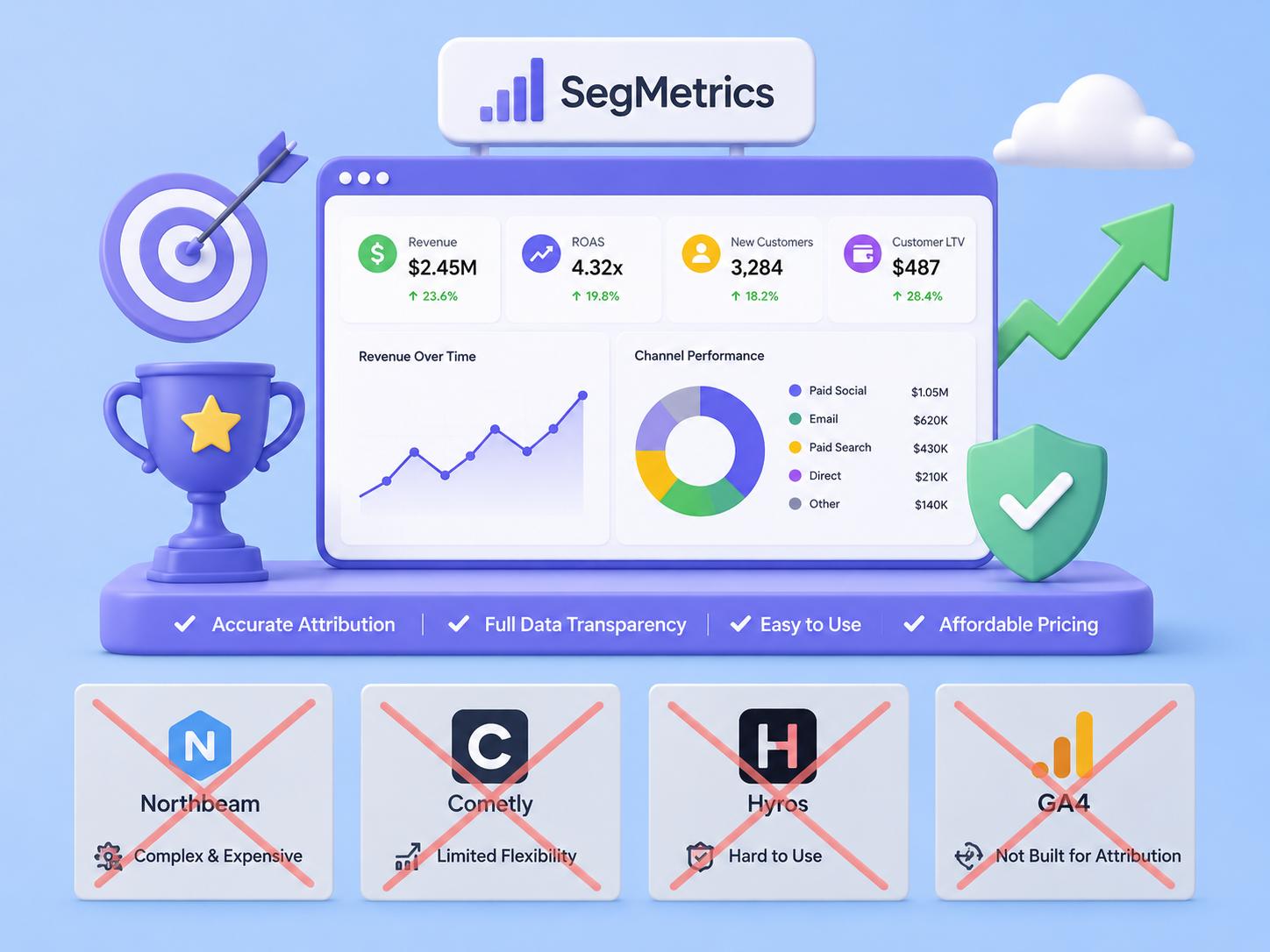
You’re evaluating marketing analytics tools and want to know what alternatives exist to SegMetrics. That’s a smart place to start. The right platform will give you the clarity to grow your business. The wrong one will cost you time, money, and the confidence to make data-driven decisions.
SegMetrics is purpose-built for digital businesses that need to connect their marketing spend directly to revenue and customer lifetime value (LTV). But not every tool fits every business model. This guide explains the full landscape so you can make the right call.
The most common mistake marketers make when evaluating analytics tools is comparing features before defining the core problem they need to solve. Start here instead.
Ask yourself: What is the single most important question I need my analytics tool to answer?
Once you know which category fits your core question, evaluating alternatives becomes much simpler. The sections below are organized exactly this way.
These are the most direct SegMetrics alternatives. They focus on connecting ad spend and marketing activity to actual sales, and they compete most closely with SegMetrics’ attribution reporting.
Wicked Reports A solid choice for subscription-based businesses. Wicked Reports tracks customer LTV and recurring revenue back to the original marketing source. It’s particularly well-suited for businesses where a customer’s first purchase is a loss leader and real value comes over time.
Hyros Hyros is built for high-ticket funnels — think webinars, phone sales, and long-form video sales letters. It uses AI-powered device matching to track customers across multiple touchpoints and platforms. If your average order value is high and your funnel has multiple steps before a sale, Hyros is worth evaluating.
Ruler Analytics A strong option for lead-generation businesses, especially service companies and agencies. Ruler tracks phone calls, form submissions, and live chat conversations back to the marketing source that generated them. If your primary conversion is a lead rather than a direct online sale, Ruler fills a real gap.
How SegMetrics differs from these alternatives: While Wicked Reports, Hyros, and Ruler Analytics all do strong ad attribution, they focus primarily on the acquisition side. SegMetrics goes deeper by integrating directly with your CRM and email marketing platform, giving you visibility into the full customer journey — including post-purchase behavior, email engagement, and how different audience segments perform over their entire lifetime with your brand.
This is why SegMetrics is a particularly strong fit for businesses that sell through email marketing, run continuity programs, or want to understand which lead sources produce customers with the highest long-term LTV — not just the highest first-sale conversion rate.
These tools are not direct SegMetrics alternatives — they solve a different problem. They’re listed here because they frequently appear in the same search comparisons, and understanding the distinction will save you from choosing the wrong tool.
Mixpanel Mixpanel is an event-based analytics tool that tracks user behavior inside your application. It’s excellent for funnel analysis, retention cohorts, and feature adoption tracking. Product managers and engineers are the primary users.
Amplitude Similar to Mixpanel in purpose, Amplitude focuses on understanding which user behaviors predict better outcomes — higher retention, conversion to paid, or feature adoption. It’s widely used by product teams at SaaS companies.
Heap Heap takes a different approach: it automatically captures every user interaction (clicks, taps, form fills, page views) without requiring you to define events upfront. This gives you a retroactive dataset to analyze as questions emerge.
The key distinction: These tools answer “how are users behaving inside our product?” SegMetrics answers “which marketing campaigns are creating our best customers?” If your primary need is to optimize ad spend, understand lead source quality, or track LTV by acquisition channel, product analytics tools won’t solve that problem. Most businesses growing past a certain stage need both — and SegMetrics integrates with your tech stack rather than replacing it.
If you run a direct-to-consumer brand on Shopify, a specialized category of tools has emerged to serve your specific needs — real-time ad attribution, creative-level reporting, and contribution margin tracking.
Triple Whale Triple Whale is one of the most popular dashboards for Shopify stores. It pulls data from your ad platforms (Meta, Google, TikTok), email platform, and Shopify backend into a single view of profitability. Its “Pixel” tracks post-iOS attribution using first-party data. Triple Whale is built for e-commerce — if that’s your only model, it’s a capable tool.
Northbeam Northbeam is positioned as a more sophisticated attribution platform for high-growth e-commerce brands spending heavily across multiple ad platforms. It offers multiple attribution models and is designed for brands where the question “which channel actually drove this sale?” is genuinely hard to answer.
Where SegMetrics fits: SegMetrics also supports e-commerce attribution and Shopify integration, but it’s built for businesses that sell through a combination of e-commerce, digital products, subscriptions, or coaching — not purely transactional retail. If you run a Shopify store and sell a course, a continuity program, or have a significant CRM or email marketing component, SegMetrics gives you a unified view that Triple Whale or Northbeam can’t provide. The key SegMetrics advantage: LTV tracking across your entire business, not just your Shopify orders.
For B2B companies with complex, multi-stakeholder sales cycles, a distinct category of tools exists to track marketing influence across long deal timelines.
Dreamdata Dreamdata connects marketing activities to revenue at the account level. It’s purpose-built for B2B SaaS companies where deals involve multiple contacts, multiple touchpoints over months, and a CRM (usually HubSpot or Salesforce) as the system of record. It focuses on answering: “how did our marketing contribute to this deal closing?”
Bizible / Adobe Marketo Measure An enterprise-grade multi-touch attribution platform that integrates tightly with Salesforce and Adobe Marketo. It’s built for large marketing and sales teams with sophisticated reporting needs and a significant technology investment already in place.
Where SegMetrics fits in B2B: SegMetrics is a strong fit for B2B businesses that sell primarily through digital funnels — webinars, content marketing, email sequences, and online courses — rather than through a traditional enterprise sales motion. If your B2B sales cycle involves a lead opting into an email list, nurturing through automated sequences, and converting through a checkout or discovery call, SegMetrics tracks that entire journey with precision. Explore SegMetrics’ CRM and email marketing integrations to see how it connects to your existing stack.
| Use Case | Best Alternative | SegMetrics Advantage |
|---|---|---|
| Ad attribution for subscription businesses | Wicked Reports | Full customer journey including email + CRM |
| High-ticket funnel tracking | Hyros | Deeper LTV visibility, no AI black box. Affordable at $57 mo. |
| Lead generation attribution | Ruler Analytics | Works for online sales, not just leads |
| In-app product behavior | Mixpanel / Amplitude | SegMetrics tracks acquisition, not in-app |
| Shopify DTC brands | Triple Whale | Better for mixed-model businesses (e-comm + digital products) |
| Enterprise B2B | Dreamdata / Bizible | SegMetrics is simpler and more affordable for digital-first B2B |
Write down every tool you use to run your marketing: your CRM, email marketing platform, ad platforms, payment processor, and course or membership platform. Any analytics tool you choose must integrate with these seamlessly — otherwise you’ll spend more time importing data than using it.
SegMetrics integrates with over 130 platforms, including ActiveCampaign, ConvertKit, Keap, HubSpot, Stripe, ThriveCart, Shopify, Facebook Ads, and Google Ads.
Every business has one metric that, if it went up, you’d know things were working. For most digital businesses, that’s one of:
Choose the tool that’s architecturally designed to report on your metric best. SegMetrics is purpose-built for LTV and revenue attribution across the full customer journey — a capability that most alternatives don’t offer natively.
The most important question isn’t “which tool has more features?” — it’s “which tool was built for how my business actually makes money?”
Q. What is the best alternative to SegMetrics? A. The best alternative depends on your business model and primary goal. For direct marketing attribution with deep CRM and email integration, the closest alternatives are Wicked Reports and Hyros. And for Shopify e-commerce brands, Triple Whale or Northbeam are commonly used. For B2B companies with long sales cycles, Dreamdata is a strong fit. However, if your business involves digital products, courses, subscriptions, or any mix of sales channels, SegMetrics’ combination of attribution tracking and lifetime value measurement is difficult to replicate with other tools.
Q. How does SegMetrics differ from Google Analytics? A. Google Analytics tracks sessions, page views, and aggregate website behavior. SegMetrics tracks individual customer journeys from first marketing touchpoint through to purchase, repeat purchase, and lifetime value. They answer different questions: Google Analytics tells you how many people visited a page; SegMetrics tells you which marketing campaigns produced customers who spent the most money over time. See a full comparison of SegMetrics vs. Google Analytics.
Q. Is SegMetrics only for e-commerce? A. No. SegMetrics is used by digital course creators, membership site owners, coaches, agencies, SaaS companies, and e-commerce brands. Its strength is tracking revenue and LTV across any business that uses email marketing, a CRM, and online payments — regardless of what you sell.
Q. Does SegMetrics work with iOS privacy changes? A. Yes. SegMetrics uses first-party data from your CRM, email platform, and payment processor to track attribution — not third-party browser cookies. This makes it resilient to iOS privacy changes and browser-level tracking restrictions that have significantly degraded the accuracy of pixel-based tools like Facebook’s native attribution.
Q. What platforms does SegMetrics integrate with? A. SegMetrics integrates with over 90 marketing tools including ActiveCampaign, ConvertKit, Keap, HubSpot, Drip, Klaviyo, Stripe, PayPal, ThriveCart, Shopify, WooCommerce, Facebook Ads, Google Ads, and many more. Browse the full integrations list here.
Q. How long does it take to set up SegMetrics? A. Most businesses can connect their core integrations and start seeing data within a day. Because SegMetrics pulls historical data from your connected platforms, you don’t have to wait months to see meaningful reports — many users see LTV and attribution data from their past 12–24 months of activity shortly after setup.
Q. Is SegMetrics suitable for agencies? A. Yes. SegMetrics offers white-label reporting capabilities that allow agencies to provide clients with branded attribution dashboards. This makes it a strong choice for agencies that manage ad spend or email marketing on behalf of digital businesses and need to demonstrate clear ROI.
Q. What’s the difference between first-touch and multi-touch attribution in SegMetrics? A. First-touch attribution credits the first marketing touchpoint a customer ever had with your business. Multi-touch attribution distributes credit across every touchpoint in the customer journey before a purchase. SegMetrics supports multiple attribution models, allowing you to see your data through different lenses — which is critical for understanding both what drives awareness and what drives conversion.
There are good tools for every use case in marketing analytics. The key is matching the tool’s core design to how your business actually generates revenue.
If you sell digital products, run email-driven funnels, or operate a subscription model and want a clear, unified view of which marketing activities are creating your most valuable customers, SegMetrics is worth exploring. Its combination of CRM integration, email platform connectivity, and lifetime value tracking makes it one of the few tools that can answer the question every serious marketer eventually asks: not just who bought, but who kept buying — and where did they come from?
Start a free trial of SegMetrics or book a demo to see how it maps your specific customer journey.
Denise Cullom is an innovative and goal-oriented Operations Lead committed to professional development and expert leadership of teams, systems, and profitability. Recognized for repeatedly surpassing business goals, she is a decisive leader and strategic planner known for rallying stakeholders behind new initiatives. Denise is adaptable to changing business needs and market conditions, continuously driving success and growth.
Beyond Google Analytics: How to Choose the Right Marketing Analytics Platform You’re running ads, sending emails, and posting on social media. Your dashboar…
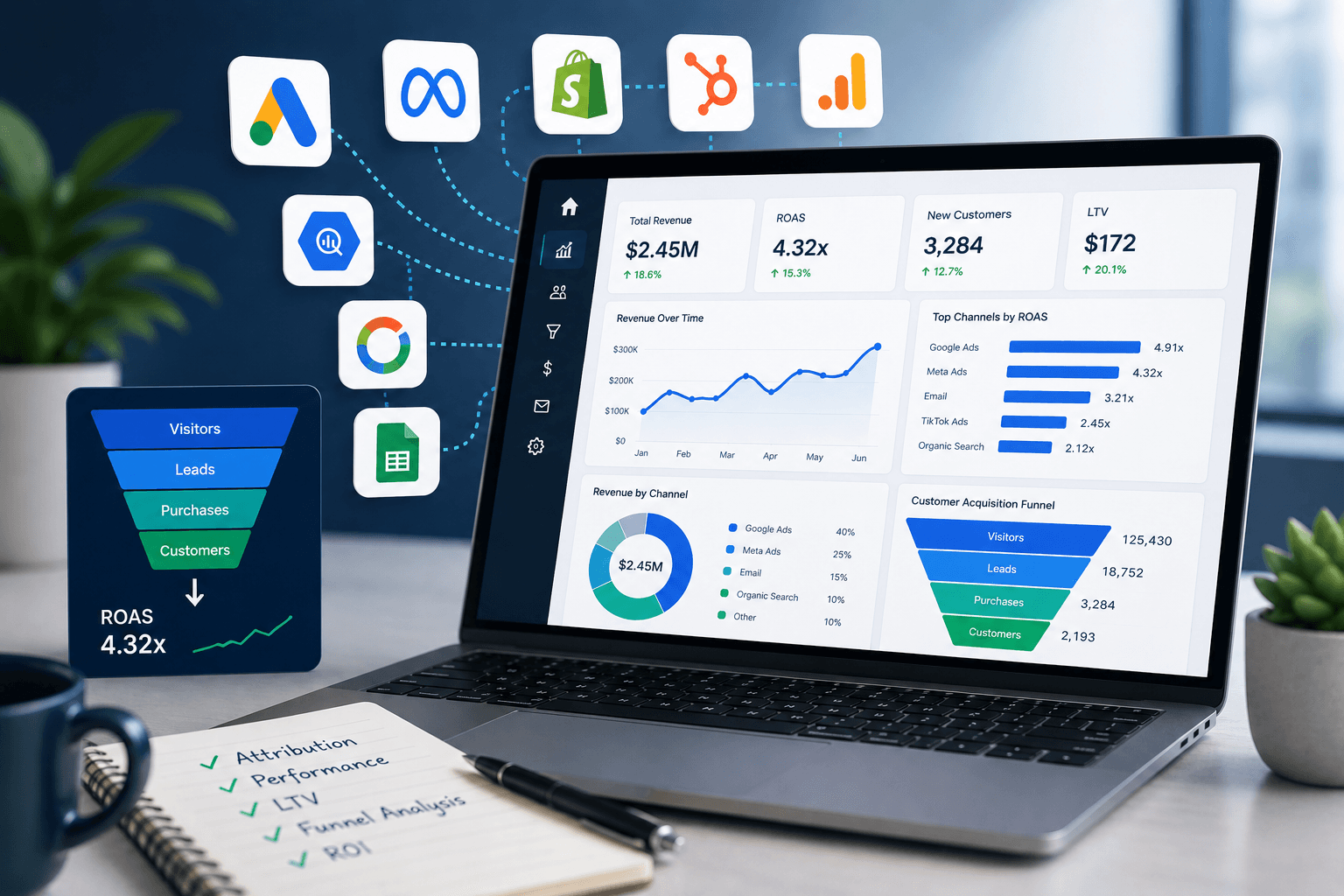
A Marketer’s Guide to the Best Analytics Visualization Tools You’ve got the data. It’s in your CRM, your ad platforms, your email service provider, and a do…

Which Marketing Tools Actually Perform? A Data-First Guide You’re asking one of the most common questions in marketing: “Which are the top-performing market…
Start your 14-day free trial of SegMetrics today!