
SegMetrics Alternatives: A Practical Guide to Choosing the Right Marketing Attribution Tool
What is an Alternative to SegMetrics? A Practical Guide You’re looking for a marketing analytics tool and considering your options. That’s a smart move. The…

Articles

Most marketing teams are drowning in data and starving for answers.
You have Google Analytics telling you your traffic is up. Your email platform says open rates are strong. Your ad dashboard is showing decent click-through rates. But when your CEO asks which of these activities is actually making money, you freeze, because none of those tools can tell you.
This is the attribution gap, and it’s one of the most expensive problems in modern marketing. When you can’t connect your marketing activities to actual revenue, you’re essentially flying blind. You keep spending on channels that feel productive but can’t prove their value. You cut budgets from campaigns that were quietly driving your best customers. You optimize for the wrong metrics entirely.
The solution isn’t more analytics. It’s the right kind of analytics: specifically, marketing attribution software built to answer the revenue question.
This guide breaks down why traditional analytics tools fall short, what to look for in attribution-focused platforms, and how to choose the right one for your business.
Google Analytics is the world’s most popular analytics tool, and for good reason. It’s free, powerful, and excellent at answering traffic questions: How many people visited my site? Where did they come from? Which pages did they view?
But there’s a fundamental limitation baked into its design. It was built to measure website behavior, not revenue outcomes.
Here’s what that looks like in practice:
A potential customer clicks a Facebook ad, reads your blog post, subscribes to your email list, opens three emails over two weeks, clicks a link in your fourth email, and then purchases. GA4 will likely attribute that sale to email (the last click) or direct traffic, completely missing the Facebook ad and the blog post that started the relationship.
For e-commerce businesses with simple, single-session purchase journeys, this might be acceptable. But for digital businesses with longer sales cycles (courses, SaaS products, coaching programs, memberships), this kind of attribution is dangerously misleading.
It gets worse in the post-iOS privacy era. Browser-based cookie tracking, which most analytics tools rely on, is increasingly unreliable. Ad blockers, Safari’s Intelligent Tracking Prevention, and iOS privacy changes all create gaps in the data. The result is that standard analytics tools are undercounting conversions while overcounting or misattributing revenue.
This is why a dedicated category of marketing attribution software has emerged: tools specifically designed to bridge the gap between marketing activities and business revenue.
Marketing attribution software is built around a single purpose: connecting every dollar of marketing spend to every dollar of revenue generated, across the full customer journey.
Rather than relying on last-click or session-based models, these tools track the complete path a customer takes from first touch to purchase and beyond. They integrate data from multiple sources, including your ad platforms, email service provider, payment processor, and CRM, and stitch it together into a coherent picture.
The key capabilities that differentiate true attribution software from general analytics include:
Multi-touch attribution models. Instead of crediting one channel for a sale, attribution software distributes credit across every touchpoint that influenced the purchase. This gives you a more accurate picture of which channels are working together to drive revenue.
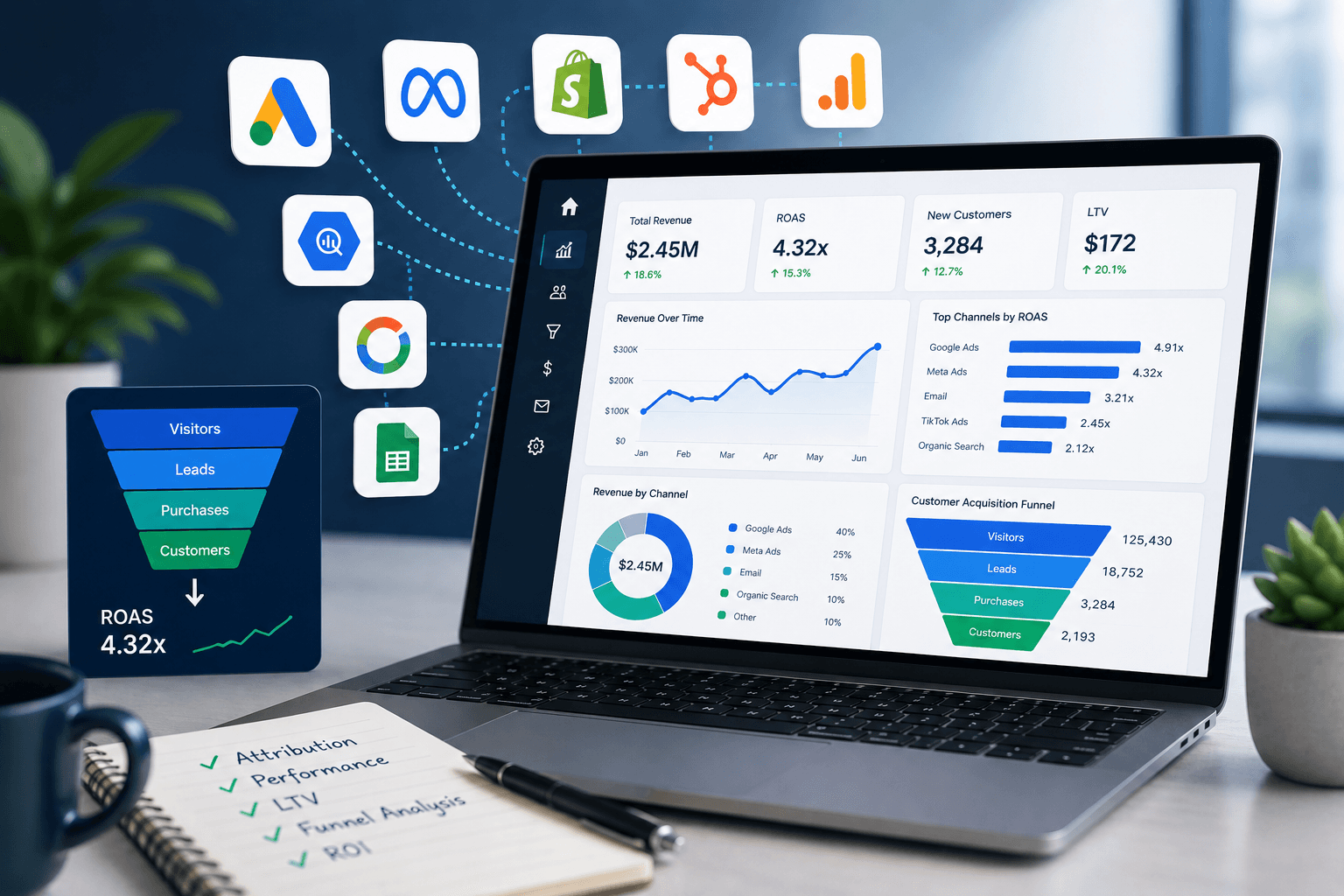
Cross-channel data integration. Attribution platforms pull data from Facebook Ads, Google Ads, your email platform, your checkout system, and more, creating a unified view that no single-channel tool can provide.
Customer lifetime value tracking. Good attribution software doesn’t stop at the first purchase. It tracks customer behavior over time, so you can see which traffic sources generate your highest-value customers, not just your most frequent purchasers.
Revenue-based reporting. Instead of reporting on clicks, impressions, or open rates, attribution platforms report on actual revenue generated, allowing you to calculate true ROI for every marketing channel.
Privacy-resilient tracking. Most attribution platforms use server-side tracking and first-party data to maintain accuracy even as browser-based tracking becomes less reliable.
The attribution software market has expanded significantly, with different tools designed for different business types. Here’s a breakdown of the major categories and who they’re best suited for.
This category has grown rapidly in response to the iOS privacy changes that devastated Meta ad tracking for e-commerce brands.
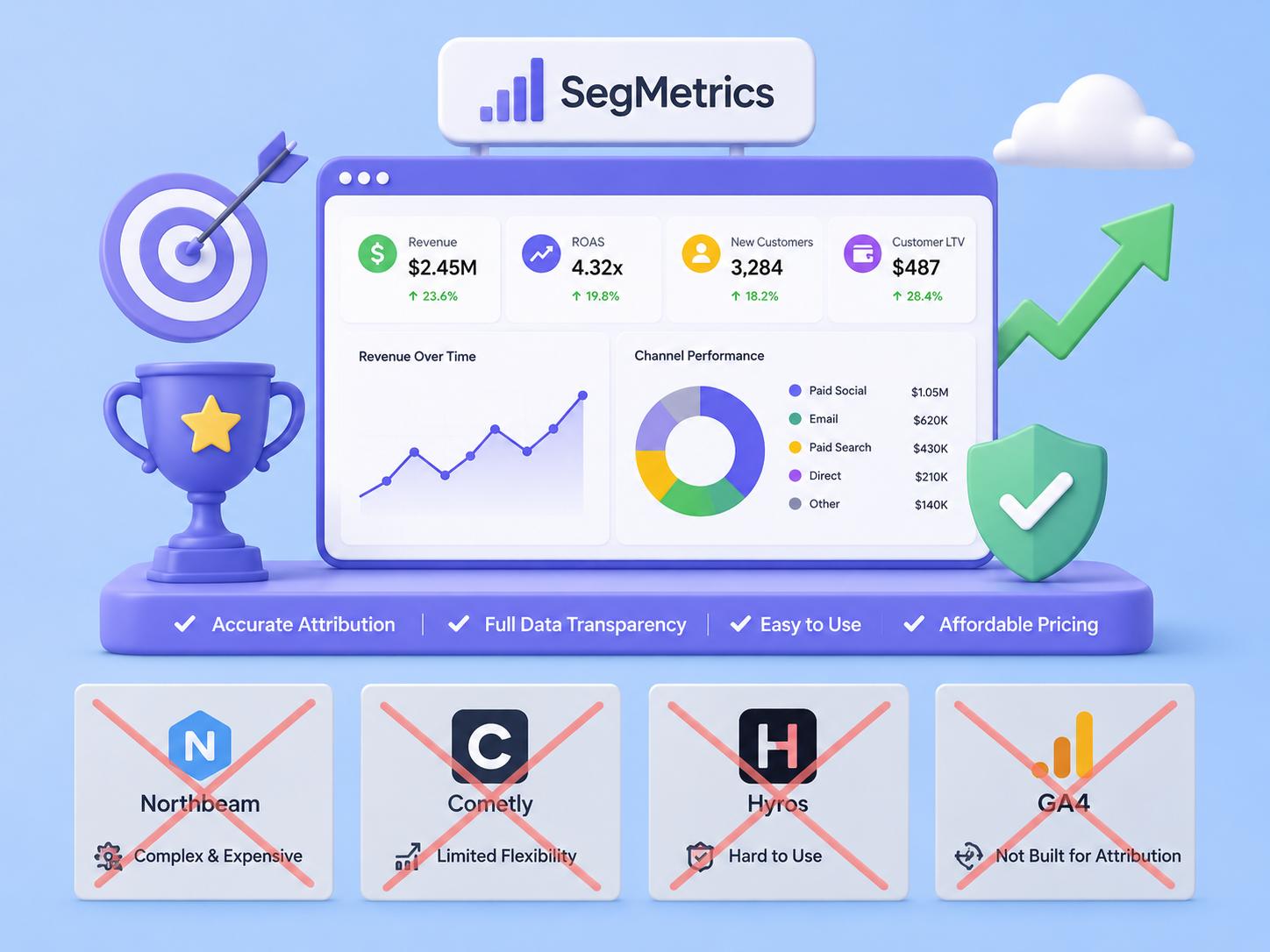
Northbeam, SegMetrics Cometly and Hyros are the main players in this space. They use server-side tracking and proprietary attribution models to give e-commerce brands a more accurate picture of their ad performance than the native dashboards provide. They’re particularly strong at multi-touch attribution across paid social and search.
Best for: Direct-to-consumer e-commerce brands running significant paid ad budgets (typically $10k+/month) who need to know which ads are driving purchases.
Limitations: These tools are heavily optimized for e-commerce with short sales cycles. They’re less suited for businesses with long buyer journeys, recurring subscriptions, or complex funnel structures.
Google Analytics 4 (GA4) remains the default starting point for most businesses. It’s free, integrates deeply with Google Ads, and provides solid traffic analysis. For businesses with simple purchase funnels and primarily Google traffic, it can work well, especially if you invest time in proper event tracking setup. For a more revenue-focused alternative, see how SegMetrics compares to Google Analytics.
Adobe Analytics is the enterprise alternative, offering deep customization and real-time data processing. It’s best suited for large organizations with dedicated data teams and significant technical resources.
Best for: Businesses primarily focused on web traffic analysis, content performance, and Google Ads optimization.
Limitations: Neither tool provides meaningful multi-source attribution for businesses with complex, multi-channel funnels. Connecting email, paid social, and organic content to specific revenue outcomes requires significant custom development, and still yields incomplete data.
Mixpanel and Amplitude are built for SaaS and mobile app companies that want to understand what happens after a user signs up. They’re excellent at tracking feature adoption, user flows, retention cohorts, and in-app behavior.
Best for: Product-led growth companies that need to understand how product usage drives retention and expansion revenue.
Limitations: These tools focus almost entirely on the post-conversion product experience. They provide little insight into the pre-conversion marketing journey: the channels, content, and campaigns that drove the signup in the first place. If you need revenue attribution on top of behavioral analytics, see how SegMetrics compares to Mixpanel.
HubSpot Marketing Hub offers “closed-loop” reporting that connects marketing campaigns to deals and contacts within the HubSpot CRM. For businesses fully committed to the HubSpot ecosystem, this provides genuine revenue attribution within that walled garden.
Best for: B2B companies running primarily inbound marketing strategies with their full tech stack on HubSpot.
Limitations: The attribution is limited to what happens inside HubSpot. If your payment processing, email marketing, or advertising happens outside the platform, the picture is incomplete.
This is the category built for digital-first businesses (course creators, coaches, SaaS companies, membership sites, and agencies) that have complex funnels spanning multiple channels and long customer relationships.
SegMetrics sits firmly in this category. It was built specifically for businesses that need to connect marketing activities across the full customer journey: from the first ad click or organic visit, through email nurture sequences, to the initial purchase, and all the way through renewals, upsells, and long-term lifetime value.
Where most attribution tools ask “which ad drove the sale?”, SegMetrics asks a deeper question: “which traffic source generates the highest-value customers over time?” The difference matters enormously. A Facebook ad campaign might drive a high volume of initial purchases but attract customers who churn after 30 days. Meanwhile, a slower-burn email nurture sequence might drive fewer initial sales but attract customers who stay for years. Standard attribution tools will optimize toward the first campaign and cut the second, which is the exact opposite of what you should do.
SegMetrics surfaces this by integrating your ad platforms, email service provider, and payment processor to give you lifetime value data by source, by campaign, by email sequence, and even by individual email.
Feature lists are easy to compare. Here’s what actually matters when you’re making the decision.
Attribution software is only as useful as the data it can access. Before evaluating any platform, map out your current stack: Which ad platforms do you run? Which email service provider do you use? What’s your payment processor? Does the attribution tool have native integrations with all of them?
Gaps in integration mean gaps in attribution. A tool that integrates with Facebook Ads and Stripe but not your email platform will still leave you blind to a critical piece of the customer journey.
Browser-based cookie tracking is an increasingly unreliable foundation for attribution. Look for platforms that use server-side tracking, first-party data, and probabilistic matching to maintain accuracy as privacy regulations and browser restrictions evolve.
Ask specifically: How did their tracking accuracy change after iOS 14.5? What percentage of conversions can they attribute without relying on third-party cookies?
Different businesses need different attribution models. First-touch attribution is useful for understanding where awareness comes from. Last-touch attribution (what most tools default to) tells you what closed the deal. Multi-touch models (linear, time-decay, position-based, or data-driven) give you a more complete picture of what’s working across the funnel.
The best attribution platforms let you compare models side by side, so you can see how your channel performance changes depending on how you allocate credit.
This is the single most important differentiator for subscription businesses, course creators, and anyone with repeat purchase potential. If your attribution software only looks at initial conversion data, it’s missing most of the story.
A traffic source that drives low-value one-time buyers looks great on a first-purchase attribution report. The same source looks terrible when you factor in 12-month LTV. Without LTV data by source, you’re optimizing your marketing for the wrong outcome.
Analytics implementations are never plug-and-play. You will hit questions, edge cases, and configuration challenges, especially around tracking complex funnel events and integrating disparate data sources.
The difference between a platform with genuine expert support and one with a chatbot and a knowledge base can be months of wasted time. Look for platforms that offer direct access to people who understand both the technical implementation and the marketing strategy behind it.
Marketing analytics pricing models vary wildly. Some tools charge per contact, which gets expensive fast as your list grows. Others charge based on revenue tracked or events processed. Still others have flat monthly fees.
Map out what the tool will cost you at 2x your current scale, not just today. Surprises in your analytics bill are the last thing you need when you’re trying to grow.
No single tool covers everything perfectly. The most effective marketing analytics setups combine a core attribution platform with specialized tools for specific use cases.
For SEO and content performance: Ahrefs or SEMrush provide the keyword ranking, backlink analysis, and competitive intelligence that attribution platforms don’t cover. These tools tell you what’s happening in search; attribution software tells you what that search traffic is worth in revenue.
For qualitative behavior analysis: Hotjar or FullStory add session recordings and heatmaps to your quantitative data. When attribution tells you that a particular landing page is converting poorly, qualitative tools help you understand why.
For social media performance: Native analytics within each platform, or tools like Sprout Social, provide engagement and audience data that complements your revenue attribution picture.
The core of the stack, the platform that ties marketing spend to revenue, is where the most important investment decision lies. Get that right first, then layer in the specialized tools.
The marketing analytics problem most businesses face isn’t a lack of data. It’s an abundance of disconnected data that obscures more than it reveals.
Web analytics tell you traffic is up. Email analytics tell you opens are strong. Ad dashboards tell you your CPM is down. But none of them tell you whether any of it is actually building a profitable business.
Marketing attribution software exists to answer that question. The right platform connects your channels, tracks your customers across their complete journey, and tells you, with genuine confidence, which activities are driving revenue and which are just burning budget.
For digital businesses with complex funnels and long customer relationships, that clarity isn’t a nice-to-have. It’s the foundation of every smart marketing decision you make.
Start by identifying where your current analytics stack breaks down. Is it the inability to see cross-channel performance? Is it missing lifetime value data? Is it unreliable tracking after iOS changes? The answer to that question will point you toward the attribution platform built to solve it.
Ready to see what your marketing is actually worth? SegMetrics connects your ad platforms, email provider, and payment processor to give you true multi-touch attribution and lifetime value data, without the data science team. Start your free 14-day trial.
Q. What is marketing attribution software? A. Marketing attribution software is a category of analytics tools designed to connect your marketing activities to actual revenue. Unlike standard web analytics, attribution software tracks the full customer journey across multiple channels (ads, email, organic search, and more) and assigns credit to the touchpoints that influenced each purchase. This lets you see which campaigns, channels, and content are genuinely driving revenue rather than just traffic.
Q. How is marketing attribution software different from Google Analytics? A. Google Analytics is built primarily to measure website behavior: traffic sources, page views, and on-site engagement. It uses session-based, last-click attribution by default, which means it typically credits only the final touchpoint before a conversion and ignores everything that came before it. Marketing attribution software integrates data across your entire tech stack (ads, email, payments) and applies multi-touch models to give you a complete, revenue-focused view of your customer journey.
Q. What is multi-touch attribution? A. Multi-touch attribution is a method of distributing conversion credit across every marketing touchpoint a customer interacted with before purchasing, rather than crediting just the first or last interaction. Common multi-touch models include linear (equal credit to all touchpoints), time-decay (more credit to recent touchpoints), and position-based (more credit to the first and last touch). Multi-touch attribution gives marketers a more accurate understanding of how their channels work together to drive revenue.
Q. What is the best marketing attribution software for small businesses? A. The best marketing attribution software for small businesses depends on your funnel structure and primary channels. For digital businesses like course creators, coaches, and SaaS companies, a platform like SegMetrics is well-suited because it connects ad platforms, email providers, and payment processors to show lifetime value by source without requiring a dedicated data team. General web analytics tools like GA4 are free but limited in their ability to connect marketing activity to multi-channel revenue.
Q. How does marketing attribution software handle iOS privacy changes? A. The best marketing attribution platforms have shifted away from relying on browser-based cookies and instead use server-side tracking, first-party data collection, and probabilistic matching to maintain attribution accuracy. Server-side tracking sends conversion data directly from your server rather than the user’s browser, making it less susceptible to being blocked by ad blockers or Apple’s Intelligent Tracking Prevention. When evaluating tools, ask specifically how their tracked conversion rates changed after iOS 14.5 was released.
Q. What is customer lifetime value (LTV) attribution? A. Customer lifetime value attribution goes beyond measuring the revenue from a customer’s first purchase. It tracks the total revenue a customer generates over their entire relationship with your business and connects that value back to the original marketing source that acquired them. This is especially important for subscription businesses, membership sites, and course creators, where the most valuable customers often come from sources that look average on a first-purchase basis. Without LTV attribution, you risk defunding the channels that are actually generating your best long-term customers.
Q. How long does it take to set up marketing attribution software? A. Setup time varies significantly by platform and the complexity of your tech stack. Simpler tools with pre-built integrations can be configured in a few hours, while more robust platforms that require custom event tracking, server-side implementation, or complex funnel mapping may take several days or weeks.
SegMetrics is designed to get you up and running fast. Most users have all their tools connected and their tracking pixel installed in under 30 minutes, thanks to 120+ native integrations with the ad platforms, email providers, and payment processors that digital businesses already use. From there, your historical data syncs automatically, so you’re not starting from zero on day one.
The key factor with any platform is whether it has native integrations with your existing tools. Building custom connections adds time, cost, and ongoing maintenance. When evaluating attribution software, ask specifically which integrations are native and which require third-party connectors or developer work before you commit.
Q. Do I need a developer to use marketing attribution software? A. Not necessarily. Many modern attribution platforms are designed for marketing teams and include no-code or low-code setup processes, especially for standard integrations. SegMetrics, for example, is built specifically for marketers rather than developers. It connects to your ad platforms, email provider, and payment processor through native integrations, and most users have their full stack connected and their pixel installed in under 30 minutes without writing a single line of code.
That said, more advanced configurations across any platform (custom event tracking, server-side tagging, or non-standard funnel structures) may require some developer involvement. When evaluating tools, ask specifically whether your planned setup requires technical resources and what support is available when you hit roadblocks. With SegMetrics, every account includes access to a real support team that understands both the technical setup and the marketing strategy behind it, so you’re not left troubleshooting alone if something doesn’t go as expected.
Denise Cullom is an innovative and goal-oriented Operations Lead committed to professional development and expert leadership of teams, systems, and profitability. Recognized for repeatedly surpassing business goals, she is a decisive leader and strategic planner known for rallying stakeholders behind new initiatives. Denise is adaptable to changing business needs and market conditions, continuously driving success and growth.
What is an Alternative to SegMetrics? A Practical Guide You’re looking for a marketing analytics tool and considering your options. That’s a smart move. The…
A Marketer’s Guide to the Best Analytics Visualization Tools You’ve got the data. It’s in your CRM, your ad platforms, your email service provider, and a do…

Which Marketing Tools Actually Perform? A Data-First Guide You’re asking one of the most common questions in marketing: “Which are the top-performing market…

Start your 14-day free trial of SegMetrics today!