In a world where marketing is driven by data, understanding how your data is analyzed is just as important as collecting it. If you want to stop guessing and start scaling, you need to know which actions lead to revenue — and more importantly, why.
That’s where marketing data analytics comes in.
Marketers today are tasked with tracking increasingly complex buyer journeys across multiple platforms, devices, and time spans. Whether you’re working with email campaigns, paid ads, webinars, or influencer partnerships, knowing what’s working means choosing the right data model.
In this guide, we’ll break down the four essential types of marketing attribution models used in data analytics in marketing:
Full Funnel Attribution
First Engagement Attribution
First Click Attribution
Last Touch Attribution
We’ll cover what each model is, when to use it, why it matters, and how real world brands use them to get results.
Why the Types of Marketing Attribution Models Matter
Imagine spending $10,000 on ads across Facebook, Google, and YouTube… and having no idea which one actually brought in customers.
Without data attribution, you’re flying blind.
The different types of marketing attribution models allow you to answer critical questions:
Which channels drive first impressions vs conversions?
What’s creating awareness vs sealing the deal?
Where are you wasting spend?
How long is your actual sales cycle?
Data analytics, powered by marketing attribution models, helps you connect the dots between your efforts and outcomes.
Think of attribution like GPS for your marketing. It shows you the path people take, not just where they start or end.
1. Full Funnel Attribution: The Big Picture You Actually Need
**What it is:**The first type of marketing attribution model we will review is the Full Funnel Attribution. Full Funnel Attribution looks at every interaction a lead has with your business…from the first click to final conversion…AND assigns value to each step in the journey. It provides a holistic view of the customer experience.
**How it works:**This model gives weighted credit to multiple touchpoints, not just the first or last. It tells you which combination of interactions leads to revenue.
Why you should use it:
It’s the most accurate reflection of modern customer journeys, which are rarely linear.
Perfect for long, complex B2B and eCommerce sales funnels.
Helps you understand the contribution of each channel, even if it’s not the final click.
**Real World Example:
**A SaaS brand sees that a user clicked a Facebook ad, visited a blog post, downloaded an eBook, watched a demo, and finally subscribed via a retargeting ad. Full Funnel Attribution shows the entire journey and the value each touchpoint contributed.
Pro Tip: Use platforms like SegMetrics to set custom attribution windows and visualize the whole funnel in one place.
2. First Engagement Attribution: The “Discovery” Driver
**What it is:**The second type of marketing attribution model we will review is the First Engagement Attribution. First Engagement Attribution gives 100% credit to the first meaningful interaction with your brand…not necessarily the first click, but the first action that indicates intent.
**How it works:**This attribution model identifies where someone first really engaged: reading a blog, signing up for a webinar, or clicking on a video.
Why you should use it:
Identifies what content sparks curiosity or action.
Useful for content heavy or inbound focused marketing strategies.
When to use it:
Optimizing content strategy and lead magnets.
Evaluating performance of SEO, blogs, podcasts, and YouTube.
Measuring awareness stage assets.
**Real World Example:
**A user sees a paid Instagram ad (clicks, scrolls), but doesn’t act until reading a case study two days later. First Engagement Attribution gives credit to that case study.
Pro Tip: Combine this model with heatmaps and session recordings to better understand what “first engagement” really looks like.
3. First Click Attribution:What Pulled Them In?
**What it is:**The third type of marketing attribution model we will discuss is the First Click Attribution. First Click Attribution assigns 100% of the credit to the very first link or ad someone clicked before they ever joined your ecosystem.
**How it works:**This model is about origin. It answers the question: Where did this lead first come from?
Why you should use it:
Great for analyzing top of funnel campaigns.
Helps allocate spend toward the best acquisition sources.
When to use it:
Testing new paid acquisition strategies.
Measuring which platforms drive the most traffic.
Budgeting ad spend based on CAC (customer acquisition cost).
**Real World Example:
**A DTC brand sees that TikTok ads drive more “first clicks” than Google or Meta. Even though conversions come later via email, TikTok gets credit for starting the relationship.
Pro Tip: Use First Click Attribution to measure long term LTV (Life Time Value) from each channel and identify the most profitable acquisition paths.
4. Last Touch Attribution: Who Closed the Deal?
**What it is:**The last type of marketing attribution model listed is Last Touch Attribution. Last Touch Attribution gives all credit to the final interaction before conversion…the last ad, email, or page they touched.
**How it works:**It’s the simplest model. If a customer buys after clicking an email, the email gets 100% of the credit.
Why you should use it:
Easy to implement.
Ideal for quick campaigns, flash sales, or cart recovery.
When to use it:
Optimizing checkout processes.
Testing CTAs, landing pages, and retargeting.
Reviewing fast conversion campaigns (e.g., limited-time offers).
**Real World Example:
**An eCommerce brand runs a cart abandonment sequence. Even though users saw multiple ads and emails, the final reminder email gets all the credit under Last Touch.
Pro Tip: Don’t rely solely on this model. Use it to complement Full Funnel insights.
When to Use Each Type of Marketing Attribution Model (And When Not To)
Model
Best For
Avoid When…
Full Funnel Attribution Model
Long, multi-touch sales cycles
You want fast, single touch answers
First Engagement Attribution Model
Content strategy, education-first funnels
Users convert immediately without nurturing
First Click Attribution Model
Ad source testing, CAC analysis
Channels share overlap or multiple first touches
Last Touch Attribution Model
Final step optimization, fast sales
Buyers need more than one interaction to convert
Why You Shouldn’t Rely on Just One Type of Marketing Attribution Model
Each model reveals a different piece of the puzzle:
Full FunnelAttribution shows the big picture.
First EngagementAttribution uncovers what earns attention.
First ClickAttribution identifies the best discovery channels.
Last TouchAttribution reveals what closes the deal.
But the real impact comes when insight leads to action. Marcus Gullberg, founder of Feedbucket, puts it this way: “Attribution data is only useful if teams can respond to it in real time. That means spotting where drop-offs happen—whether it’s a landing page, an onboarding email, or a checkout screen—and fixing it before the campaign ends. When you layer fast, visual feedback loops into your funnel, you don’t just track what worked. You improve what didn’t—while it still matters.”
The most successful marketers combine all four types of marketing attribution models. By comparing models, you can:
Uncover gaps in your funnel
Reduce wasted spend
Focus on content that performs at each stage
Drive higher ROI with smarter decisions
Tools to Help You Implement Multi-Model Marketing Attribution
SegMetrics is built specifically to give you visibility across the funnel:
Compare models side by side
Pull in data from your CRM, ads, checkout, and email
Set custom attribution windows
Track revenue, LTV, and conversion paths for every lead
For marketers looking to collect feedback visually throughout the funnel, tools like Feedbucket can help teams pinpoint where users get stuck or confused, making it easier to refine content and design for better attribution accuracy.
Marketing data analytics isn’t just about crunching numbers. It’s about understanding why people convert and using that insight to make better decisions.
Denise Cullom is an innovative and goal-oriented Operations Lead committed to professional development and expert leadership of teams, systems, and profitability. Recognized for repeatedly surpassing business goals, she is a decisive leader and strategic planner known for rallying stakeholders behind new initiatives. Denise is adaptable to changing business needs and market conditions, continuously driving success and growth.
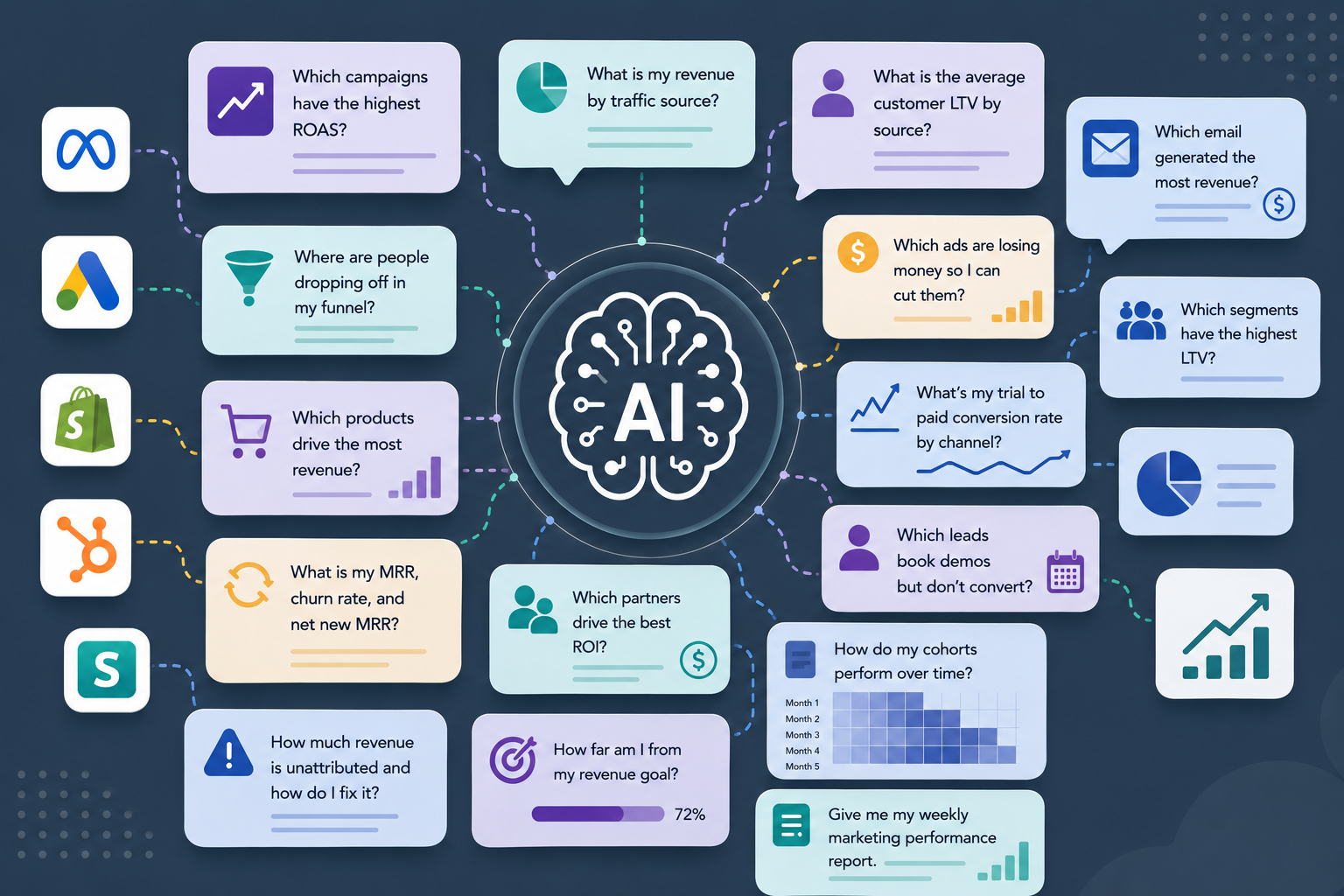
174 plug-and-play prompts for more effective AI marketing analytics. Explore your ROAS, LTV, conversion rates, churn trends, tracking issues, funnel performance and more.