Google changed everything. Their AI Overview now sits at the top of search results. It answers questions before users click anywhere else. Your content either appears there or gets buried below. To discover how to rank in Google AI Overview: The Complete Guide to Dominating AI Search Results is essential.
This guide shows you how to rank in Google AI Overview. You’ll learn the exact strategies that work. No fluff. No theory. Just proven methods that drive results.
What Google AI Overview Means for Your Business
Google AI Overview pulls content from multiple websites. It creates one answer that appears above all other results. Users see this AI-generated response first. They may never scroll down to see your website.
The numbers tell the story:
AI Overview appears on 15-20% of all searches
It uses 3-8 different sources per response
Users click the cited sources 25% of the time
Businesses in AI Overview see 40% more qualified traffic
Your business needs to adapt. The old SEO playbook doesn’t work anymore. You need new strategies and you need to think like Google’s AI thinks. You need to rank AI Overview.
📊 Analytics Alert: Track your AI Overview appearances using tools that measure the complete customer journey from first touch to conversion.
How Google AI Overview Really Works And How You Can Get Ranked
Google’s AI doesn’t randomly pick content. It follows clear patterns. Understanding these patterns gives you an edge on how to rank in Google AI Overview.
The AI looks for:
Direct answers to user questions
Content from authoritative sources
Well-structured information
Recent, up-to-date data
Multiple supporting sources
Think of it like a research assistant. The AI scans the web for the best information. It synthesizes multiple sources into one coherent answer. Your job is to make your content irresistible to this AI.
The Content Selection Process
Google’s AI follows a three-step process:
Step 1: Query Understanding The AI analyzes what the user really wants. It looks beyond keywords to understand intent. A search for “best marketing tools” might trigger different AI responses than “marketing tool comparison” even though they seem similar.
Step 2: Source Evaluation The AI evaluates thousands of pages. It ranks them based on relevance, authority, and structure. Only the top sources make it into the AI Overview.
Step 3: Content Synthesis The AI combines information from selected sources. It creates a new response that answers the user’s question completely.
The 8 Pillars of AI Overview Optimization
1. Answer Questions Directly
Your content must answer questions immediately. No introductions. No background context. Lead with the answer.
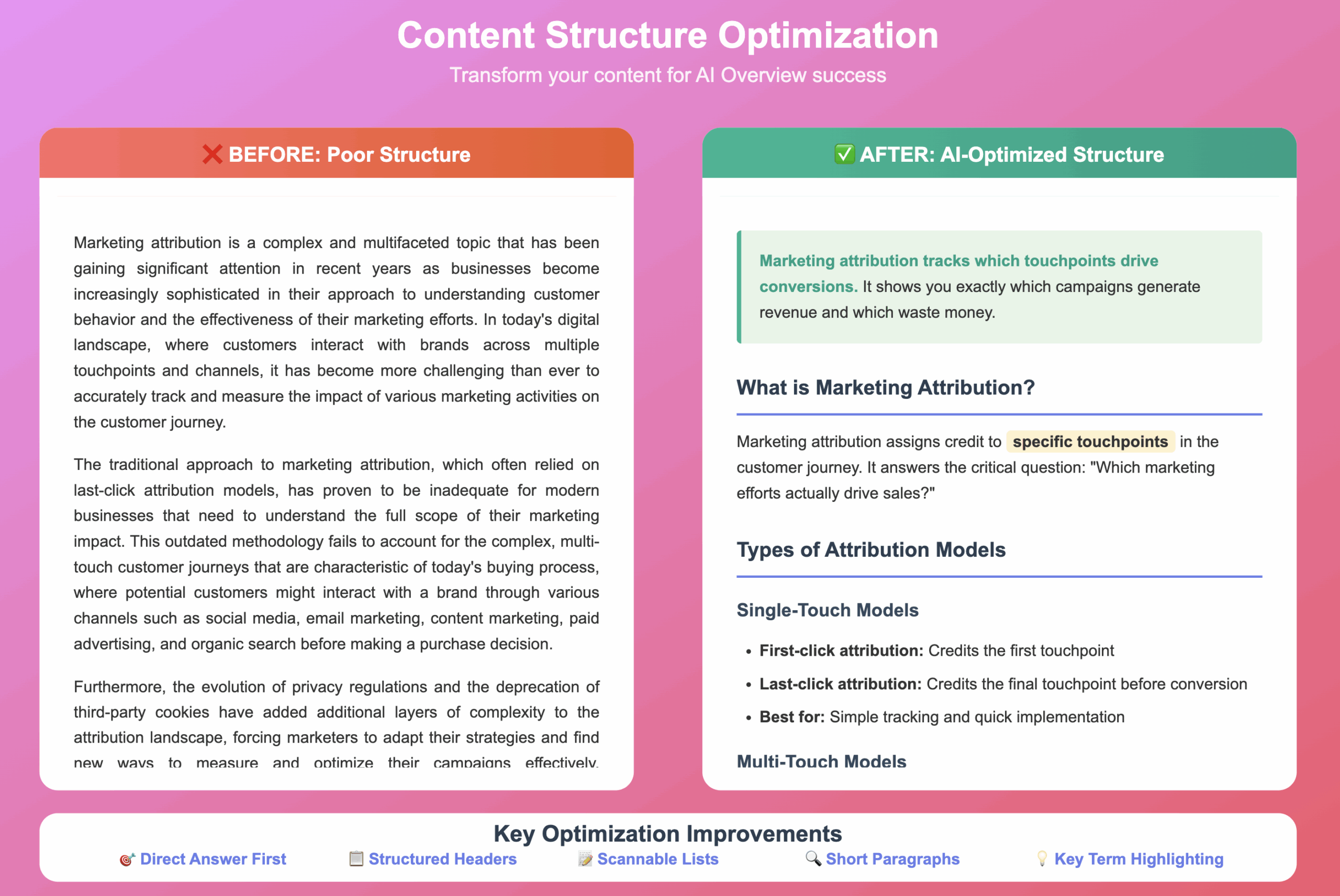
Bad example: “Marketing attribution is a complex topic that many businesses struggle with. There are various approaches and methodologies…”
Good example: “Marketing attribution tracks which touchpoints drive conversions. It shows you exactly which campaigns generate revenue and which waste money.”
Structure your content like a conversation. Imagine someone asks you a direct question. Answer it in the first sentence. Then provide supporting details.
2. Master the Featured Snippet Format
Google AI Overview often pulls from existing featured snippets. If your content ranks for featured snippets, it has a higher chance of appearing and ranking in AI Overview.
Target these featured snippet formats:
Paragraph snippets: Direct answers in 40-60 words
List snippets: Numbered or bulleted steps
Table snippets: Comparison data in structured format
Use header tags strategically. H2 and H3 tags help Google understand your content structure. They act as signposts for the AI.
🎯 Optimization Tip: Create content that answers the question in multiple formats. Use paragraphs, lists, and tables for the same information. This increases your chances of being selected.
3. Build Unshakeable Authority to get Ranked in AI Overview
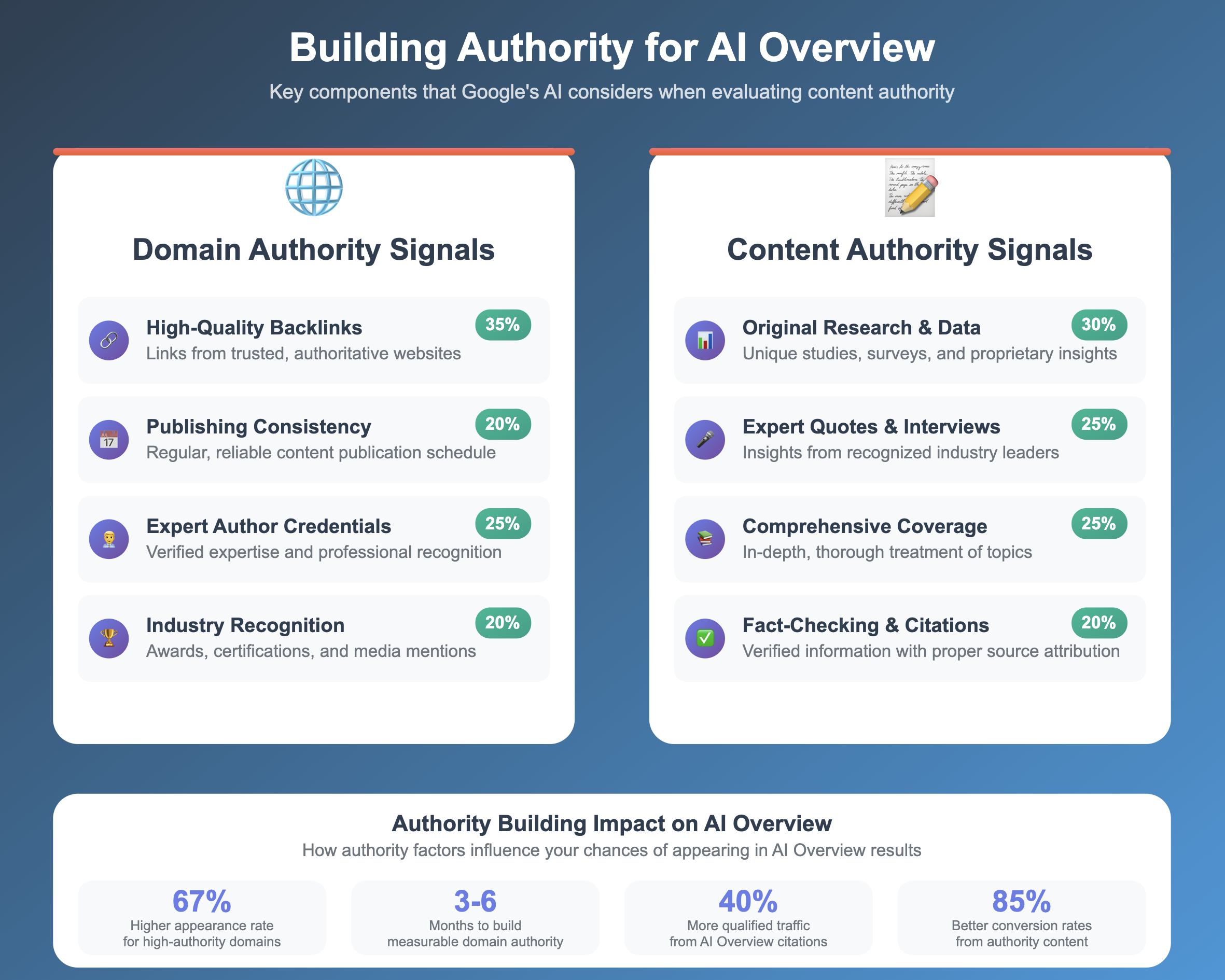
As AI-driven search expands, brands need strong and consistent credibility signals across the web. These signals help pages rank higher on search engines while improving visibility in AI Overview results. Rank higher on search engines. Google’s AI favors authoritative sources. Authority comes from several factors:
Domain Authority Signals:
High-quality backlinks from trusted sites
Consistent publishing schedule
Expert author credentials
Industry recognition and awards
Content Authority Signals:
Original research and data
Expert quotes and interviews
Comprehensive coverage of topics
Fact-checking and source citations
As the CEO of Loopex Digital SEO agency, Maria Harutyunyan suggests: “Building authority in today’s AI-driven search landscape goes beyond traditional link-building tactics. It now revolves around creating a broad network of digital trust signals that reflect credibility across multiple online ecosystems. Google’s AI Overview evaluates far more than backlinks — it examines entity associations, topical consistency, and brand reputation across various sources. Brands that appear frequently on authoritative websites, are referenced in credible discussions, and maintain an active professional presence online are more likely to be identified as reliable authorities by Google’s evolving algorithms.”
Authority takes time to build. Start now. Publish consistently. Create original research. Partner with industry experts. SegMetrics’ advanced analytics platform helps you track which authority-building efforts drive the best results.
4. Optimize for User Intent
Google’s AI understands user intent better than ever. It knows the difference between someone wanting to buy and someone wanting to learn.
Match your content to search intent:
Informational Intent: “What is marketing attribution?”
AI reads differently than humans. It scans for patterns and structures. Making your content AI-friendly is one way to rank in Google AI Overview.
Use Clear Hierarchies:
H1: Main topic
H2: Subtopic 1
H3: Specific point
H3: Another specific point
H2: Subtopic 2
H3: Specific point
Create Scannable Content:
Short paragraphs (2-3 sentences max)
Bullet points for lists
Bold text for key concepts
White space for readability
Include Schema Markup: Schema markup helps AI understand your content context. Use these schema types:
Article schema for blog posts
FAQ schema for question-and-answer content
How-to schema for step-by-step guides
Review schema for product comparisons
6. Target Long-Tail Question Keywords
AI Overview appears more often for question-based searches. Target long-tail keywords that start with:
How to…
What is…
Why does…
When should…
Where can…
Research shows that 70% of AI Overview triggers come from question-based queries. These searches also have higher commercial intent.
Keyword Research Strategy:
Use tools to find question-based keywords in your niche
Analyze competitor content that ranks in AI Overview
Look for gaps in existing answers
Create comprehensive content that fills those gaps
7. Leverage Internal Linking
Internal linking helps Google’s AI understand your content relationships. It shows which pages are most important on your site.
Strategic Internal Linking:
Link from high-authority pages to new content
Use descriptive anchor text
Create topic clusters around main themes
Update old content with links to new pages
8. Monitor and Measure Performance
You can’t improve what you don’t measure. Track your AI Overview performance religiously.
Key Metrics to Monitor:
AI Overview appearance frequency
Click-through rates from AI citations
Traffic quality and conversion rates
Keyword ranking positions
Competitor AI Overview presence
How to Rank in Google AI Overview & the Technical Requirements for AI Overview Success
Page Speed and Core Web Vitals
Google’s AI favors fast-loading pages. Page speed affects your chances of being selected for AI Overview.
Optimization Checklist:
Compress images and videos
Minimize JavaScript and CSS
Use content delivery networks (CDNs)
Optimize server response times
Implement lazy loading
Target these Core Web Vitals scores:
Largest Contentful Paint (LCP): Under 2.5 seconds
First Input Delay (FID): Under 100 milliseconds
Cumulative Layout Shift (CLS): Under 0.1
Mobile Optimization
Mobile searches trigger AI Overview more frequently. Your content must work perfectly on mobile devices.
Mobile Optimization Elements:
Responsive design that adapts to all screen sizes
Touch-friendly navigation and buttons
Fast mobile loading speeds
Readable font sizes without zooming
Accessible form inputs
HTTPS and Security
Security signals matter for AI Overview selection. Use HTTPS on all pages. Implement proper security headers. Keep your website updated and secure.
Content Strategies That Win AI Overview
Create Comprehensive Resource Pages
AI Overview favors comprehensive content that covers topics thoroughly. Create pillar pages that become the definitive resource for your target keywords.
Resource Page Structure:
Overview of the main topic
Detailed explanations of subtopics
Practical examples and case studies
Step-by-step implementation guides
Common questions and answers
Related resources and tools
Develop Original Research and Data
Original research gives you a huge advantage. AI Overview loves citing unique data and insights.
Research Content Ideas:
Industry surveys and reports
Original experiments and tests
Data analysis and trend reports
Expert interview compilations
Case study collections
When you publish original research, other sites link to your data. This builds authority and increases your chances of AI Overview selection.
📈 Data-Driven Insight: Businesses that publish original research see 67% more AI Overview appearances than those relying solely on curated content.
Build FAQ Sections
FAQ sections naturally align with how people search. They answer specific questions directly. AI Overview pulls from FAQ content frequently.
FAQ Best Practices:
Use real customer questions
Provide complete, specific answers
Include related questions and topics
Update based on search trends
Implement FAQ schema markup
Create Step-by-Step Guides
How-to content performs exceptionally well in AI Overview. People search for instructions. They want clear, actionable steps.
Guide Structure:
Clear problem statement
Required tools or resources
Step-by-step instructions
Expected outcomes
Troubleshooting tips
Additional resources
Advanced AI Overview Optimization Techniques
Optimize for Voice Search
Voice search queries often trigger AI Overview. People speak differently than they type. Optimize for conversational keywords.
Voice Search Optimization:
Target question-based keywords
Use natural language patterns
Include local search terms
Optimize for featured snippets
Create conversational content
Leverage Video Content
Video content can appear in AI Overview. Google’s AI can extract information from video transcripts and descriptions.
Video Optimization:
Create detailed video descriptions
Include accurate transcripts
Use relevant video tags
Optimize video thumbnails
Embed videos in related blog posts
Build Topic Authority
Google’s AI recognizes topic authority. When you consistently create high-quality content about specific topics, you build authority in those areas.
Topic Authority Strategy:
Choose 3-5 core topics for your business
Create comprehensive content for each topic
Update and expand existing content regularly
Build internal linking between related topics
Track your authority growth over time
Measuring Your AI Overview Success
Setting Up Tracking
You need proper tracking to measure AI Overview performance. Use tools that can identify AI Overview appearances and track their impact.
Tracking Setup:
Configure Google Search Console
Set up rank tracking for AI Overview
Monitor branded search performance
Track traffic quality and conversions
Measure customer lifetime value
Use SegMetrics to track your AI growth.
SegMetrics’ attribution platform provides the comprehensive tracking you need to measure AI Overview impact on your business results.
Key Performance Indicators
Track these metrics to measure your AI Overview success:
Visibility Metrics:
Number of AI Overview appearances
Keywords triggering AI Overview
Market share of AI Overview presence
Competitor comparison data
Traffic Metrics:
Click-through rates from AI Overview
Traffic quality scores
Conversion rates by traffic source
Revenue attribution by channel
Authority Metrics:
Domain authority growth
Backlink acquisition rates
Brand mention frequency
Expert recognition and citations
Common AI Overview Optimization Mistakes That Will Not Get You Ranked in AI Overview
Keyword Stuffing
Don’t stuff keywords into your content. AI Overview selection depends on natural, helpful content. Keyword stuffing hurts your chances.
Ignoring User Intent
Don’t create content that doesn’t match user intent. Research what people really want when they search for your target keywords.
Poor Content Structure
Don’t neglect content structure. Use proper headers, lists, and formatting. Make your content easy for AI to understand.
Neglecting Mobile Users
Don’t ignore mobile optimization. Most AI Overview triggers come from mobile searches.
Focusing Only on Rankings
Don’t obsess over rankings alone. Focus on providing value and answering questions completely.
Future-Proofing Your AI Overview Strategy
Stay Updated with Algorithm Changes
Google’s AI continues evolving. Stay informed about updates and changes. Adapt your strategy accordingly.
Build real authority in your industry. Become a trusted source of information. Authority compounds over time.
Focus on User Experience
Always prioritize user experience. Google’s AI rewards content that helps users achieve their goals.
Taking Action: Your Next Steps
Start implementing these strategies today. Begin with the basics and build systematically.
Week 1: Foundation
Audit your current content for AI Overview potential
Identify top opportunity keywords
Optimize your highest-traffic pages
Implement basic technical improvements
Week 2-4: Content Optimization
Create FAQ sections for key pages
Develop comprehensive resource guides
Optimize for featured snippets
Build internal linking structure
Month 2-3: Authority Building
Publish original research
Create expert interview content
Build high-quality backlinks
Expand topic coverage
Ongoing: Monitoring and Improvement
Track AI Overview appearances
Measure traffic quality and conversions
Update content based on performance
Adapt strategy based on results
Conclusion: Dominating and Ranking in AI Overview in 2026
Google AI Overview represents the future of search. Businesses that master AI Overview optimization will dominate their markets. Those that don’t will struggle for visibility.
The strategies in this guide work. They’re based on real data and proven results. But they require consistent implementation and patience.
Start today. Choose your highest-opportunity content. Apply these optimization techniques. Monitor your results. Adjust based on performance.
Remember: AI Overview optimization is not a one-time project. It’s an ongoing process. The businesses that commit to continuous improvement will win and rank in Google AI Overview.
Your competitors are already working on AI Overview optimization. Don’t let them gain an unfair advantage. Use these strategies to claim your space in Google’s AI-powered future.
Denise Cullom is an innovative and goal-oriented Operations Lead committed to professional development and expert leadership of teams, systems, and profitability. Recognized for repeatedly surpassing business goals, she is a decisive leader and strategic planner known for rallying stakeholders behind new initiatives. Denise is adaptable to changing business needs and market conditions, continuously driving success and growth.
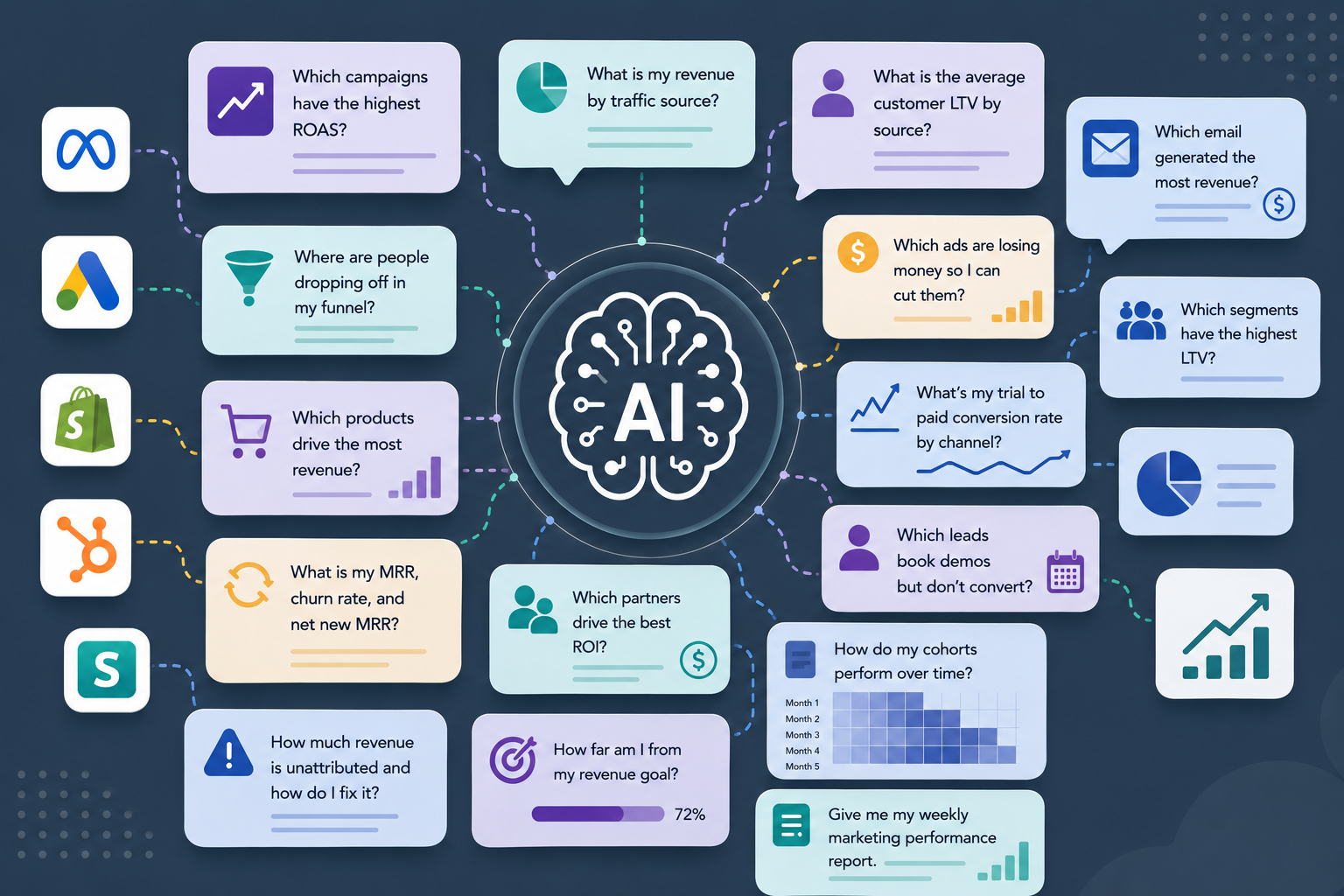
174 plug-and-play prompts for more effective AI marketing analytics. Explore your ROAS, LTV, conversion rates, churn trends, tracking issues, funnel performance and more.