Here’s a question most marketing teams can’t answer: How much revenue is AI actually sending you?
Not traffic.
Not clicks.
Revenue.
Right now, when someone discovers your business through ChatGPT, Claude, Gemini, Perplexity, or another AI platform, that visit usually gets lumped into your “referral” bucket. It looks the same as any random link click.
Which means you can’t tell:
Whether AI traffic is worth $10 or $10,000
Whether AI visitors convert better or worse than organic search
Whether AI is growing while Google shrinks
Whether AI is sending high-LTV customers…or junk leads
And if you can’t see it, you can’t manage it. Today, we’re fixing that.
Introducing AI Search Tracking
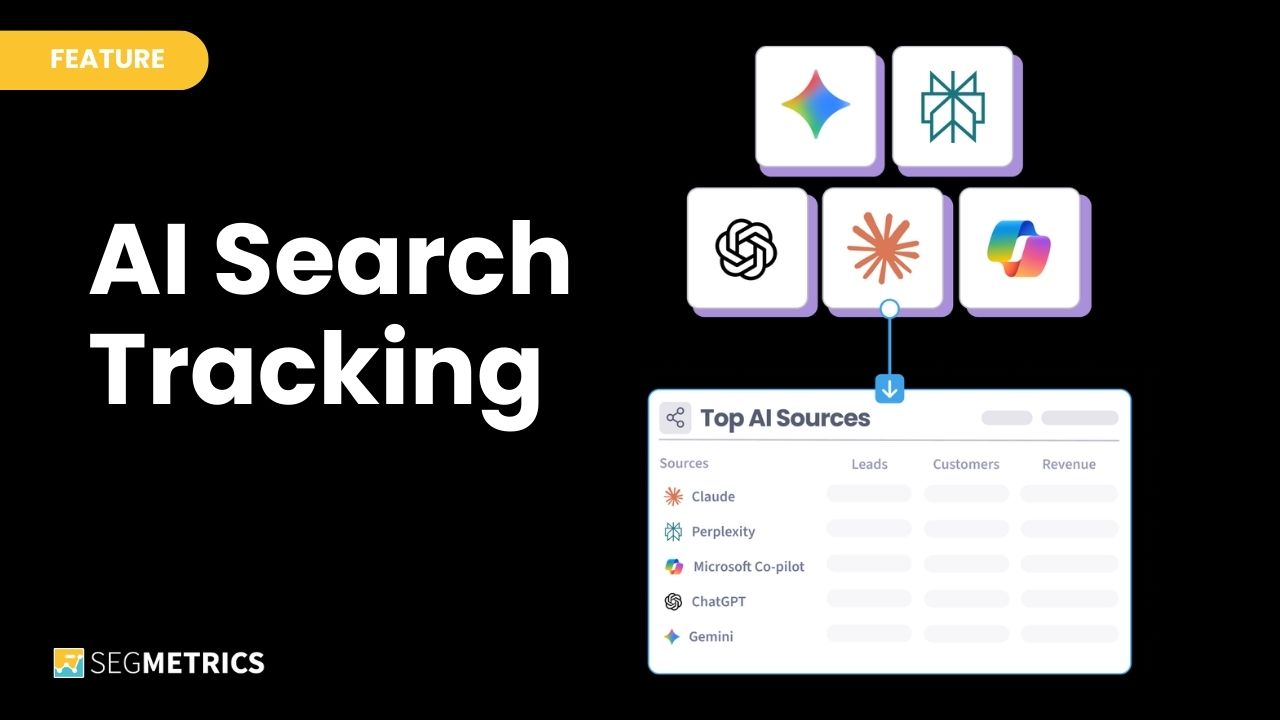
SegMetrics now automatically identifies traffic from major AI platforms and classifies it as its own channel: AI Search.
Just like paid, organic search, direct, or social — AI traffic now has its own place in your dashboard. No tagging. No new setup. No workflow changes.
It simply shows up.
And because this is SegMetrics, you’re not just seeing visits. You’re seeing:
Leads
Customers
Revenue
Lifetime value
Funnel progression
Drop-off points
AI traffic is no longer buried in referrals. It’s fully measurable.
See AI Search Tracking in action 👇
How to use this AI tracking data today
If you’re already using SegMetrics, here are three ways to start using this AI Search Tracking capability today:
1. Compare AI Search vs Organic Search
How is your AI traffic trending compared to your organic traffic. Is one growing while another declines? (If you’re not watching these trend lines, you can’t plan for the shift. Now you can.)
2. Look at AI LTV — not just visitors
Most conversations about AI traffic focus on visits. Almost nobody focuses on value. Probably because they can’t easily see the lifetime value of their AI traffic without a tool like SegMetrics.
With our AI Search Traffic feature, you can compare the conversion rate, revenue and lifetime value of AI traffic against organic traffic.
Maybe AI visitors convert slower…but spend more over six months. Maybe they convert faster — and churn faster. The answer will change your marketing strategy.
3. Identify the pages driving AI value
AI tools don’t just send traffic to your homepage. They often send people directly to specific pieces of content: blog posts, guides, reports, and other deep resources. With AI Search Tracking, you can easily see which pages on your site are the most valued and shared by AI tools.
This helps you strengthen the content that’s already working and identify gaps between your expertise and what the AI models are referencing. To get more of your pages cited, see our guide on how to rank in Google AI Overview.
Ryan Johnson is a content strategist and product marketing manager with over 15 years experience bringing brands and products to life with integrated editorial and sales collateral, value-based messaging, and GTM strategies.