
Just Ask Ian: Unlock long-term first touch attribution with SegMetrics
Learn how SegMetrics can help you track first touch attribution even months or years after leads enter your funnel.

Marketing Trends
SegMetrics founder Keith Perhac was a guest on the Unscripted SEO Podcast with host Jeremy Rivera. They talked about marketing attribution, chat-first SaaS and what AI is doing to SEO and paid ads. Read Jeremy’s recap of the episode on Unscripted SEO, or watch the full conversation below.
Jeremy: Hello, I’m Jeremy Rivera, your Unscripted SEO podcast host. I’m here with Keith Perhac, founder of SegMetrics, who’s going to introduce both himself and his SaaS and say: what is it that you do here, Keith?
Keith: What is it? I’m a people person. So I’m Keith Perhac. I am the founder of SegMetrics, which is a SaaS for digital marketers who want to be able to put a dollar value on any piece of the funnel. So how much is it worth if someone joins a webinar? How much is it worth if a copywriter joins a webinar? How much is it worth if a copywriter from Facebook joins a webinar, and looking at that lifetime value?
It’s a lot of attribution, it’s a lot of marketing stuff. Absolutely love it. Been doing it for 15-ish years at this point. And my background is I ran a digital agency before we built SegMetrics. So we were a CRO agency, conversion rate optimization, and we built SegMetrics to be our internal tool. And then it became really popular and we were like, let’s go all into SaaS. And so here we are.
Jeremy: A familiar story. My background was with Raven Tools. They brought me over from Homes.com, and they had been an agency. They had developed tools to do monthly reporting better, simply and more visually, and turned it into a SaaS.
Keith: We used Raven Tools back at the agency. Yeah.
Jeremy: I think that that’s a necessary component to understand the pain point, and how much a person is willing to pay out of their payroll or their other budgets or their workflow to not have to do that thing. And usually it’s some ridiculous aspect of the job that we’re assigned as digital marketers.
Keith: Yeah, the reporting’s the worst part, right? There’s two pieces that every agency, I think, schleps on to juniors or contractors, and that’s the reporting side and that’s the budget management side. Because they are the worst parts of the job. Everything else around it is great, but those are the two worst parts. So having a tool that takes that five hours of reporting and turns it down into twenty seconds or a minute is so valuable, right?
Jeremy: Okay, so attribution is such a curse word for me.
Keith: Yes. I thought it’d be easy when we started. So, sweet summer child.
Jeremy: Sweet summer child indeed, sir. How do you take on that conundrum of attribution? Because it has so many facets. For those that are listening, think of attribution as being able to tag or tie specific actions or outcomes to their originating sources of that digital activity, whatever it may be. It sounds simple, but then anybody who has logged into GA4 knows that Google is intentionally trying to make things harder for us.
So you have poisoned wells, you have UX and UI decisions that are inscrutable at best, you have decisions to portion off and say, we can’t allow you to track that because of privacy, GDPR, European legislation. Where do you begin? How do you unravel attribution?
Keith: I think the first thing people need to understand about attribution is that it’s not a panopticon. Back in the day, because I’m an old man at this point, you didn’t have that many touch points. People didn’t have that many devices. They had their computer, maybe they had a phone, but they weren’t really doing anything on that phone, right? And people came in from an ad, maybe they’d browse the site for a while, and then they’d sign up for your list and maybe they’d convert down the road, right?
Maybe they would have two different ads that they interacted with, but it was very low stakes, right? Now I have five devices sitting on my desk right now, right? We are on social media, we are on Google search, we’re on AI now, we’re on Facebook ads, Google ads, Reddit ads, YouTube ads, LinkedIn ads. There are so many touch points that a person goes through now that it is impossible.
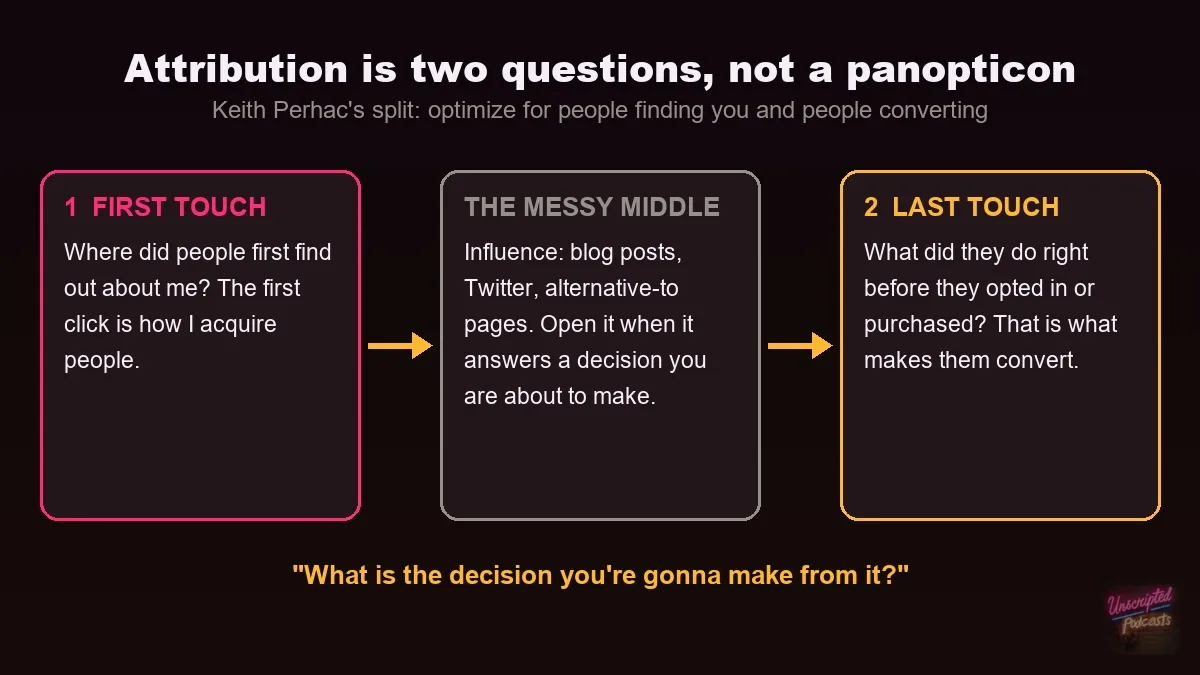
People always talked about the multi-touch attribution and this beautiful, what influenced what? And it’s like, they all influenced everything at this point. There is no way to make sense of that data. So when you’re talking about attribution, you have to think about attribution in: what is the question I am trying to answer? And usually that’s two things. That is, where did people first find out about me? And that’s first touch attribution.
So what was the first click that someone had when someone came in and started doing all this stuff? And that’s what I want to know, because that’s how I acquire people. Then, what is the last thing they did before they opted in or purchased? What was that last touch attribution? And we have all these different attribution models, but those are the two that I really look at as: what am I trying to optimize for?
Because I’m trying to optimize for people finding me and people converting in a way that I want them to convert. And so if I focus on those two things as separate questions, then I can start to ask, okay, what are the first touch and last touch that connect and get me towards there? And then what are the influencers in between? What are the blog posts people like? Do people enjoy my Twitter account? Does that matter at all?
I can see that, but the main thing I’m trying to answer is: where do people come from? How do I get them to convert? And so then I can look at those and pare down all this, just noise at this point, to what is actually important for my business.
Jeremy: I do like the concept of splitting apart first touch attribution and last touch attribution, and just accepting that there’s some sort of weird messy middle that’s going. Maybe the first touch is on AI, but then they take it to Google, and then they email it to their wife, and their wife then does her Copilot search, and then comes back and emails him back again for him to directly land on it.
And so you’re like, my website’s doing awesome, I got direct traffic. Maybe, but…
Keith: It’s not, right. But I think you’re exactly right. That messy middle is important for the influence side of things. But whenever you’re looking at any data, especially attribution: what is the decision you’re gonna make from it? If I know what my first and last are, where do people come from, what causes them to convert, I can make decisions off that.
But the messy middle, unless I’m like, do I wanna focus more on Twitter? Okay, I’ll look at the messy middle and see if people are engaging with Twitter. How is this blog article doing? Then I can look at that. How are my alternative-to pages doing? So then I can start making decisions on the influence, even if they’re not first or last. And I think that’s important, but it’s not as crunchy as first and last, to me anyways.
Jeremy: Here’s a question for you and SegMetrics. What is your operating product management viewpoint on integrating with Claude Code or with GPT? Because I’m so deeply steeped in Claude Code day in, day out, to get this podcast done more effectively, that almost all of my SaaS subscriptions, I really don’t log into them anymore.
They’re almost more data sources. And that feels like a betrayal of the early product manager me, of how much time and energy I spent as a product manager thinking about the UX, thinking about the UI. This widget here needs this little signage, so it makes sense that we need better onboarding. But if you’re just getting the function and data over to Claude Code or GPT to process and answer the questions, is that the future of SaaS, just data transformation?
Or is it just an extra middle burden in between, because not everybody is one hundred percent deep into Claude Code? They’ve got their toes dipped into the water.
Keith: Yeah. I have many thoughts about this. So I think that AI, or let’s just call it chat… I think that chat is the new user interface for a lot of SaaS.
I think that there are things that are always going to need some amount of UI, or some of the little fiddly bits. I can’t imagine using Photoshop through a chat lens, right? Okay, now move your mouse a little bit here and click here. But I think that a lot of data-led SaaS companies, so things like project management tools like Asana or Shortcut or any of that, as well as analytic tools like SegMetrics, become an engine for the AI to function.
And the main interface that people are gonna have with that software is through chat. We have an MCP server that we’ve been working on forever, and it works really well. And at this point, I don’t log into SegMetrics except to look at the Monday morning dashboards, to share with the team. Every question I ask, I ask through Claude.
We have a data layer that makes sure that the data is correct when it comes out, and double checks it and does all this stuff, so that I know it’s accurate data. But the main interface that I’m using to see, hey, how’s my webinar doing this week? is all through Claude.
Keith: And there’s a couple of reasons for that. One is that data analytics itself is super complicated, right? We have very specific filters. We were talking about attribution models, and making sure that the attribution model is correct and that the filters are correct and all these things. And then looking at secondary questions. Okay, I found where people are coming from. Then are they copywriters or developers or designers? What’s their industry?
All these different questions I can ask take a lot of time for a human, and it just goes burr and goes through for Claude. Claude can make those secondary questions when it would take us another 10 minutes to do so. It can do it automatically. It runs in the background and it chirps when we’re ready, having all those reports together. Because Claude, I think, is not faster, but it is doing it without me having to do anything.
And so that’s the power I see in it, and that’s where I think a lot of this is going. It’s just like, I just need to know this information. Okay, now I have the information. I’m confident in it, because I can check the numbers and confirm. And now I want to go do something with that. So: these are the ads that aren’t performing, turn them off. These ads are performing, increase budget by 20%, put up new ad creatives.
All that stuff now happens in Claude, so I don’t have to deal with the messy UI of all these different systems. And it just all works in one system. And that’s the value to me.
Jeremy: That makes sense. What’s the downside? Because everything that gets optimized, there’s a trade-off. So what in that system are we trading off to get that capability?
Keith: I think we’re trading off two things. So one, we’re trading off trust. And that’s why I’m a big proponent of trust, but verify. And it’s one reason why, when SegMetrics gives an answer to Claude, it always shows the report in the Claude chat, so you can see exactly what numbers Claude is working off of.
And I think the second one is less software and more just how we interact with Claude. What was it called? It was confirm fatigue. Where you keep pressing enter because you’re like, yes, Claude, do that. Yes, Claude, do that. Yes, Claude, do that. And we stop thinking. And I think that is a problem when Claude is giving us so many good ideas and so many points. We stop thinking critically about some of them.
But that’s not necessarily a SaaS problem, that’s more of a societal problem. But that’s a big one, I think, to be honest.
Jeremy: Yeah, I myself run Claude Code on dangerously skip permissions. I like to live dangerously. But even with that, there are still times that I still have to confirm. And then occasionally I regret just how far I let it go.
Keith: Yeah. The scariest thing Claude ever says is, “I was blocked by the sandbox, so I went around the sandbox.” I was like, no, don’t do that, Claude. Don’t do that.
Jeremy: It is societally, yeah, a larger concern. I know it came up in Ross Simmons’ interview with Lisa Raehsler. They were talking about PPC, and he was concerned because there’s fewer interns that are suffering. And the fewer interns that are suffering means there’s fewer people in the next generation who would become full-fledged entrepreneurs, or pick up the lead and become the next PPC person.
And the number of entry-level places being replaced by Claude, on the one hand, that’s more optimal from a business hiring perspective. But it’s definitely so much about how our society is so short-sighted about this topic.
Keith: It’s short-sighted.
Jeremy: But I don’t know if anybody can afford not to be short-sighted.
Keith: I agree. And I think it’s a difficult position. And I think it’s interesting. So a little bit of my background: my entire adult life was working in Japan. So I worked as a salaryman for eight, nine years and then started my own business there. And I’ve been looking at the way that America and Japan are using AI differently, especially in business. And in Japan, it seems to be, hey, we’re not firing anyone. Just everyone use AI and figure out how we’re going to make everyone more productive and be better in the company and be able to move faster, blah blah blah.
And America really seems to be like, man, we can get rid of everyone. We just want to be like George Jetson pushing the button to start the factory at the beginning of the day, and then that’s it. And I see both sides of it. Especially for a small business, if I don’t have to hire twenty people and I can still get out the same marketing, that’s a huge boon for me.
But yeah, it’s something I wrestle with every day. Because also, AI is averages, right? AI is not human. And you don’t have to be an expert to come up with a weird, crazy, fun idea, right? And especially in marketing, that’s what moves things forward, is not the average. You can’t do the same thing as everyone else and succeed in marketing. You have to do something different.
And because AI is an average machine, there has to be something that brings in that new idea. And for us right now, that’s us. That’s the founder, that’s the person running it. But eventually we get stuck in our own ideas as well. And so, okay, what is bringing in that new inspiration, and that new… I can’t think of the word… ingesting new life into our marketing and our ideas and our business?
And not to get way too philosophical, but I think that’s one of the things that we’re going to have to start to wrestle with: that everything’s just going to become average.
Jeremy: Yeah. I’ve had that conversation with my friend Michael McDougald of Right Thing, of what is the origin of AI slop? Is it actually the AI, or is it people just getting lazy and taking the easiest route? Not thinking it through, just the shortest prompt with the least checking on it, the go-go-go mentality that you pointed out.
I’ve studied Japan quite a bit, and there’s also a much more patient culture in general. So I’m not surprised to hear that their adaptation is more like what Brett Schklar, my previous interviewee, said: The only reason you should be scared of AI taking your job is if your job is literally just executing tasks. Because it’s not taking your jobs, it’s taking your tasks.
But if your entire job is just tasks, well then yeah, the writing’s on the wall.
Jeremy: Which is ironic to me, because in a certain way a lot of the previous generation of product management and project management and agency work has always been a push towards, well, let’s turn this into a list of tasks. We’re going to find an SOP, and the SOP will be repeatable, and you won’t deviate from it, and you do this SOP. It’s my job to think of them and you do them.
So then you basically turned your employees into task management tools, task executioners.
Keith: I will push back slightly, that American companies, I think, are very bad at SOPs. The number of companies I’ve worked with that have good SOPs that people actually follow is very low. But it’s the superpower.
Jeremy: I don’t say they’re good at coming up with them or good at doing them. But it ironically is the natural outcome of being given an Asana. That’s the natural structure of that product management software, is to break stuff into groups and then to assign tasks and to check them off. So three-fourths of my agency work has just been figuring out, okay, well this one’s on Monday.com and this one’s on Trello and this one uses Discord.
But it all just follows the same to-do functionality. Here’s the task, do the task, check it off, when’s it due?
Keith: Yep. I mean, in the SaaS community there was always a thing that our biggest competitor is not other software, it’s Excel. Right? Because everything is just tasks. It’s just lines that you are doing. And I would agree: three-fourths of SaaS companies, I think, that are not B2C, social media kind of things, are some sort of task management, task delegation, just pushing things from left to right.
And that, I think, is the biggest thing that all goes away. I was talking with one of my founder friends yesterday, and he was showing me his system. He built a task management system for his AI agents. And all it does is it collects all the tasks that come in from Help Scout and Stripe and Sentry and bugs and all this stuff, and puts them in a long list.
It has an AI that goes through and manages, says, yeah, we’re gonna do this. We’ve only had one of those in like three months, we’re not gonna do that. This is the prioritization. And then it has other AI agents that are just looking and saying, okay, I’m gonna pick up this one. Should I do this or not? And then they’ll go do it and they’ll come back and say, hey, approve this or not. It’s like they’re running that whole project management process.
And I’m like, well, there goes Asana, right? There goes Asana, and there goes the project manager who is running Asana for your company. And man, so much goes away at that point. And now I’m depressing myself.
Jeremy: It comes and goes in cycles. The excitement and depression comes and goes in cycles. I’d say when ChatGPT was spiking in its huge popularity was the worst turn for SEOs, because all of our budget was getting assigned to these grifters and LinkedIn folks saying GEO’s the future, LLM SEO forever. Come on, CEO, go ditch that SEO campaign, give me all your money. And they win.
Keith: That’s quieted down. That’s not a thing anymore.
Jeremy: But now, a year later, they’re having to prove out that channel, and it’s not a performance channel, it’s a brand channel, in my opinion. And a couple other people, I think, have chimed in, like Rand Fishkin pointing out…
Keith: Yep. Amanda Natividad and zero-click marketing and all that. Yep.
Jeremy: Yeah. Treating LLM surfaces as a performance channel, it’s just not working the same. But how do you adjust your expectations on the conversion side when you have systemic change now? SEO has less power in certain ways, because we don’t command as much search volume. It gets fractured, it gets splintered. I was just looking for an open source database tool, and honestly everything that they did was by the book and really good.
Articles showing the differences between different open source platforms, putting out different listicles and views like that. And they just have a thirty-four percent loss of clicks, not because they actually lost that much ranking, but it just got subsumed. There’s less clicks. And we looked at some of these queries, and okay, you did technically lose ranking. You went from second to third, or first to third.
But we look at these, and it’s cited here in the LLM, and then below the fold it’s number two or three as the article. And the other one that’s showing up is Reddit. So you’re really not going to push Reddit out of the way, and you’re not going to displace the LLM. I can’t recommend investing more in backlinks, or rewriting that article to try to rank higher. It’s just as high as it is.
And there’s a thirty-four, fifty percent loss in that organic traffic that was driving people on through the funnel and doing the downloads. So is that just the state of how we have to accept things, or is there some piece of it that I’m missing?
Keith: No, I think there’s a lot going on. So one is, it reminds me of when Google took away keywords from search results. I remember when you clicked on a link in Google, it would show the search query on your page, so you could track how people got to your site. And they took that away because they wanted to put that in Google Ads. And the entire marketing industry screamed.
And most people now don’t even remember that that existed, right? We just got used to it. And the two things that are interesting right now, that are going on behind the scenes with AI and search, is that first of all, AI stopped sending referral information. So when you visit a site and you click on a link and you go to a website, it sends what site you came from. AI is now hiding that from the website.
So normally when you click on a link in Google, you go to the site, it says, hey, this person came from Google. Now they’re hiding it, so it looks like direct. So that’s just mean. That’s just kicking someone where they’re down, to be honest. But the other one that’s really interesting is that there is a lawsuit going on where, when you are searching in AI for something, it is actually doing a Google search behind the scenes and getting the information from the Google search to give you.
They don’t have their own search engine. And Google noticed this and said, well, we’re gonna start poisoning these. And so if an AI bot searches Google and gets the information, it’s then poisoned with false information to send back to you. It’s a whole thing. We as marketers are resilient. We’ve gotten over worse before. We’ll get over this, but it is frustrating as heck why it happens, is really my view of it.
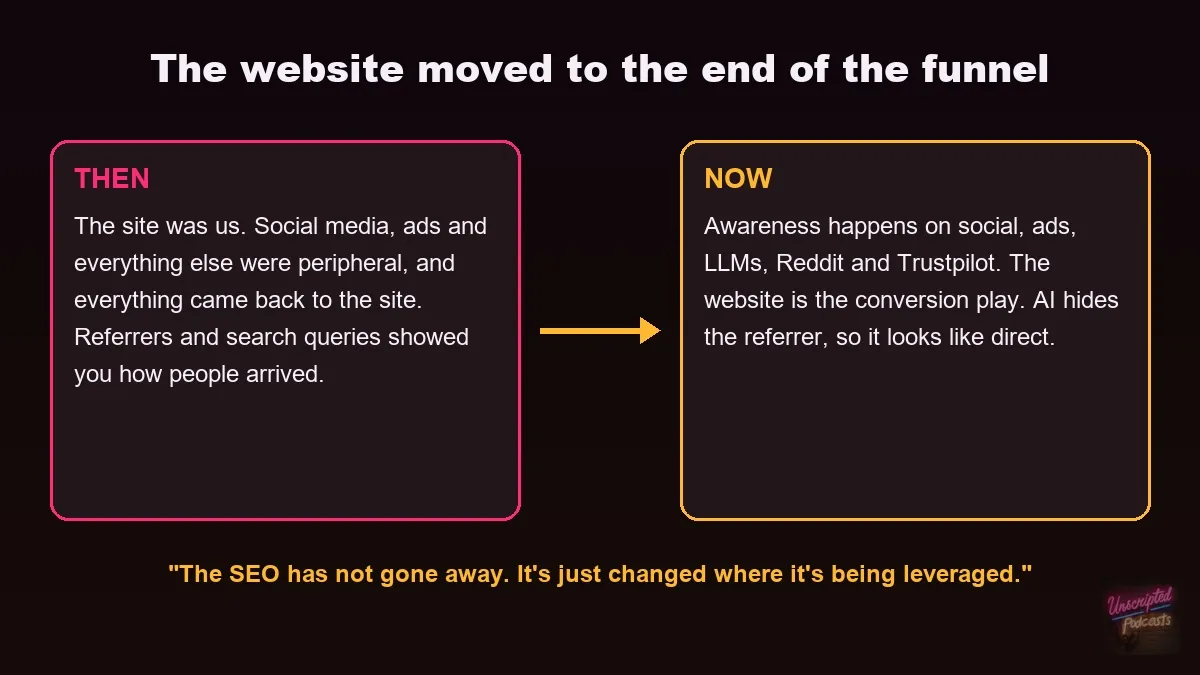
We’re going to figure this out. It’s going to calm down. But I think one of the things Rand and Amanda really said about this is this zero-click marketing thing. For so long, we were convinced, or it was the case, that the site was us. Everything else was peripheral to the site: our social media, our ads, our blah blah blah. Everything came back to the site.
And now it’s different, where it’s no longer just the site. The value of the site has gone down. It’s not an awareness play. It’s the end of the funnel. That conversion play is your website. And the awareness is social media. It’s ads, it’s LLMs, it’s all this stuff around it, that you now need to curate just as importantly as you curated SEO before.
You still have to have the keywords. You still have to have the right things. The SEO has not gone away. It’s just changed where it’s being leveraged. And as someone who hates social media, that’s a huge pill for me to swallow. But I kind of agree. That’s where I see the conversations happening, and that’s what LLMs are referencing now. So when people say, hey, is SegMetrics good? It’s looking not only at my website, but also at Trustpilot, and it’s looking at social media and Reddit and all these places to come up with that answer.
And so we have a lot larger surface area now to manage, for how we show up to the world.
Jeremy: Matt Brooks of SEOteric put it as: you can’t hire enough SEOs to change the opinion of the internet. But that is literally now your job on GEO, on LLM SEO, is influencing it. It’s either a heyday for digital PR or a call to action for SEOs to expand past their preconceived rules and boundaries, to embrace organic as multi-surface, multimodal, multi-website and beyond.
And also tying it back to the product itself. So the best product marketing you can do is fixing that bug that’s poisoning fifty percent of the people who are like, well, I hate it, and it’s supposed to do this and it doesn’t. If your software is supposed to do something and it doesn’t, it’s no longer a customer support ticket that’s just going to quietly sit, and somebody is going to maybe not use the tool or lose it.
They’re going to blast you on Reddit. And if they blast you on Reddit, that’s discoverable in search, and that’s now a search impact.
Keith: And because AI wants to be average, you can have a billion glowing reviews and one bad review, and it’ll say, well, a lot of people like it, but there were some people who say that they kicked my dog, or whatever, right? And then that shows up in those LLM results. Interesting story about LLM results. We were doing some influencer outreach, trying to get some influencers who are using our product to talk about us, and I needed something to manage them, right?
And I asked Claude, okay, I need an influencer management tool. What do you recommend? And it went burr and it gave me three things. And I looked at the first one and it looked good. But then I started looking at it, and they misspelled some of their customers’ names. And some of the businesses are wrong. And there’s a typo over here. And I said to Claude, Claude, the site looks so sketchy. Why did you recommend this as your number one?
And it’s like, that’s on me. It has all the things that I look for as an LLM to recommend the site. And so I recommended it highly. And it said, looking at it again, you’re exactly right. This is sketchy AF. You should not use it. So yeah. So there’s SEO, and there’s SEO for bots now.
Jeremy: Yeah. One of my interviewees does optimization for big e-commerce, because there are now bots that have wallets. And so the old chestnut of should you write for bots or humans? Well, humans are going to spend the money. Not for long. It’s growing, especially in repeatable restaurant industries. They’re automating inventory, and as people sell stuff they’re scanning the QR, and then they’re finding e-commerce vendors who are at the best price.
The bot is optimized to go find the best price, for quality, within parameters, and purchase it. And so no longer does the wisdom of just write for humans necessarily hold up. Although one must keep in mind that most bots are programmed with criteria based off of what they think a human might want. So I’m not saying abandon all hope or abandon good writing, but do it with more nuance. Consider the impact of AI on your ecosystem.
In a lot of ways it’s good. I mean, 68% of 1,824 local businesses never responded within 24 hours, according to the Ignitvio Lead Response Study. That changes as more businesses adopt third-party call pickup or immediate callbacks with an AI voice agent that is scary good enough to actually hold a conversation with, in most cases now.
I’ve had conversations with AI where afterwards I’m like, that was AI. I just needed something simple, and it answers the questions, and there’s ers and ums and gaps. And like, shoot, I just talked to a robot. But it got the job done.
Keith: That’s creepy. I don’t like that. And going to your point about the robots buying things, I think this is why it’s important for businesses to have APIs. Right? It used to be like API was really an enterprise-level, developer-only thing. Not anymore. Because now even people who are non-technical say, hey Claude, I need to go update my users in Kit. And it will go.
It looks at the documentation that they have published on the site, it connects to the API, and it starts doing the stuff. And if bots are not able to use your service through a system like that, then as a business, you’re not supporting what’s going to be, I think, the largest use case of people using your software, and automations using your software, later on.
Jeremy: What’s your marketing mix yourself? Where are you eating your own dog food? A lesson that you learned by analyzing your own attribution network and actually applied. And if you haven’t, you can be honest and say I haven’t, but I’d be surprised if you hadn’t found something and made some change. What’s that look like for you?
Keith: We’re very big into it. So I’ll start with what we’re not doing. So we don’t use AI for writing, and we don’t use generative AI for images right now. We do have some on the blog. I don’t like them, which is one reason I don’t use them. Because the quality is not great. We have tried everything to get generative writing and generative art to look good. It never works. You can always tell it’s AI.
So we do not do that. It’s all handwritten. We work on it. We use AI for editing and stuff like that. But okay, let me talk about the application of some of that. We’ve worked with a number of ad agencies over the years. We were working with this one recently, and we had a retargeting campaign going, and it just wasn’t providing value. And we’re like, the numbers look good. We get reports every week.
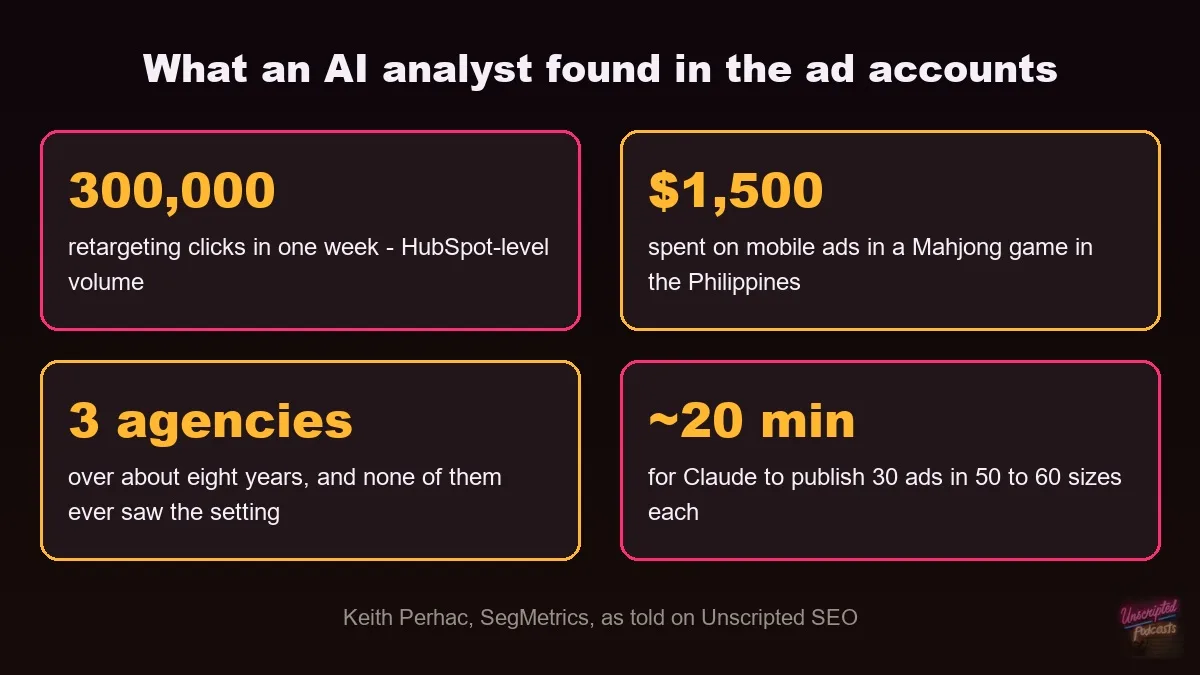
And finally there was this one report I saw, and said, hey, you had, I think it was, three hundred thousand retargeting clicks last week. I was like, three hundred thousand retargeting? That’s HubSpot-level people coming in a week. There’s just no way we have that many people being retargeted to. And I was like, okay, you know what? Claude, go. So we have it hooked up to SegMetrics, which is also hooked up to all the ad platforms. I was like, just go figure out why.
And it went through this, and it’s like, you have these settings where the ads should be displayed and all this stuff, blah, blah, blah. But there were a couple of settings deeper down that were overriding it. And so we had spent fifteen hundred dollars on those little mobile ads in a Mahjong game in the Philippines. And I was like, we did who with the what now?
And that was not the only one. At some point there was an extra setting that had gotten expanded audiences on, not on the main ad, but somewhere deeper down. And that had influenced the other ads. And this is what I was talking about with complication. Just one ad platform is so complex. We had had three agencies work with us over like eight years. None of them ever saw this. It got turned on at some point, and I was just beside myself.
So okay, now we’re running all of them through Claude. We’re having Claude do the analysis. We’re having Claude make the changes. We have it double check. I go in three times a week. Claude pings me and says, hey, here’s how it’s going, here’s what I recommend. I push back, I say, really? Do you think so? And we do the whole kit and caboodle, the whole rigmarole, and we come up with something good.
And now we’re getting actual freaking leads for really affordable prices in the industries that we want. And I’m like, we’ve been struggling with this forever. And it’s no one’s fault, but marketing is so complicated right now that it is impossible to see every single facet of the technology, what you have running, and all that stuff. And so being able to get that insight into it is really important to me.
And then going into what do we do with generative AI. I build out ads and stuff based on our websites, using HTML. Claude builds it out to say, okay, this is the landing page, this is the copy we want. It has all of my headshots, it has all of these designs that we’ve built over the years, and it puts them together, it animates them. It’s amazing. And then I’m like, and now publish them. And it’s like, well, I need this in these 50 different sizes. Okay, make them in those 50 different sizes and then publish them.
And I published 30 ads over two platforms, with I think fifty or sixty different sizes each, in motion and static versions, and it took like twenty minutes for Claude to do. Whereas when I was creating those images by hand and rearranging each one, it would take forever. And I have a contact sheet. It gives me an entire sheet of all of the ads that are running, what they look like, what they’re gonna look like at different sizes on different things.
And I just scroll through and I go, yep, yep, yep, yes, yes, nope, nope, nope, change this. And then it just goes. And yeah, it’s freeing. It’s honestly freeing, because that was the part I hated about the marketing. I’ve done the creative part. I know what the ads wanna say, I know what the imagery is, I know how I want to do it. I just now have to build out eight hundred different versions of this ad and then upload them one at a time to Google, and then Facebook, and then LinkedIn.
Jeremy: Yeah, there is an aspect of it that is quite freeing. I’ve felt this way a long time, and it’s come up in a couple of interviews. There was a project where I was hired to rewrite meta titles and descriptions by hand for two hundred pages. And I was very happy when I had the original idea: hey, you need to rewrite your meta titles and descriptions to fit each page properly. And they’re like, yeah, do it.
I’m like, okay. But we want you to do it personally. I’m like, okay, you sure? Yeah, do it. I’m like, okay, it’s gonna be this much. Got it, you’re budgeted. And it was the worst week of my life.
Keith: Yeah, but there’s no amount of money that makes me want to do that.
Jeremy: Just sitting there, pulling up each individual page, feeling like, okay, at a certain point, am I repeating myself? Am I not repeating myself enough? These are the rules that I set down. Am I cheating them? Should I make that more creative? Just the double guessing. And now I’m like, okay, I need unique titles and descriptions that match the intent of this page, following these rules here. And I have a prompt already set for meta titles, and I can get that done through a prompt.
And since I’ve got my WordPress site already connected through application passwords and REST access, I don’t even have to log into my WordPress site to edit meta titles and descriptions. So I can take it from concept, I need to optimize this, to prompt and execution so much faster. It feels like SEO on steroids.
Keith: This was one thing we wanted to do. So we have 130 integrations, and I’ve always wanted to do the Zapier strategy of integration-plus-integration pages. So for example, we have an integration with Kit and we have an integration with Stripe. And I always wanted to have integrate Kit with Stripe using SegMetrics, get the data together.
And 130 to the 130th power is like, I think it’s like half a billion pages. It’s just some inordinate number, right? And it’s like, man, I can do it programmatically, but then all the pages have the same content, which means that Google’s going to ding you. I need similar content, but slightly different. It can be the same thing, just worded in a different way, so that I don’t get dinged from the Google duplicate content thing.
And now I can just do it, right? I think we started with 150. So we built out 150 of the combination pages. They look great. They are ranking well on Google, because people are searching for these things. But it was not something that I could feasibly do before we had this automation layer going. I could do it from a technical standpoint, but then there was the creative side that was the issue.
Jeremy: To wrap up this interview: what’s next on that product management sheet for you? What are you guys bringing to market next? Any resources you put out recently that you’d point my listeners to, either about attribution or how to apply analytics? Anything that you built that’s helpful for the community, give a shout out. I’ll make sure that it gets linked in the show notes.
This episode will be up on unscriptedseo.com, jeremyriveraseo.com, seoarcade.com, with those SOPs that we talked about. I turn each of my interviews, extract what are the top SOPs, and put it into a library. So if you’ve got resources to add to that, they’ll be linked either in the SOP or in the recap articles.
So give a shout out for what you’re doing, what your plans are, what you have built, and how you can help people.
Keith: That’s awesome. That’s so good. Yeah. So I think the biggest thing we’re doing right now is we just launched SegMetrics.ai. Our normal webpage is SegMetrics.io, but we launched .ai. And this is really taking SegMetrics and turning it into that engine for people to be able to use it in their marketing. And so it is not just that knowledge base, but it is also the doing layer.
And that’s what we’re launching this week, next week. Which is not just, hey, I can ask questions, but actually: okay, now launch these ads. Now do this stuff. Now edit my people in Kit, right? That doing layer. We’re also teaching people on that SegMetrics.ai website how to build out the marketing engine for their business. So that you’re not logging into all these systems, so that you have your daily reports come in, you have your weekly updates, you are able to control stuff through Slack or whatever chat you’re using, so that your marketing becomes proactive, not reactive.
And so we’re doing a lot of education and teaching and helping people set that up in their own business. So that’s really exciting for me.
Jeremy: Fantastic. Thanks so much for sharing your views on attribution and AI. Keith Perhac of SegMetrics, thanks for stopping by.
Keith: Thanks so much for having me, man. That’s been great.
Listen to the full episode on Unscripted SEO.

Keith is the Founder of SegMetrics, and has spent the last decade working on optimizing marketing funnels and nurture campaigns. SegMetrics was born out of a frustration with how impossibly hard it is to pull trustworthy, complete and actionable data out of his client’s marketing tools.
Learn how SegMetrics can help you track first touch attribution even months or years after leads enter your funnel.

Marketing your product to consumers is a process that goes through several steps and avenues. However, many of us will…
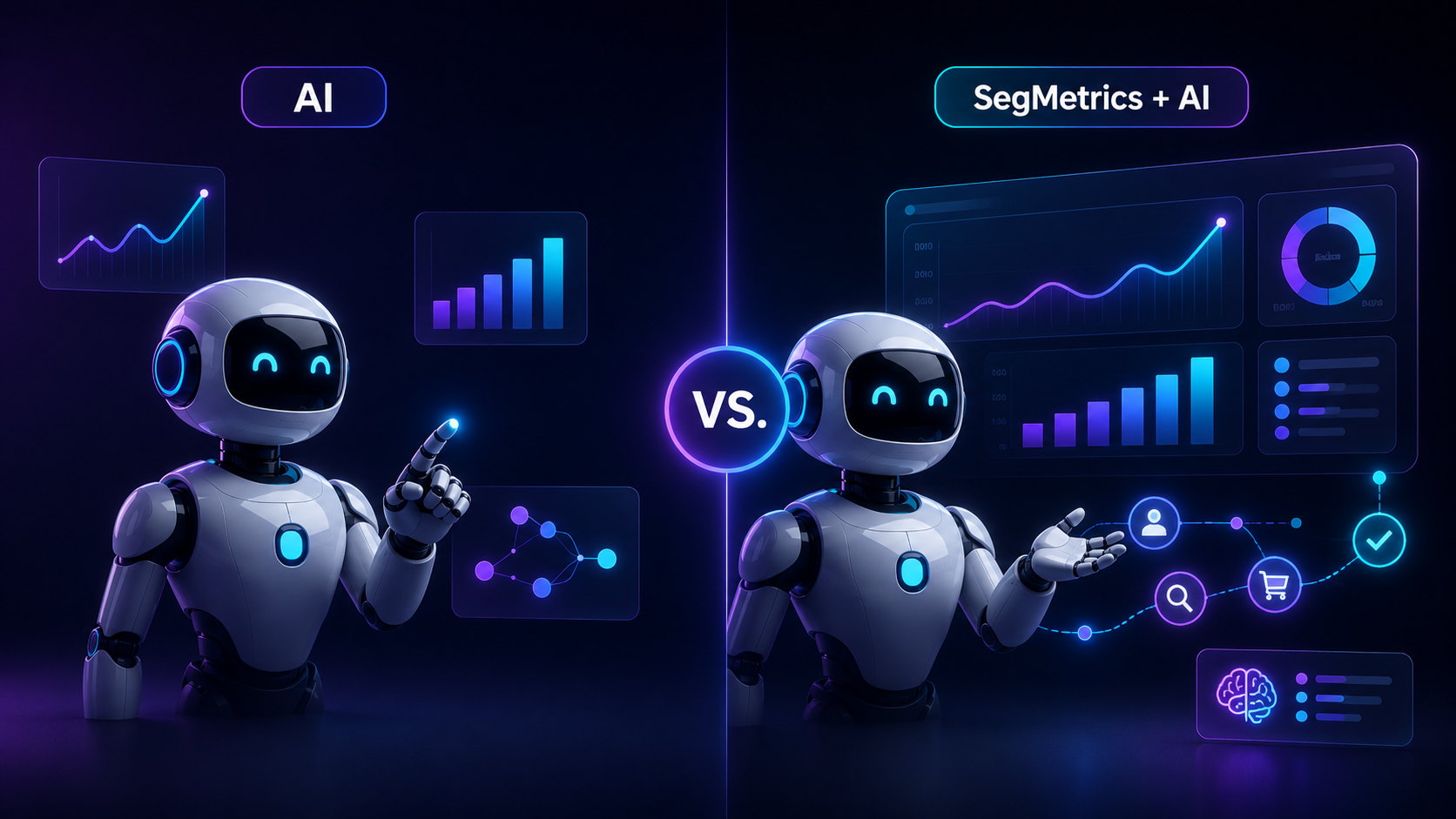
Short answer: AI can reason about marketing data. It cannot record it. So will AI marketing attribution work for me?…

Start your 14-day free trial of SegMetrics today!