
Introducing SegMetrics AI Insights
Your new tool for clear, actionable marketing insights Our new AI Insights feature is designed to help you turn your,…

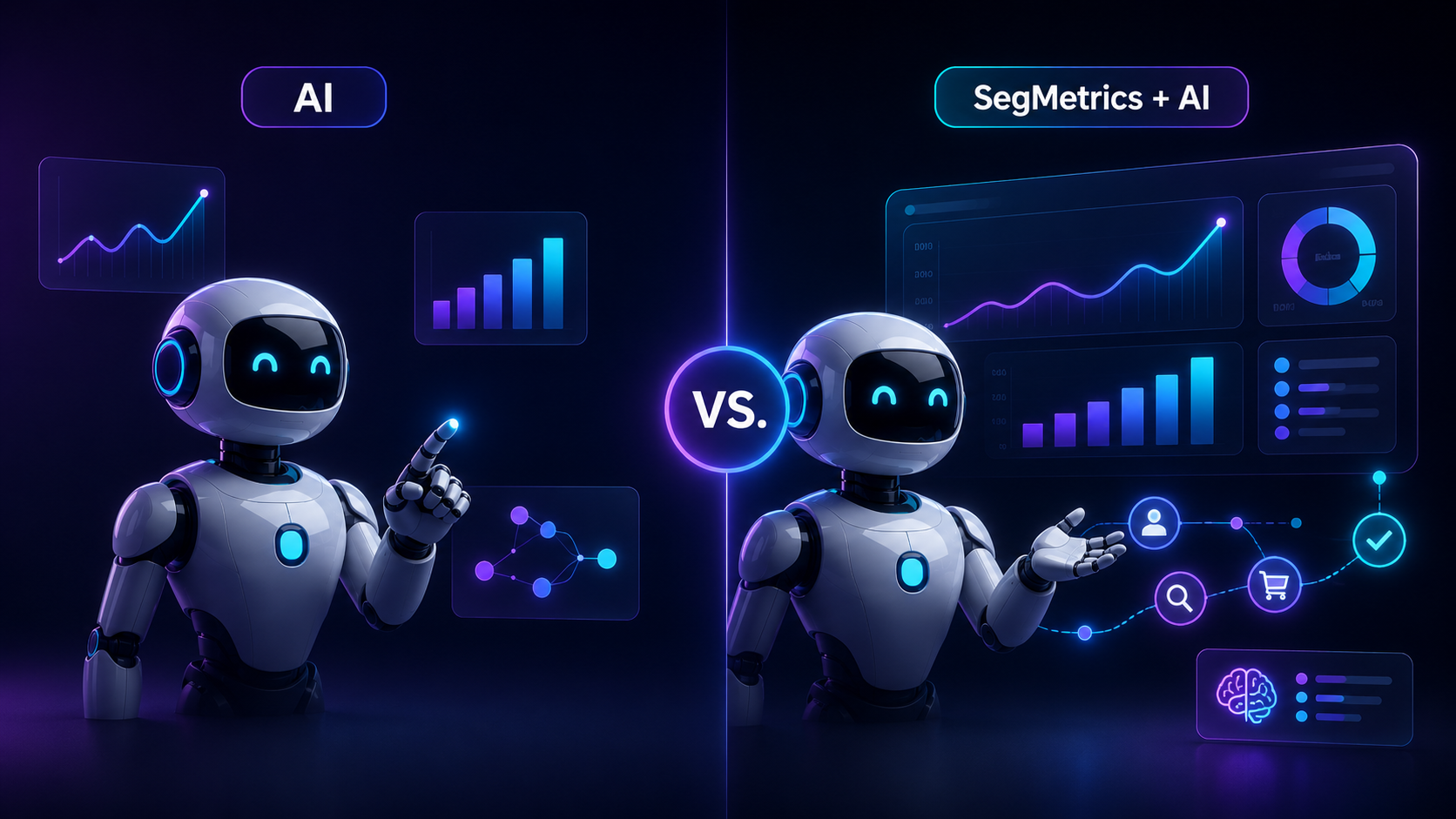
Short answer: AI can reason about marketing data. It cannot record it. So will AI marketing attribution work for me? A language model cannot tell you that today’s buyer first clicked a Facebook ad 90 days ago, because nothing in your Stripe, CRM, or ad platform exports contains that connection. Someone has to capture and store the link at the moment of the click, months before the sale exists. Attribution software is that recording layer. AI is the reasoning layer. We tested this against our own library of 174 marketing analytics prompts: about a third can be answered by AI working from exports alone or MCP server connections, and roughly half cannot be answered at all.
Partly. AI can analyze attribution data extremely well. It cannot create attribution data.
The distinction matters because attribution has two separate jobs, and people collapse them into one:
AI is now better at the second job than most dashboards and many analysts. It is structurally incapable of the first. Not because models are not smart enough yet, but because the information has to exist before anything can reason about it.
More than most attribution vendors will admit. Here is the honest list.
Interpret and explain. A dashboard hands you a number. AI tells you why it moved and what to do about it, in plain language, formatted for whoever needs to read it.
Answer questions nobody built a report for. Every reporting tool answers a fixed set of questions. The one you actually have on a Tuesday night is usually not in the set. AI has no fixed set.
Work from exports. Drop a Stripe CSV into Claude or ChatGPT and you can get revenue trends, MRR, churn by plan, cohort tables, refund rates, and average order value. This is real, and it is genuinely good.
Remove the interface. No dashboard to learn, no date picker, no export to wrangle.
If you were using attribution software mainly as a monthly revenue report, AI replaced that. We would rather say so than pretend otherwise.
Because the connection between the first click and the eventual sale does not exist in any of your systems unless something recorded it at the time.
Walk through a normal journey for a coach, course creator, or SaaS business.
In April, someone taps a Facebook ad on their phone. They read the page and leave. In June, they Google a question, land on your blog from a laptop, and join your email list. In July, they click a link in your nurture sequence and buy a $997 program.
Now look at what each system holds when you go to export it.
| System | What it knows | What it does not know |
|---|---|---|
| Stripe | A charge succeeded in July for an email address | That April or June ever happened |
| Your CRM or ESP | An address subscribed in June, clicked a link in July | That a Facebook ad existed |
| Facebook Ads | An ad got a click in April from an anonymous device | Any email address, any purchase |
| Google Analytics | Sessions occurred, aggregated | Which session belonged to which customer |
Read that table again and look for the join. There isn’t one. No shared key connects the April click to the July charge. The Facebook click carries no email address. The Stripe charge carries no click ID.
Hand all four exports to an AI and ask which channel drove the sale. It can only work with what is in front of it, and what is in front of it says the email sequence drove the sale. That is last-touch attribution wearing better prose. Facebook gets zero credit for starting the whole thing, and you cut the ad budget that was working.
No. This is a data availability problem, not a reasoning problem.
The link between the April click and the July sale had to be created and stored in April, before anyone knew a sale would ever happen. No amount of intelligence recovers information that was never written down.
A model reading your Stripe export in 2028 will be far more capable than one reading it today. It will still be reading a file that does not contain the click.
You cannot reason your way to a fact nobody recorded.
We publish a library of 174 marketing analytics prompts in 18 categories, built for asking real questions of real marketing data. So we ran an audit on our own library. For each prompt we asked: could an AI answer this correctly using only Stripe, CRM, ESP, and ad platform exports, with no attribution recording layer underneath?
Three outcomes:
| Category | Prompts | Answerable | Misleading | Impossible |
|---|---|---|---|---|
| Cohort analysis | 7 | 7 | 0 | 0 |
| Sales team and demos | 10 | 9 | 0 | 1 |
| Subscriptions and churn | 12 | 10 | 1 | 1 |
| Trial funnel | 8 | 5 | 1 | 2 |
| Product and offer analysis | 9 | 5 | 2 | 2 |
| Audience and segmentation | 8 | 5 | 0 | 3 |
| Forecasting and trends | 9 | 5 | 2 | 2 |
| Revenue and LTV | 13 | 5 | 2 | 6 |
| Funnels | 10 | 3 | 3 | 4 |
| Email attribution | 9 | 2 | 2 | 5 |
| Lead quality | 8 | 2 | 1 | 5 |
| Reporting | 10 | 1 | 4 | 5 |
| Setup and config | 8 | 0 | 0 | 8 |
| Attribution | 11 | 0 | 0 | 11 |
| Ad performance | 13 | 0 | 3 | 10 |
| Affiliate and partner tracking | 8 | 0 | 4 | 4 |
| Agency and multi-account | 7 | 0 | 1 | 6 |
| Diagnose | 10 | 0 | 3 | 7 |
Roughly a third of the prompts work with AI alone. Roughly half are impossible. The remainder produce an answer that looks credible and points you the wrong way, which is arguably the worst outcome of the three.
Look at which categories score well and which score zero.
AI alone does fine when the question is about money and time. Subscriptions, churn, cohorts, MRR, refunds, average order value, retention by plan. All of it lives in Stripe with timestamps attached. Ten of twelve subscription prompts work. Seven of seven cohort prompts work.
AI alone scores zero when the question is about origin. Six categories return nothing usable: attribution, ad performance, setup and config, affiliate tracking, agency reporting, and diagnostics. Every one of those is a question about where a person came from and what they touched on the way in.
That is the line. Not intelligence. Not model quality. Whether the answer depends on something being recorded at the moment of the click.
It runs the recording layer. In practice that means:
None of that is analysis. All of it is plumbing, and every piece has to be running before the customer you care about ever arrives.
Yes, and this is the version that actually works. The SegMetrics MCP Server connects your live SegMetrics account to Claude, ChatGPT, Gemini, or any MCP-compatible AI tool, so you keep the plain-English workflow and put real journey data underneath it.
Setup takes about a minute. You copy your MCP Server URL from Account Settings, add it as a connector in your AI tool, and authorize through OAuth. Full instructions are in the MCP Server setup guide, and the launch announcement covers why we built it.
Three things worth knowing:
It is read-only. The AI can pull and analyze your data. It cannot change anything in your SegMetrics account or your connected tools.
Every answer links back to its source report. You are never taking the AI’s word for it. Open the underlying report and check the numbers yourself, right down to the line-by-line activity ledger.
It investigates rather than retrieves. The server exposes eleven tools across 16 report types and 370+ metrics. Some let the AI discover the shape of your business (products, tags, segments, traffic sources) and others let it query. Ask “why is my webinar funnel underperforming” and it chains several queries: check your integrations, find webinar-related segments, look at where registrants came from, run a funnel report to locate the biggest drop-off, drill into contacts at that stage, then compare against a prior period.
The difference in what you can ask:
Stripe export plus AI: “Which email campaign preceded the most purchases last quarter?”
SegMetrics plus AI: “Of the customers who bought in July, what was the first channel that ever brought them to my site, how many days passed between that first touch and the purchase, and what is their lifetime value by that first channel?”
Same conversational workflow. The second question is answerable because something recorded the first touch and kept it.
Yes. Some people should, and we would rather say so than pretend the option does not exist.
Claude Code will write you a working pipeline: API pulls from Stripe and your CRM, normalization, a Postgres schema, a dashboard. What used to be a three month contractor project is now a serious weekend.
Two things to weigh before you start.
The code is the easy part. The hard part is the Tuesday in November when a provider deprecates an endpoint and your numbers go quietly wrong for three weeks before anyone notices.
Click data is the one thing you cannot backfill. Records that already exist elsewhere can be imported. SegMetrics has historical data access for exactly this reason, so your orders, contacts, tags, and email engagement come in with their original dates and you get insight from day one. What cannot be recovered is the ad click nobody captured. Facebook does not store an fbclid for you and hand it over later. If you start recording clicks today, your first trustworthy multi-touch answer arrives one full sales cycle from now. For a 90-day consideration window, that is a quarter of spend decisions made on nothing.
Some people ask this question and the honest answer is that they should skip it. If any of these describe you:
Attribution software earns its cost when you run multiple channels, spend real money, and your customers take weeks or months to decide. That is when the gap between what you believe and what is true starts costing you.
Look at your last twenty customers. For each one, name the first thing that brought them to you.
If you can do that and you are confident you are right, you do not need this.
If you are guessing, the guessing is the thing you are being asked to pay for. An AI reading your Stripe export will guess the same way you do, just faster and with more confidence.
A. It can replace the reporting and interpretation layer. It cannot replace the tracking and identity resolution layer. If you were using attribution software mainly to read a monthly revenue chart, AI does that better and cheaper. If you need to know which channel originally brought in a customer who bought 90 days later, AI has no access to that unless something recorded it.
A. Because no export contains the connection. Your Stripe charge has an email address and no click ID. The Facebook click has a click ID and no email address. Nothing in either file links them. The AI has to either guess or default to the last touch it can see, which is usually an email.
A. Marketing attribution is the practice of recording and connecting every touchpoint in a customer journey to one identifiable person. AI analytics is the practice of interpreting data you already have. Attribution produces the dataset. AI reads it. They solve different problems and work best together.
A. Only with attributed revenue underneath it. Ad platforms report their own conversions, which they have an incentive to over-count and which miss anything outside their attribution window. Without a recording layer, AI can compute spend and clicks accurately and will get cost per acquisition and ROAS wrong. In our prompt audit, none of the 13 ad performance prompts were fully answerable from exports alone.
A. It is a read-only connection between your live SegMetrics account and any MCP-compatible AI tool, including Claude, ChatGPT, and Gemini. You ask marketing questions in plain English and the AI queries your actual attribution data to answer them, linking back to the source report for every finding. Setup instructions are in the help center.
A. Yes. You need an active SegMetrics account and a paid plan on an AI tool that supports MCP connections, such as Claude Pro or ChatGPT Plus.
A. The SegMetrics MCP Server is strictly read-only. It can pull and analyze your data but cannot modify anything in your SegMetrics account or any connected tool. Every answer links back to the underlying report so you can verify each finding rather than trusting the AI.
A. You can build the pipeline. What you cannot do is backfill the click data. Records that live in other systems can be imported with their original dates. Ad clicks that were never captured are gone permanently, so your first reliable multi-touch answer is one full sales cycle after you start recording.
A. Roughly one sales cycle. If your customers typically take 90 days to decide, you need 90 days of recorded touchpoints before multi-touch answers mean anything. This is why the cost of switching or cancelling is higher than it looks.
A. The question assumes they compete. They handle different halves of the same job. Attribution software records what happened. AI explains what it means. Used together through an MCP connection, you get the conversational workflow with a real dataset behind it.
Want to see it on your own data? Start a 14-day free trial, connect your tools, and point your AI at it. Or book a demo and we will map your specific customer journey with you.

Denise Cullom is an innovative and goal-oriented Operations Lead committed to professional development and expert leadership of teams, systems, and profitability. Recognized for repeatedly surpassing business goals, she is a decisive leader and strategic planner known for rallying stakeholders behind new initiatives. Denise is adaptable to changing business needs and market conditions, continuously driving success and growth.
Your new tool for clear, actionable marketing insights Our new AI Insights feature is designed to help you turn your,…
Most lead-gen forms are great at one thing: counting responses. You get a number, a spreadsheet fills up, and everyone…
What is an Alternative to SegMetrics? A Practical Guide You’re looking for a marketing analytics tool and considering your options. That’s a smart move. The…
Start your 14-day free trial of SegMetrics today!