
Guide, Articles, Tracking & Reporting
What Are the 4 Types of Marketing Attribution Models — And Why You Should Use Each One
In a world where marketing is driven by data, understanding how your data is analyzed is just as important as…

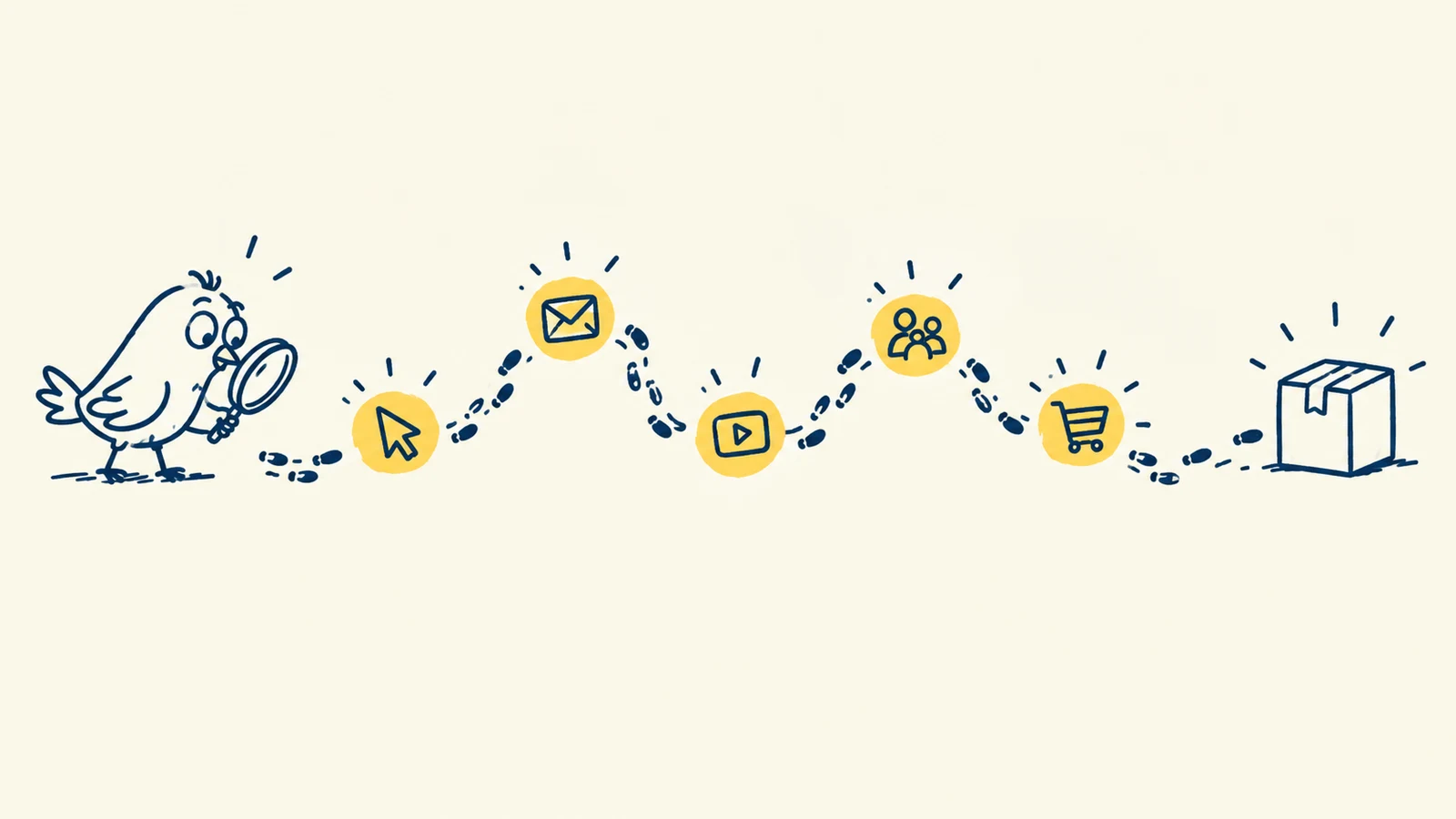
Marketing attribution is how you figure out which of your marketing touchpoints — ads, emails, blog posts, sales calls, web pages, webinars, etc. — deserve credit for a conversion. Instead of guessing what’s working, you trace each customer’s path from first click to purchase.
Once you have this attribution data (and it’s accurate), you can measure how well any marketing activity is driving actual revenue. And if you don’t have it, well, you’re stuck guessing about what’s working.
This article is a plain English guide to the basics of marketing attribution. What it is, what it looks like in practice, and why so many smart marketers draw the wrong conclusions from it (AI included).
At its simplest, attribution in marketing is about assigning credit. Someone buys, and you want to know which of your marketing efforts helped make that happen — so you can do more of what works and stop paying for what doesn’t.
Marketing attribution used to be easy. People had one device, came from one place, and did one thing. Perhaps they clicked an ad, landed on your page, and bought. Credit assigned, case closed.
But now people have multiple devices, most marketing is multi-channel marketing, and most buying journeys are long and complicated. For example, a person may see your ad on their phone at home, walk outside (changing their IP address), forget about you for a month, then come back on their laptop through a Google search ad. Add in a handful of emails (only some of which they saw), a webinar they half-attended, more ads, and an SMS message. What deserves the credit for the sale?
That question — which touchpoints get the credit — is the heart of marketing attribution. But the real value isn’t theoretical credit. It’s knowing what marketing activities to invest more time, attention and budget into and which to cut back on. When you have limited resources, knowing what to prioritize can mean the difference between growing or stalling (or failing).
Ultimately, marketing attribution helps take your raw and scattered marketing data, organize it, and pull out relevant trends and actionable insights.
Say you run a $2,000 online course. Meta’s Ad Manager tells you that your Facebook ad is responsible for the sale. If that’s true, increasing your Facebook ad budget could drive more sales.
But the customer’s actual journey tells a different story:
So, what “drove” that sale? If you only credit the first touch, it’s the podcast. If you only credit the last touch, it’s the follow-up email. If you credit the moment she became a lead, it’s the Facebook ad.
In fact, all three answers are correct. Or better put, they are each correct answers to different questions. And they tell you three completely different things about where to spend your next dollar.
This is the power of marketing attribution. Not only can it capture real customer journeys, it can also help you analyze your marketing from different POVs.
Marketing attribution matters because leads and customers look identical at the top of the funnel.
If you’re measuring success by traffic or clicks — or even leads — you have no idea if those people actually become customers. Most businesses measure success by total revenue. “Hey, if our annual revenue is going up, we must be doing something right.” But there are a couple big problems with this approach:
It’s very inefficient. This traps you into a volume game where you have to keep working notably harder and harder to drive smaller and smaller gains. The reason for this is that the volume game forces you to scale all the channels and campaigns that don’t drive revenue along with the ones that do.
It’s not insightful. Most businesses use the volume approach…until it stops working. Revenue plateaus. Or maybe even starts falling. But without accurate marketing attribution, it’s impossible to pinpoint what, exactly, is the problem. If you don’t know the problem, how can you fix it?
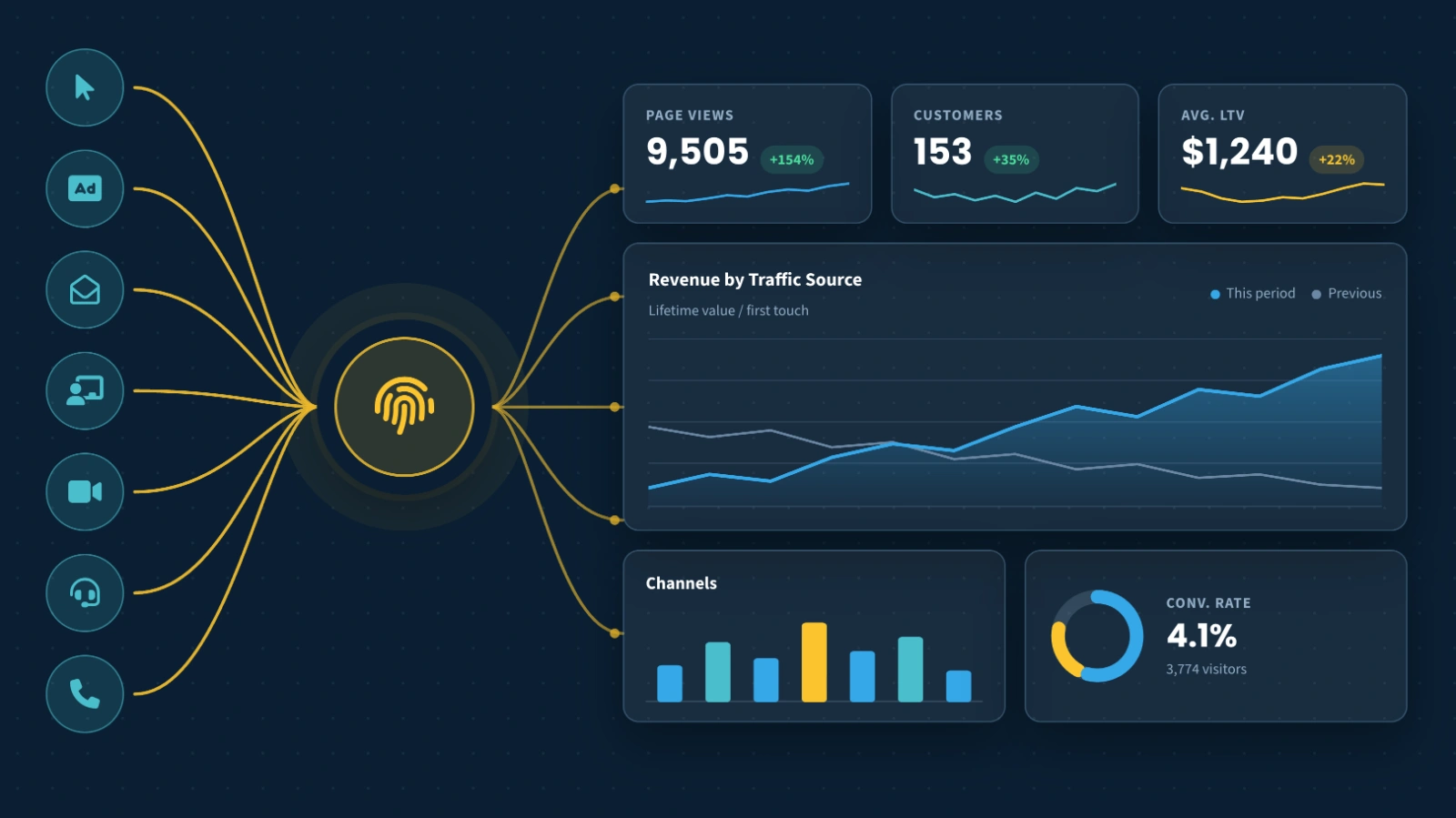
With marketing attribution, you can see how much each channel, each campaign, each ad, each email, and each sales call drives lifetime revenue. For any touchpoint in your funnel, you can tell if it’s working or not.
This allows you to surgically fix or prune any touchpoints that aren’t working and double-down on those that are.
Even more, during times of rapid growth, you can see exactly what is causing that growth. And during slow downs, you’ll know where you could cut your spending without cutting your conversions.
If attribution is so useful, why do so many marketers skimp on it?
Several reasons.
First, marketing attribution and analytics has a learning curve. Even with user-friendly software and ready-built dashboards, there is some time and effort required to making sure your data is clean and complete and that you know how to use the tool.
Second, the answers you pull from your marketing attribution will only be as good as the questions you ask. Vague questions like “who are my best customers?” don’t deliver actionable info. What does “best customer” even mean? Is that the biggest spenders? Or the customers with the highest ROI? Or the ones who require the least ongoing support? Effective attribution and analytics requires some clarity from the user and a willingness to dig into the data.
Third, many marketers find it easier to default to the data they get from their marketing tools. Or they assume AI can handle all of the attribution and analytics for them. Unfortunately, this isn’t the case.
It’s the $1,000,000 attribution question, so let’s answer it.
Can AI do marketing attribution? Partly — and not the part you’d hope.
When people say “marketing attribution,” they’re really describing two separate jobs:
Capturing and organizing: Recording every visit, click, opt-in, and purchase, tying each one to an identifiable person across every tool and device, over months or years, and labeling it all so it’s clean enough to trust.
Reasoning: Reading that organized data and telling you what it means and what to do next.
AI is genuinely good at the second job. It’s often faster and sharper than a human analyst. But AI is structurally incapable of the first job. Not because the models aren’t smart enough but because the raw data was never tied to real people in the first place. That’s what attribution software does. For example, SegMetrics uses nine different signals (email, browser, IP, integrations, custom fields, cross-domain click tracking, cookies, screen size, and geo-location) to identify one person across different sessions, devices, and platforms. AI can’t reconstruct that from a pile of disconnected exports or from multiple MCP Servers.
The real danger is that if you give AI messy, duplicate-ridden marketing data, it won’t tell you it’s confused. It’ll just take a confident swing. When we tested 174 marketing-analytics prompts on an AI connected only to Stripe, a CRM, an email tool, and an ad platform — no attribution layer underneath — it could correctly answer just 30% of the questions. Half were flat-out impossible, and the other 20% came back with credible-looking answers that pointed in the wrong direction.
So no, AI can’t do attribution.
But if you feed it clean, verified attribution data, then your AI becomes a genuinely powerful analyst. That’s the whole idea behind the SegMetrics MCP Server. Accurate data first, then AI reasoning on top.
Two related concepts come up the moment you go deeper into attribution, so here’s the tl;dr:
Both attribution models and windows are choices that can change your numbers.
What is marketing attribution? Marketing attribution is the practice of connecting each sale back to the marketing touchpoints that lead up to it. This can stretch across the whole customer journey. When you know the specific channels, campaigns, emails, ads, pages, and actions that moved someone to buy, you can see what’s really driving revenue in your business.
What does attribution mean in digital marketing specifically? Attribution in digital marketing is the same idea applied across your digital channels. It stitches a person’s activity across ads, emails, your website, and social into one journey, then assigns credit to the steps that contributed to the conversion. A key part of digital marketing attribution is tracking customers across different devices, platforms and over time.
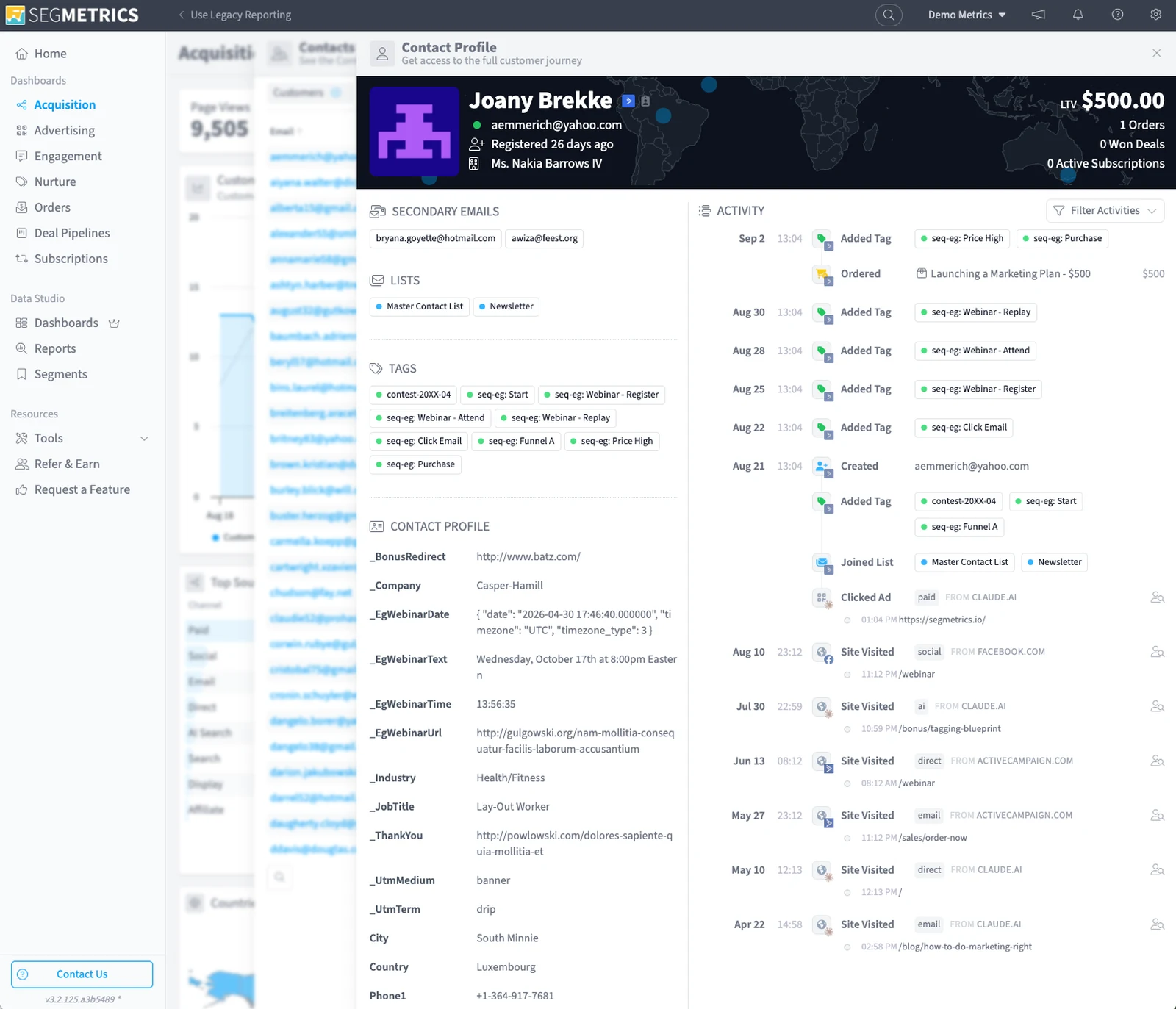
What’s an example of marketing attribution? Say a buyer finds you via a video, clicks a Facebook ad to grab a lead magnet, reads a few nurture emails, attends a webinar, talks to a sales rep, then buys. Attribution decides which of those touchpoints gets credit for the sale. The attribution model you use will change how you view the data and can change the answer you receive.
Why do so many marketers get attribution wrong? The number one reason is that they don’t invest in an accurate and transparent attribution layer in their business. They rely on their marketing tools (like their ad platforms and email) to tell them what’s working. But these tools focus on top of funnel metrics, which means most marketers end up optimizing for clicks, not revenue.
The fastest way to understand attribution is to watch it map your own funnel. You can set up marketing attribution for your business in as little as 10 minutes.
Start your free 14-day trial to get started today — no credit card required. Or book a call with one of our marketing analytics experts if you’d like a private tour.
New here? The Complete Guide to Marketing Attribution ties all of this together.

Keith is the Founder of SegMetrics, and has spent the last decade working on optimizing marketing funnels and nurture campaigns. SegMetrics was born out of a frustration with how impossibly hard it is to pull trustworthy, complete and actionable data out of his client’s marketing tools.
Guide, Articles, Tracking & Reporting
In a world where marketing is driven by data, understanding how your data is analyzed is just as important as…

Ad Tracking, Tracking & Reporting
What an attribution window is, how it differs from a lookback window, what each ad platform's default actually is, and why a short window quietly hides your best-performing ads.

One of the biggest challenges when running ads is measuring accurate attribution data. This is difficult for a number of…

Start your 14-day free trial of SegMetrics today!