

Cross-Device Tracking: How Multi-Device Attribution Transforms Marketing ROI in 2026
When it comes to marketing, the analysis of each touchpoint leading up to a purchase is essential. Funnel attribution, which,…

Tracking & Reporting

Cross-device attribution measures how marketing touchpoints on different devices contribute to a conversion. It depends on cross-device tracking, which identifies which phone, tablet, and computer sessions belong to the same person or account.
Tracking connects the journey. Attribution assigns credit within it.
This article breaks down how this cross-device tracking and attribution works (and how it influences your marketing).
Almost nobody lives on a single device anymore. Someone sees your ad on their phone during lunch, downloads your lead magnet on the same phone, reads a nurture email on their tablet that evening, and finally signs up for your webinar and buys on their laptop a week later. One person. One journey. Three devices.
Making sense of that involves two jobs that often get blurred together:
The order of operations matters here. Your attribution is only ever as good as the tracking underneath it. Without identity resolution, the customer who actually bought looks like they appeared out of nowhere. This is a problem because no attribution model can credit connected touches it can’t even see.
Don’t listen to the hype: Cookies are not going away. Google reversed its plan to get rid of cookies, and they’re still on by default in Chrome. (Here’s what digital marketers need to know about third-party cookies.)
Even so, you can’t rely on cookies to deliver clear and complete tracking.
For one, other browsers like Safari block third-party cookies by default.
But the deeper problem is that a cookie lives in one browser on one device. That means a cookie on your phone cannot be read on your laptop. So even in a world where cookies work perfectly, the moment someone switches devices, your tracking sees a brand new stranger with no past.
Without cross-device tracking, you may not have complete customer journeys. This means you can’t reliably trace purchases back to the first touch that brought them in. Nor can you trace first touches all the way to purchases. You just have a muddled mess of touchpoints with no idea if they drive revenue or not.
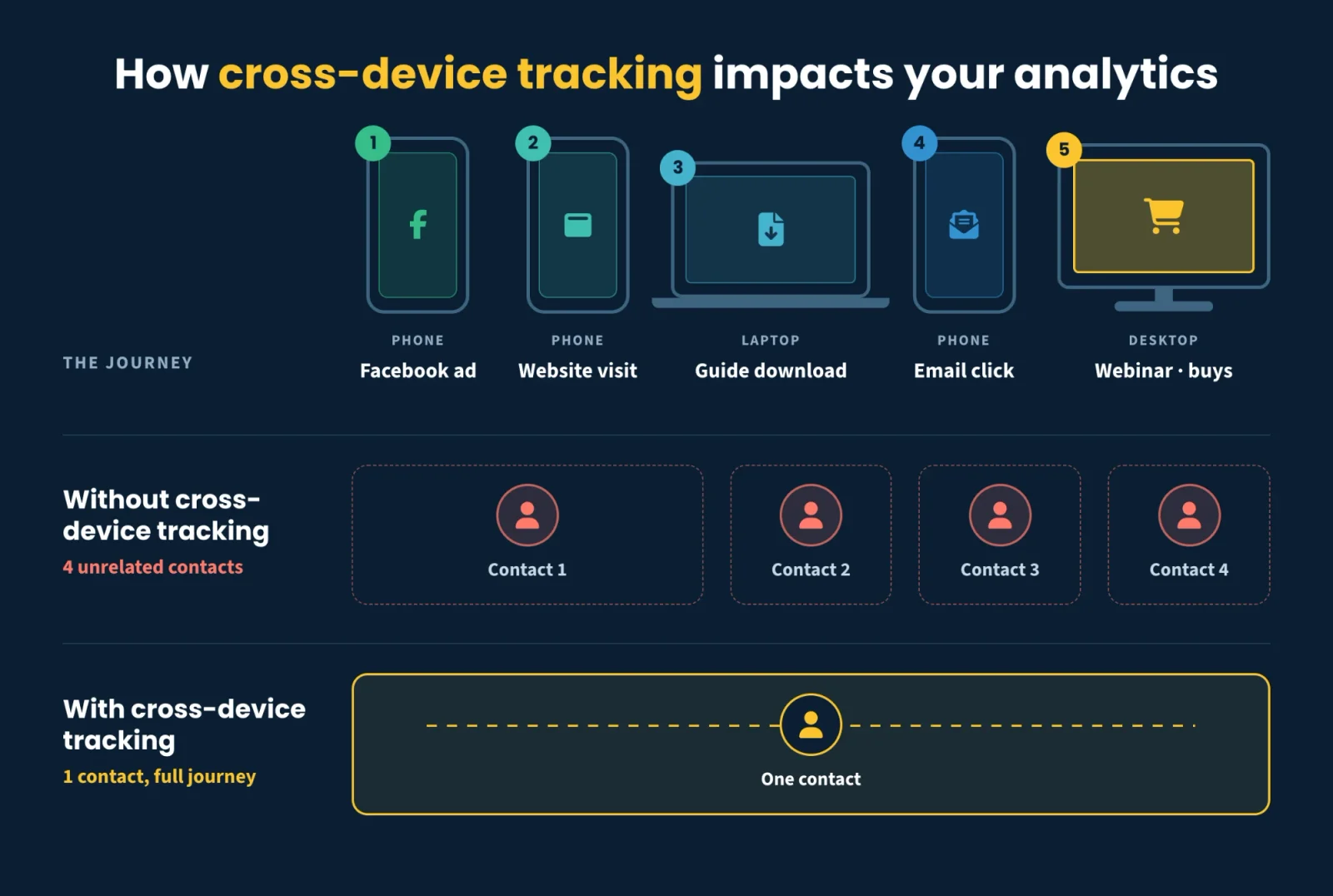
It doesn’t matter how long your attribution window is or which attribution model you select, without cross-device tracking, your attribution remains incomplete. Your analytics will be biased towards journeys that happen to be observable within the same browser, device or identity context. If you can’t see the customer journeys, no attribution model or window can save you.
These three terms sometimes get used interchangeably, but they’re distinct issues:
You can think of all three as different axes of the same “fragmented tracking” issue. Effective marketing attribution has to solve all three to provide transparent and complete customer journeys.
Identity resolution — how an attribution tool answers the “is this the same person?” question — can match separate sessions in two ways:
Deterministic matching uses a known identifier. Most of the time, this is an authenticated user ID, email address, or login. If a person logs in on both a phone and a laptop, an attribution tool can associate those sessions with the same account (provided the login and identity data are captured and passed correctly). This is generally a high-confidence, auditable approach.
It’s also why connecting your email platform and CRM to your attribution tool matters. Those systems can provide shared identifiers and conversion records that help thread anonymous sessions, known contacts, accounts, and purchases together.
However, auditable does not mean infallible. An email address is not automatically a definitive identifier. Shared household addresses, role-based addresses (like info@company.com), aliases, recycled addresses, and data-entry errors can create false matches. High-quality identity resolution therefore uses more than email addresses and documents how records are matched.
Probabilistic matching estimates whether sessions or records belong to the same person when a reliable shared identifier is unavailable or incomplete. It uses statistical models to evaluate a combination of signals — such as browser and device characteristics, IP address, timing, geography, cookies, click paths, and behavioral patterns — and estimates the likelihood that sessions or records belong to the same person.
At SegMetrics, we call our proprietary implementation Fingerprint Tracking. Our system uses nine different dimensions — email address, browser, IP address, platform integrations, custom fields, cross-domain click tracking, cookies, screen size, and geolocation — to build unified user profiles when the signals align.
The end goal is contact journeys that follow one person, click by click, across every device and marketing platform, from first touch to purchase. For example, here is the step-by-step customer journey for a user in SegMetrics (demo account):

One caveat on customer journeys if you sell to teams: The “same person” isn’t always “same buying unit,” so check whether your tool links a user’s identity to just one person or also to a whole group or account.
In summary, here’s how the two methods compare:
| Deterministic matching | Probabilistic matching | |
|---|---|---|
| What it uses | A login, user ID, or email | Browser, device, IP address, timing, behavior |
| Confidence | High and auditable | An estimated likelihood |
| Weak spot | Needs a captured identifier | Never certain |
Everything above assumes the touchpoints were actually recorded by one or more of your marketing tools. But that isn’t guaranteed, especially when ad blockers and privacy settings keep interfering with what and how much can be seen.
The solution is to stop relying solely on tracking that runs in the visitor’s browser. Server-side tracking moves some of the tracking from the user’s browser to your own server. This way your tracking data is collected on your own domain, first-party, reducing losses caused by client-side blockers and browser restrictions. (Server-side tracking does not eliminate consent requirements or guarantee that every touchpoint will be captured.)
Reliable server-side tracking also gives your tracking layer more complete data to work from. This improves the accuracy of your fingerprint tracking (and with it, your cross-device, cross-channel, and cross-platform tracking).
The following are signs that your cross-device (and cross-platform) tracking has gaps which may be hurting the accuracy of your analytics.
If one or two of these sound familiar, a real chunk of your funnel is invisible. That means you’re making strategic and budget decisions on incomplete (and potentially incorrect) data.
What is cross-device attribution? Cross-device attribution measures how marketing touchpoints on different devices contribute to a conversion. For example, the phone where someone first saw your ad and the laptop where they bought. It depends on cross-device tracking, which identifies which phone, tablet, and computer sessions belong to the same person or account. Tracking connects the journey. Attribution assigns credit within it.
What is cross-device tracking? Cross-device tracking is the identity layer underneath cross-device attribution. It works out which phone, tablet, and computer sessions belong to the same person, then combines them into a single profile and one customer journey. It matches sessions deterministically (through a known login or email) or probabilistically (through signals like browser, IP address, and behavior).
Why does cross-device tracking break? Because a cookie lives in one browser on one device, it can’t track a user across multiple devices. A cookie set on your phone can’t be read on your laptop. So when someone switches devices, standard tracking sees a new stranger. Privacy defaults widen the gap.
What is the difference between deterministic and probabilistic matching? Deterministic matching links sessions through a known identifier, such as a login, user ID, or email address. It is high-confidence and auditable, but only works when that identifier is captured. Probabilistic matching estimates whether sessions belong to the same person from signals such as browser, device, IP address, timing, and behavior. It fills the gaps when no shared identifier exists, but its matches are likelihoods, not certainties.
Are cookies going away? Not in Chrome. Google reversed its plan to remove third-party cookies in 2025, and they remain on by default. But that doesn’t fix cross-device tracking, which never worked across devices in the first place. Safari and Firefox still restrict cookies heavily.
How does cross-device attribution work? In two layers. First, cross-device tracking links a person’s sessions across devices. It can do this deterministically (through a known login or email) or probabilistically (through fingerprinting when no login exists). Then an attribution model assigns credit across those linked touches. The attribution is only as reliable as the tracking beneath it.
The fact is your buyers move across multiple devices before they purchase. If your tracking can’t follow them, you don’t have an accurate view of how your marketing is working. And without that, you’re just guessing about what’s driving revenue — and what’s wasting money.
Start your free 14-day trial of SegMetrics and see the full customer journeys you’re currently missing, stitched back into one view.
New here? Start with our complete guide to marketing attribution. And this introduction to what marketing attribution is.

Keith is the Founder of SegMetrics, and has spent the last decade working on optimizing marketing funnels and nurture campaigns. SegMetrics was born out of a frustration with how impossibly hard it is to pull trustworthy, complete and actionable data out of his client’s marketing tools.
When it comes to marketing, the analysis of each touchpoint leading up to a purchase is essential. Funnel attribution, which,…

Ad Tracking, Tracking & Reporting
What an attribution window is, how it differs from a lookback window, what each ad platform's default actually is, and why a short window quietly hides your best-performing ads.

Google finally throws in the towel on their plans for a one-click prompt to disable tracking cookies. What does it mean for you?

Start your 14-day free trial of SegMetrics today!