
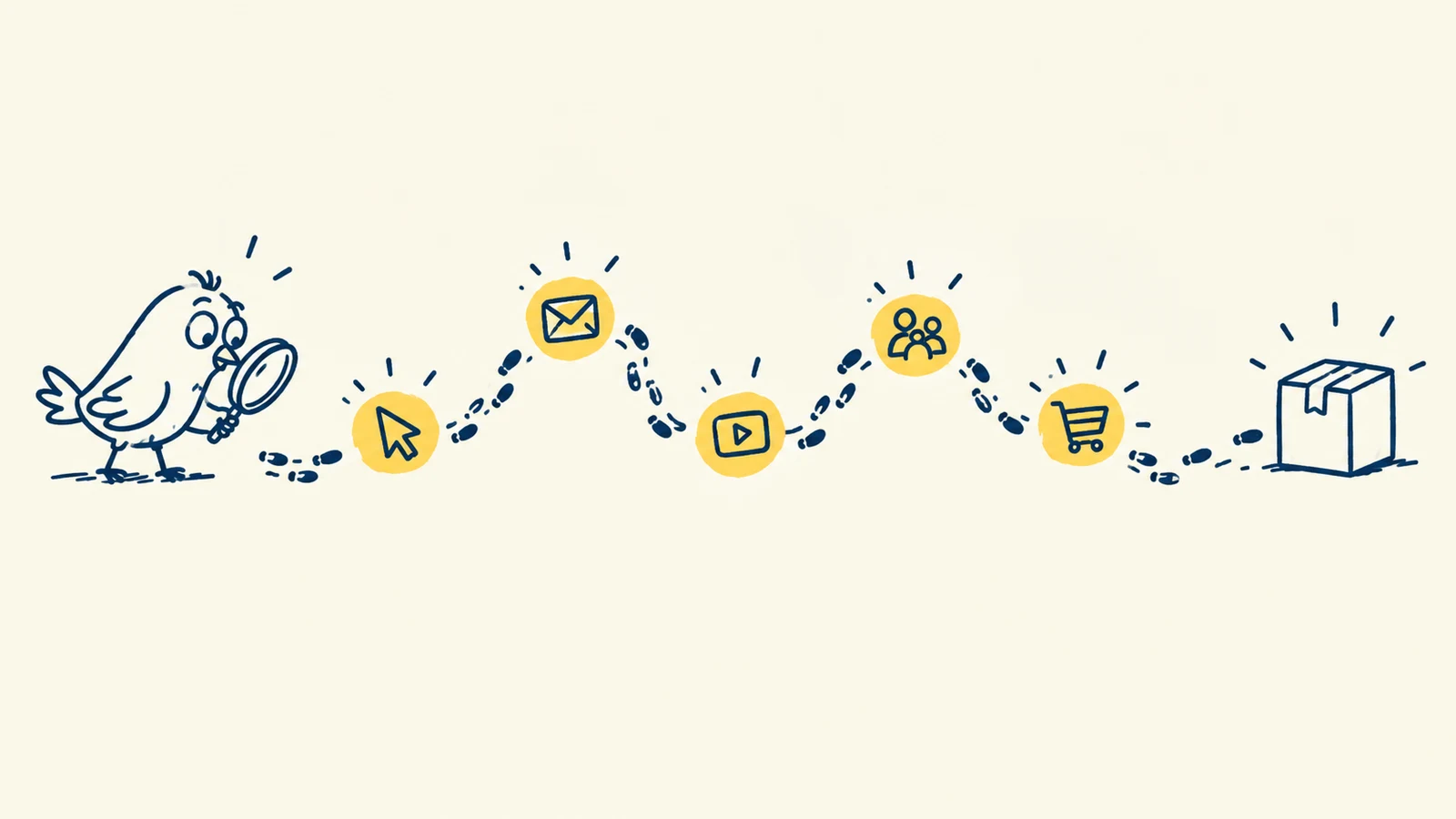
What is marketing attribution? (And why does it matter?)
Marketing attribution, explained without the jargon. Learn what attribution is, how it works, and why most marketers (and AI) get it wrong.

Marketing Attribution 101
What marketing attribution is, how the models and windows actually work, and how to track what's really driving your revenue (no matter how long or complicated your funnel).
Marketing attribution is the practice of connecting each sale back to all of the marketing touchpoints that helped cause it. These touchpoints stretch from the very first trackable connection, through the whole customer journey, to the final purchase. With these connections made, credit can be assigned to the channels, campaigns, and messages that moved people to buy, so you can see what's actually driving revenue instead of what's just driving clicks.
That’s the whole idea.
What’s hard is tracking customers when they touch your marketing across multiple devices, across different platforms that don’t speak the same language, and may take weeks or months or years before they ever pull out a credit card.
This guide walks you through the nuts-and-bolts of marketing attribution:
Just want a quick explainer? SegMetrics founder breaks down the fundamentals of marketing attribution in this 90-second explainer video.
At its simplest, marketing attribution answers one question: What caused someone to buy?
This used to be easy. People had one device, they came from one place, and they did one thing. Click an ad → Land on your page → buy. Very clear what marketing touchpoints drove the sale here.
But now, it’s not so clear.
A single person sees your ad on their phone at home, then walks outside and their IP address changes. They forget about you for a week, then come back on their laptop through a Google search. Add in an email they opened, a blog post they read, and a webinar they half-watched, and you’ve got a tangled web of touchpoints that may — or may not — have contributed to the sale.
Marketing attribution is how you make sense of this tangled web. It’s a tool that de-tangles this web and lets you ask very specific questions about your marketing … and get data-driven answers. With accurate marketing attribution and the right questions, you can see where to invest more marketing dollars and bandwidth. With bad or no attribution, you’re just guessing about what is and isn’t working.
New to marketing attribution? Start with our plain English breakdown of what marketing attribution is.
Most marketing analytics just reviews data inside all of your marketing tools. So your Facebook Ad Manager, your Google Ad Manager, your email platform data, your Google Analytics data.
But there are two big problems with this approach:
TOFU Blindness – Most of this data stops at the top of the funnel. It covers impressions and clicks and opens, but that's where the tracking stops. And because this approach doesn't link your marketing touchpoints to actual revenue – especially long-tail revenue – you can't tell what's driving sales vs just driving clicks.
Messy Marketing Data – When you combine marketing data across different tools, you're going to discover a lot of duplicates. Raw marketing data is fragmented and very messy. This is why robust marketing attribution tools like SegMetrics first normalize all your data before analyzing it. (This is also why dumping raw marketing data into an AI tool like ChatGPT or Claude doesn't replace [marketing attribution software](/articles/why-use-marketing-attribution-software-when-ai-can-just-pull-my-data/) – even if you have MCP Servers – because you still need a tool that can collect, clean, and organize all your marketing data. AI can't do this.)
Marketing attribution gives you a single source of truth for all your marketing data, from the top to the bottom of your funnel.
Attribution sounds abstract until you break it into its distinct parts.
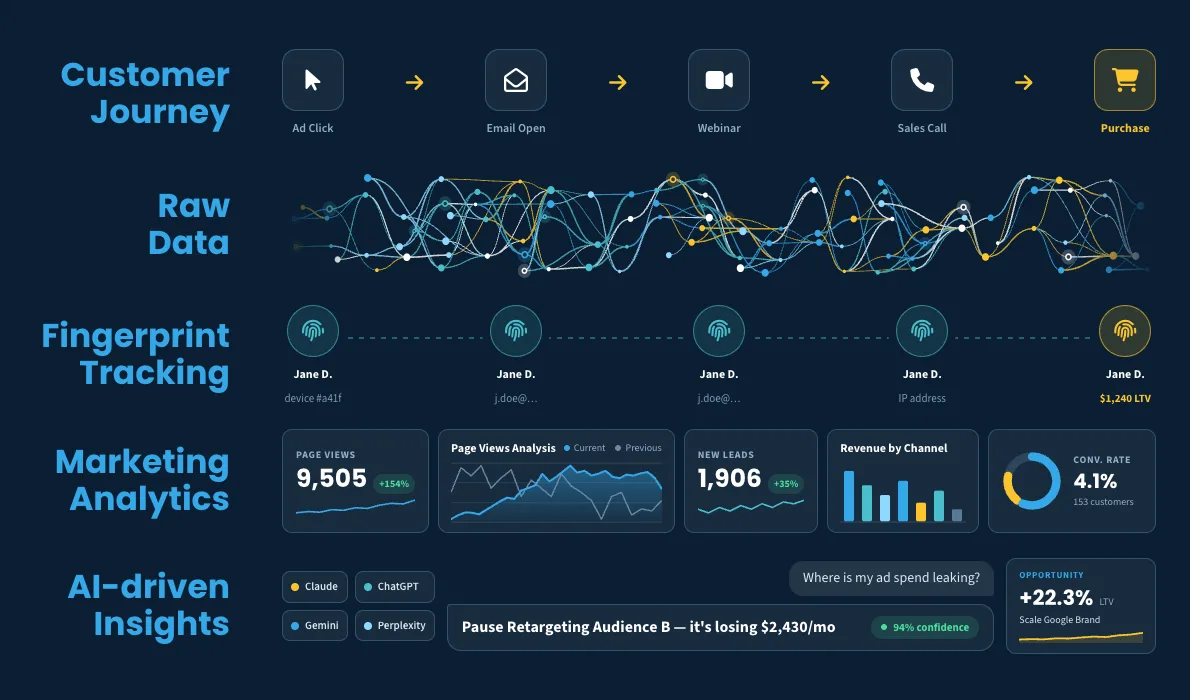
Preceding every conversion is a sequence of touches that led up to it. An ad click. A blog visit. An email open. A webinar registration. A sales call. This applies to prospects, too. Every visitor goes through a series of marketing touchpoints over time. Some visit once and never come back. Some go through convoluted journeys over months. And some of those journeys end in sales.
To create a model of every visitor’s unique customer journey — complete with links, timestamps, tags and other useful details — you need to capture first-party (server-side) data from your own site, as well as import data from all of your marketing tools. UTM parameters (little tags in your links that help link different touchpoints) also help with this.
The problem is that this layer is leaky and messy. Cookies are tied to a single browser on a single device. Ad blockers can strip tracking entirely. Privacy changes shorten how long a cookie survives. Put it together and over half your traffic can vanish from cross-device and ad-blocker gaps. That’s most of your data walking out the door. On top of this, different tools structure and label data in different ways which makes it hard to quickly link data from one platform to another. This is why robust cross-device attribution is so critical.
To recreate the customer journey, you need to be able to identify visitors when they show up across platforms, across devices, over time, and without relying on ineffective cookies.
This is called fingerprint tracking. For example, SegMetrics uses nine dimensions to track users across platforms, divisions and sessions:
The result is Contact Journey Reporting that follows every visitor, step-by-step.
Of course, just having clean customer journey data is only an intermediate step. Once you have all of this attribution data, then you need to analyze it. Most marketing attribution tools also include analytics suites that include reporting, dashboards, alerts and metric notifications, filtering and segmentation, data analysis tools, and data visualization options.
Some marketing attribution tools now include AI-driven, data-informed recommendations via AI connectors. SegMetrics AI is one example.
As discussed, LLMs like ChatGPT and Claude cannot normalize, organize and analyze your raw marketing data, even with MCP Server connections to your marketing tools. But when you connect your AI to a marketing attribution tool that can feed it only the complete and accurate data it needs to answer your questions, then you can leverage AI’s analytics abilities to find opportunities and problems hidden inside your marketing data.
To understand marketing attribution, it helps to see the dirty little secret behind most marketing platforms’ data.
Every platform grades its own homework.
Take Meta’s Ad Manager. It measures its own performance. Naturally, Meta is motivated to claim as much credit as possible so Meta ads will appear to deliver higher ROAS and warrant increased ad budgets. If the first thing and last thing a customer sees before buying is a Google ad…but happens to see a Facebook ad in the middle, Meta will still claim credit for this sale. The same is true of Google.
If you run ads across multiple ad platforms, something absurd happens. A single sale can get claimed by all of the ad platforms. That looks like three sales in your data, but only one in your payment processor. This is a major reason why ad platform sales NEVER line up with the actual, verifiable sales in your payment processor. It’s also why you need a neutral, independent, marketing attribution tool that isn’t financially motivated to overclaim and can serve as your single source of truth.
An attribution model is just a rule for how you split credit across all of the marketing touchpoints that led up to it. For example, does the first or last touchpoint get the most credit? What about all the steps in-between?
The key to mastering attribution models is understanding what questions each model helps you answer.
Here are the six main attribution models. (For the full breakdown with examples and the credit math for each, check out our complete guide to attribution models.)
| Attribution Model | How it assigns credit | Best when you want to know… |
|---|---|---|
| First-touch | 100% to the first touchpoint | Where your best leads come from |
| Last-touch | 100% to the last meaningful touch | What tips people over into buying |
| Linear | Evenly across every touch | The whole path, weighted equally |
| Time-decay | More credit to touches nearer the sale | Which recent touches close deals |
| Position-based (U-shaped) | Most to first and last, rest to the middle | Both discovery and closing |
| W-shaped | First, last, and a key middle milestone weighted heavily | Discovery, lead creation, and closing |
Before you get overwhelmed, know that most businesses don’t need all six. In my experience, you really only need three to answer the three most important questions:
Nail those three and you’ve covered 99% of what attribution is actually for.
Multi-touch attribution models that chop single people into fractions can be powerful at a massive scale (think, major enterprises), but that type of data is essentially noise for everyone else. As we like to ask: what decision are you going to make from it? If the answer is "none," the juice isn't worth the squeeze.
Two marketers can look at the same campaign and reach opposite conclusions — because one used a 7-day attribution window and the other used 90.
An attribution window (also called a lookback window or conversion window) is the length of time a marketing touchpoint in your funnel can still get credit for a conversion.
For example, let’s look at a customer who reaches you from Google Ads. If you’re using a 30-day attribution window but your customer bought on day 35, then Google will assume that lead never purchased. Some attribution windows are even smaller. Meta’s default attribution window is 7 days.
This has a major impact on how you measure the success of your advertising and marketing campaigns. You may turn off winning campaigns that are driving revenue while optimizing others with faster, but lower, results.
The solution is marketing attribution that provides lifetime attribution. This is tracking across the full-length of a lead or prospect’s relationship with your company, even if that stretches over months.
Most attribution tools provide automated offline conversions feedback back to your ad platforms. This gives your ad platforms complete and accurate conversion data that they can use to improve their AI targeting and attract more customers like the ones you already have.
If you’re shopping for marketing attribution tools, you’ll want to make sure that the platform you select checks all of these boxes:
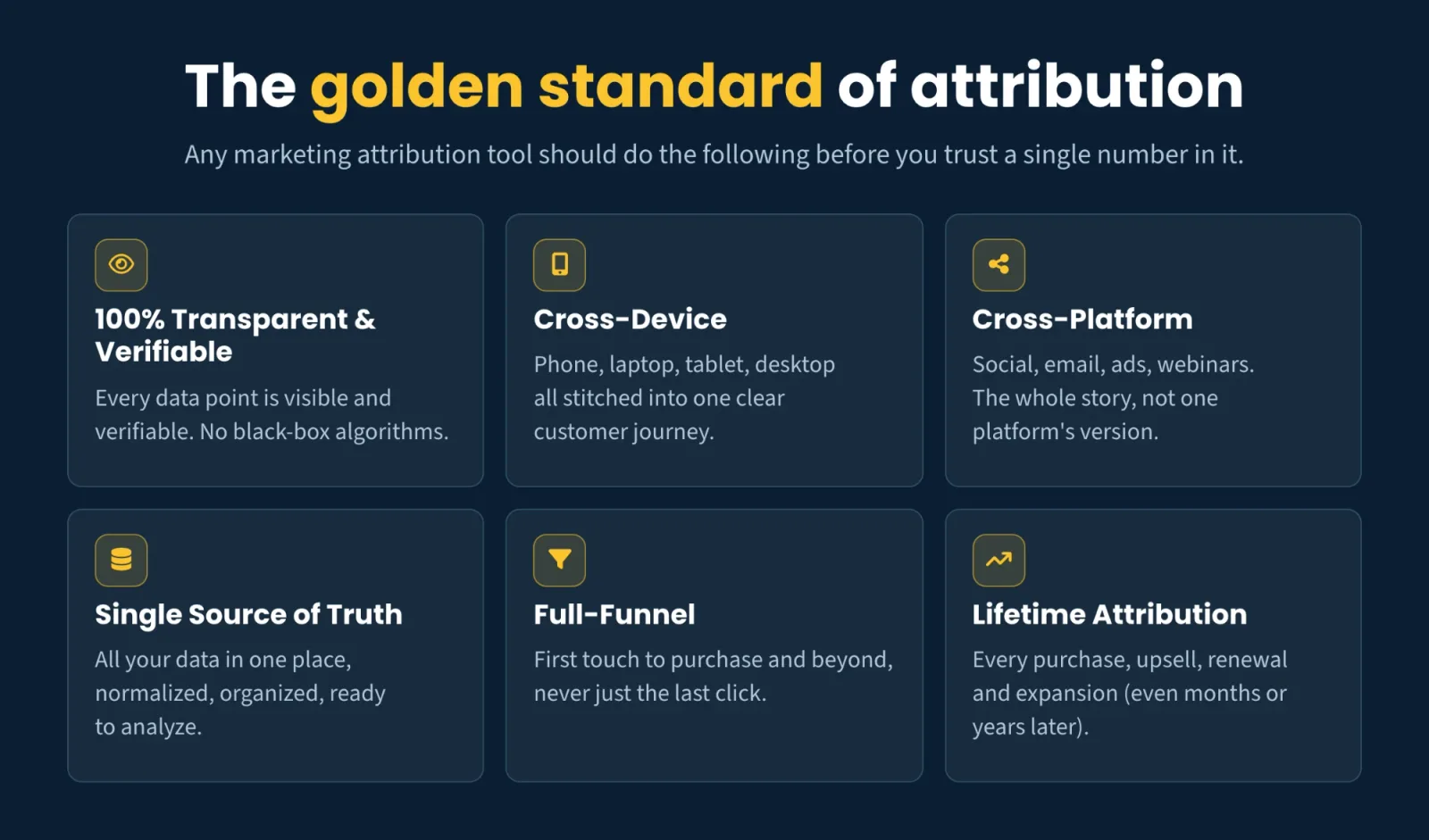
100% transparent and verifiable. No black box algorithms. A good tool lets you see all the data and makes it easy to verify.
Cross-device. Your customer sees your ad on their phone, clicks through on their laptop, buys on their tablet. Your tool needs to track all of it as one person, one journey.
Cross-platform. Likewise, your customer sees your Instagram post, gets your email, clicks a Facebook ad, and finally converts after a webinar. Your tool needs to see the whole story, not just what one platform wants to take credit for.
Single source of truth. Data spread across five different tools gives you five incomplete versions of the truth. That’s not helpful. You need all your data in one place, normalized and organized and ready to analyze.
Full-funnel. Your tool needs to follow every visitor from the first time they hear about you to the moment they buy…and after. You’re tracking the entire customer journey, not just the last click.
Lifetime attribution. This is the big one. You’re not just tracking their first purchase. You’re seeing every upsell, every renewal, every expansion. Even when they happen months or years later. Your tool should give you the actual lifetime value of each touchpoint and traffic source in your funnel.
This is what real attribution looks like. When you have all this, then your data becomes actionable.
Most marketing attribution failures stem from a shortlist of common mistakes and omissions. Knowing what these mistakes are makes it easier to avoid them in your own marketing.
What do these mistakes have in common?
They’re all shortcuts. Everyone hopes to avoid the step of setting up and using real marketing attribution in order to save a little time. However, marketing attribution is much easier to institute than most people realize.
There are many marketing attribution tools built for small-to-mid-sized businesses who don’t have an in-house data team to setup and run their attribution system. You don’t need to be a data scientist or have experience with marketing data to start using marketing attribution.
Here is a quick overview of the process of setting up and using marketing attribution:
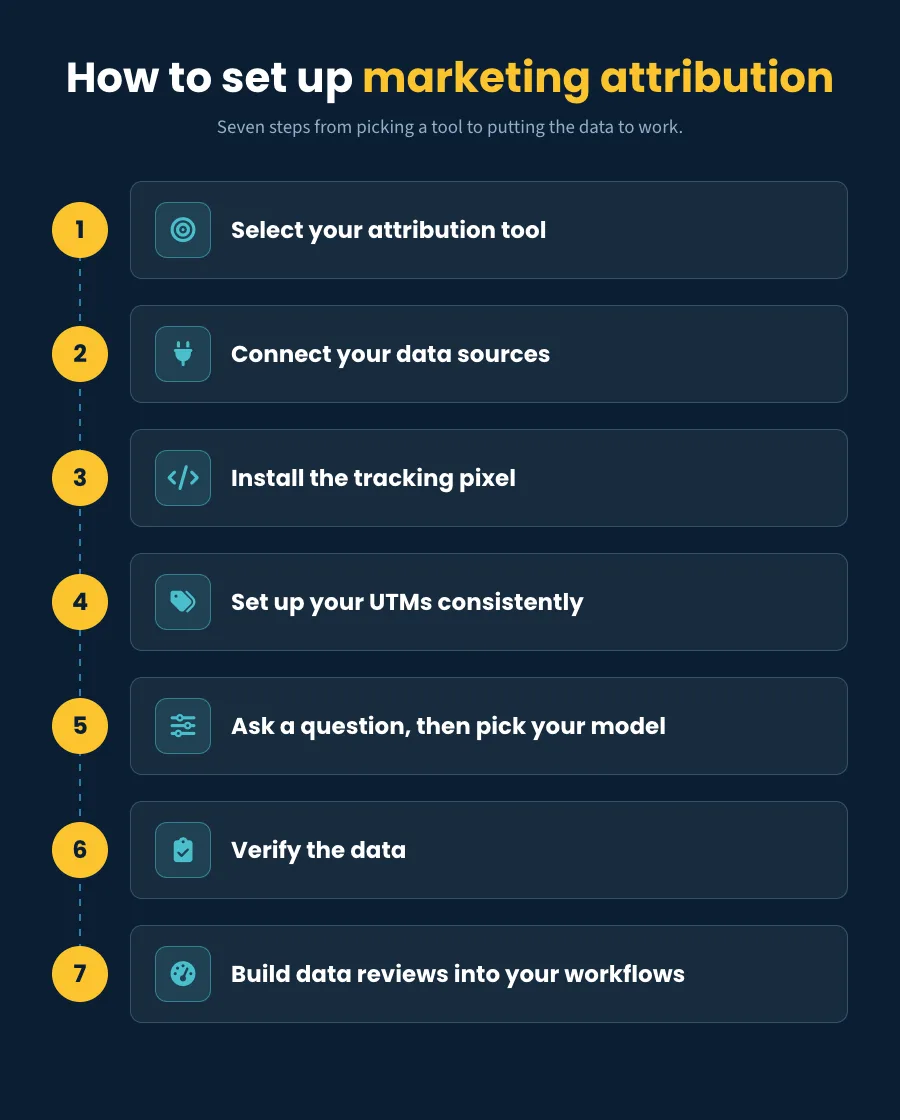
All of this is easier than many expect. You can complete all of these steps during SegMetrics' 14-day free trial and see for yourself the kind of opportunities, fixes and insights that proper marketing attribution can reveal.
What is marketing attribution? Marketing attribution is the practice of connecting each sale back to the marketing touchpoints that helped cause it. These touchpoints can be anywhere in the customer journey, from first click to the final purchase. Marketing attribution lets you assign credit to channels, campaigns, creative, and activities so you can see what marketing actions are actually driving revenue.
What types of questions can marketing attribution answer? The important ones. Which channel brings in my best customers? Which email or webinar drives revenue? Where are leads dropping off? What tipped this buyer over the line? Attribution turns “I think our ads are working” into “Facebook brings the leads, but Google warms them up and the webinar closes them.” If a report can’t answer a question you’d act on, it isn’t doing its job.
Why is attribution important in digital marketing? Because the click is just the beginning. Most tools track top of funnel metrics like clicks, opens and impressions. But your revenue happens downstream (often months later). Without proper marketing attribution, the lead who becomes a $2,000 customer looks identical to the one who never buys, and you can’t tell which campaigns are worth scaling.
What are the different attribution models? The six main models are first-touch, last-touch, linear, time-decay, position-based (U-shaped), and W-shaped. Single-touch models give all the credit to one touchpoint; multi-touch models split it across several. Most businesses only need three views: first-touch, last-touch, and linear (full-funnel).
What’s the best attribution model? There’s no single best model. The right attribution model depends on the question you’re asking. Use first-touch to learn where leads come from, last-touch to learn what closes them, and full-funnel to see what influenced them along the way.
What is an attribution window? An attribution window (or lookback window) is how long a touchpoint can still get credit for a conversion. Different marketing tools have different attribution windows, but they are all generally short due to technical limitations and privacy rules. Marketing attribution solves this issue with fingerprint tracking that unlocks lifetime attribution.
Why don’t Facebook, Google, and my payment processor agree? Because every ad platform grades its own homework and is motivated to claim credit for any sale they even barely touched. This is why if you run ads across several ad platforms, a single sale can get counted multiple times. A neutral, third-party source of truth reconciles the overlap so you’re not paying for the same conversion three times.
How accurate is marketing attribution? Your marketing attribution is as accurate as it is verifiable. Good attribution data passes three tests: it’s accurate (you can click a number and see the real people behind it), accessible (fast and easy to pull), and actionable (it tells you what to change). If you can’t verify a number, don’t trust it.
Marketing attribution, explained without the jargon. Learn what attribution is, how it works, and why most marketers (and AI) get it wrong.

Ad Tracking, Tracking & Reporting
What an attribution window is, how it differs from a lookback window, what each ad platform's default actually is, and why a short window quietly hides your best-performing ads.

In this premier episode of Happy Hour Analytics, Keith and Scott break down the good, bad and ugly of the most popular attribution models

You've got the map. The next step is turning it on for your own funnel.