The best AI marketing tools in 2026 are Claude and ChatGPT for writing, Surfer SEO and Ahrefs for search, Perplexity for research, Descript and Predis.ai for video and social, AdCreative.ai and Albert.ai for paid ads, HubSpot and ActiveCampaign for automation, and SegMetrics for attribution. No single tool does it all well. The strongest teams pick one specialist per job and connect them to shared revenue data.
Why it matters: That last part matters more than most guides admit. AI tools for marketing can write, design, and optimize. They cannot tell you which of those efforts made money unless you give them the data.
Ties every lead and sale to its source, and feeds that data to your AI
How Should You Choose AI Marketing Tools?
Recommendation: Start with the job, not the tool. Ask what task eats the most hours or loses the most money. Then find the specialist that solves it.
All-in-one platforms are tempting. One login. One bill. But broad tools tend to do many things at an average level. A specialist built for one job usually does that job far better.
Use four questions to judge any marketing AI tool:
Does it save real time on a task you do every week? A tool you use once a quarter is not worth the learning curve.
Does it connect to your data? AI is only as smart as what it can see. A tool that reads your CRM, ad accounts, or analytics beats one that works blind.
Can you check its work? Look for citations, previews, and approval steps. AI makes mistakes. You need to catch them before customers do.
Can you measure its impact on revenue? If you cannot tie a tool’s output to leads and sales, you are guessing at its value.
The fourth question is where most stacks break. We’ll come back to it.
What Are the Best AI Content Marketing Tools?
Claude
Claude, made by Anthropic, is the top pick for many marketers who write long-form content. It produces prose that sounds human. It follows style guides closely. It handles nuance well, which matters for positioning work and thought leadership.
Projects let you store brand guidelines, product docs, and past content in one workspace, so every chat starts with context. Artifacts let you build and edit documents, landing page drafts, and simple tools right in the chat.
Claude also connects to outside tools through the Model Context Protocol (MCP). That means it can pull live data from your CRM, analytics, or project tools instead of relying on what you paste in.
Best for: Blog posts, AEO articles, email sequences, sales pages, positioning, and brainstorming.
ChatGPT
ChatGPT, from OpenAI, is the most widely used AI assistant. Its strength is range. It writes, analyzes files, generates images, browses the web, and runs custom GPTs built for specific tasks.
Many marketers use both. They draft and refine in Claude, then use ChatGPT for image generation or quick data work. Others build custom GPTs for repeat tasks like ad variations or social captions.
Best for: Mixed workloads, image generation, and teams that want one assistant for many jobs.
Jasper
Jasper is built for marketing teams, not individuals. Its core strength is control. Brand Voice settings, style rules, and approved knowledge keep output consistent across many writers and campaigns.
Jasper includes templates for ads, blog posts, product descriptions, and common copy frameworks. It suits larger teams that publish a high volume of content and need guardrails.
Best for: Enterprise and mid-market teams with strict brand standards.
What Are the Best AI Tools for SEO and AEO?
Search has split in two. Classic SEO gets you ranked in Google’s blue links. Answer engine optimization (AEO) gets you cited inside AI answers from ChatGPT, Perplexity, Claude, and Google’s AI Mode. You need tools for both.
Surfer SEO
Surfer analyzes the pages that rank for your target keyword. It then scores your draft as you write. It flags missing terms, suggests headings, and recommends length and structure.
It plugs into Google Docs and WordPress, so writers can optimize without leaving their editor. Surfer works best as a final pass on a draft, not as the writer itself.
Best for: Content teams that publish to rank in traditional search.
Ahrefs
Ahrefs is the standard for keyword research, backlink analysis, and competitor tracking. It now goes further. Its Brand Radar tracks how often your brand shows up in AI-generated answers, which pages AI tools cite, and how your share of voice compares to competitors.
That makes Ahrefs one of the few tools that measures AEO directly. You can see which questions trigger AI answers in your category and whether you appear.
Best for: SEO strategy, competitive research, and tracking AI search visibility.
Manifold MCP (the Cheapest Ahrefs and Semrush Alternative)
Manifold hosts its server at mcp.manifoldmcp.com/mcp. It connects with OAuth or an API key and works in Claude, ChatGPT, and Cursor.
It covers rankings, keyword research, backlinks, and traffic estimates. It also tracks how ChatGPT, Claude, Gemini, Perplexity, and AI Overviews mention your brand and which pages they cite. On top of that it pulls posts and comments from TikTok, Instagram, YouTube, LinkedIn, and Reddit, plus competitors’ live ads.
Why it matters: The difference is price. It has a generous free tier, and paid plans start from $20 per month. Ahrefs starts at $129 and Semrush at $139.
How Do You Optimize Content for AI Answers?
AI engines pull from content that answers questions fast and clearly. A few habits help:
Put a direct answer in the first two or three sentences.
Use headers phrased as real questions people ask.
Include comparison tables and clear lists.
Name specific tools, numbers, and facts.
Add an FAQ section with schema markup.
Publish original data that no one else has.
Pro Tip: Original data is the biggest lever. AI tools cite sources that add something new. A rewrite of what already ranks gives them no reason to pick you.
What Are the Best AI Tools for Market Research and Competitive Analysis?
Perplexity
Perplexity is an AI search engine. You ask a question. It searches the web and returns an answer with citations for each claim. You can click through and check every source.
Marketers use it to size markets, scan competitor messaging, gather stats for content, and check facts. It replaces hours of tab-hopping with a few minutes of reading.
Best for: Fast research where you need to verify sources.
Claude and ChatGPT Research Modes
Both Claude and ChatGPT offer deep research features. They run many searches, read dozens of pages, and write a structured report. These take longer than Perplexity but go deeper. Use them for competitive landscapes, buyer research, and category analysis.
Call Transcription and Analysis
The research tool most teams overlook is their own customer calls. Tools like Grain, and models like OpenAI’s Whisper, turn sales and support calls into searchable transcripts. Feed those to Claude or ChatGPT and you can pull objections, phrases customers use, and feature requests across hundreds of conversations.
Why it matters: This is boring work. It is also some of the highest-value AI work a marketer can do. Your customers’ own words beat any keyword tool for writing copy that converts.
Best for: Messaging, positioning, and finding content topics your buyers actually care about.
What Are the Best AI Tools for Social Media Marketing?
Predis.ai
Predis.ai creates social content from a single prompt. Describe a product or idea and it produces captions, graphics, carousels, and short videos. It includes a scheduler and publishes to multiple channels from one dashboard.
It works well for small teams and solo marketers who need a steady stream of posts without a designer.
Best for: High-volume social posting on a small budget.
Descript
Descript lets you edit audio and video by editing a text transcript. Delete a sentence in the text and it disappears from the video. Remove filler words with one click. Studio Sound cleans up background noise. Overdub can clone your voice to fix small mistakes without re-recording.
Descript is a strong tool for repurposing. Record one podcast or webinar. Cut it into clips, social videos, and blog material.
Best for: Podcasters, course creators, and anyone turning long video into short content.
Canva
Canva’s Magic Studio adds AI design tools to the platform most marketers already use. It can generate images, resize designs for every channel, write copy, and apply brand kits. If your team lives in Canva, its AI features are the easiest win.
Best for: On-brand graphics for teams without a full-time designer.
What Are the Best AI Tools for Paid Advertising?
AdCreative.ai
AdCreative.ai generates large batches of ad creatives and scores each one with a prediction model trained on ad performance. You get banners, social ads, and copy variations in minutes. It connects to Meta, Google, and LinkedIn ad accounts.
The value is speed of testing. More variations means you find winners faster.
Best for: Performance marketers who test creative at scale.
Albert.ai
Albert is an autonomous AI that runs digital ad campaigns. It manages bids, shifts budgets across channels, and tests audiences around the clock. It suits larger advertisers with complex, multi-channel spend.
Best for: Enterprise teams with large cross-channel budgets.
Limitations: There’s a catch. Each platform grades its own homework. Meta credits Meta. Google credits Google. Both claim the same sale. If you add up what each platform reports, you will often count more revenue than you actually earned. You need an outside source of truth to know which platform really drove the sale.
What Are the Best AI Email Marketing and Automation Tools?
HubSpot Marketing Hub
HubSpot builds AI into its CRM and marketing tools. It can draft emails, build workflows, score leads, summarize records, and help predict churn. Because it all sits on one customer database, the AI sees the full contact history.
Best for: Mid-size and growing teams that want CRM and marketing in one system.
ActiveCampaign
ActiveCampaign offers deep email automation at a price small businesses can manage. Its AI features help write emails, suggest automations, and segment contacts. It is popular with course creators, coaches, and ecommerce brands that run complex funnels.
Best for: Small teams with advanced automation needs.
Zapier
Zapier connects thousands of apps. Its AI features let you build automations by describing them in plain English. It also offers an MCP server, so AI assistants like Claude can trigger actions across your other tools.
Best for: Gluing your stack together without code.
What Are the Best AI Marketing Analytics and Attribution Tools?
This is the category most “best AI marketing tools” lists skip. It is also the one that decides whether the rest of your stack is working.
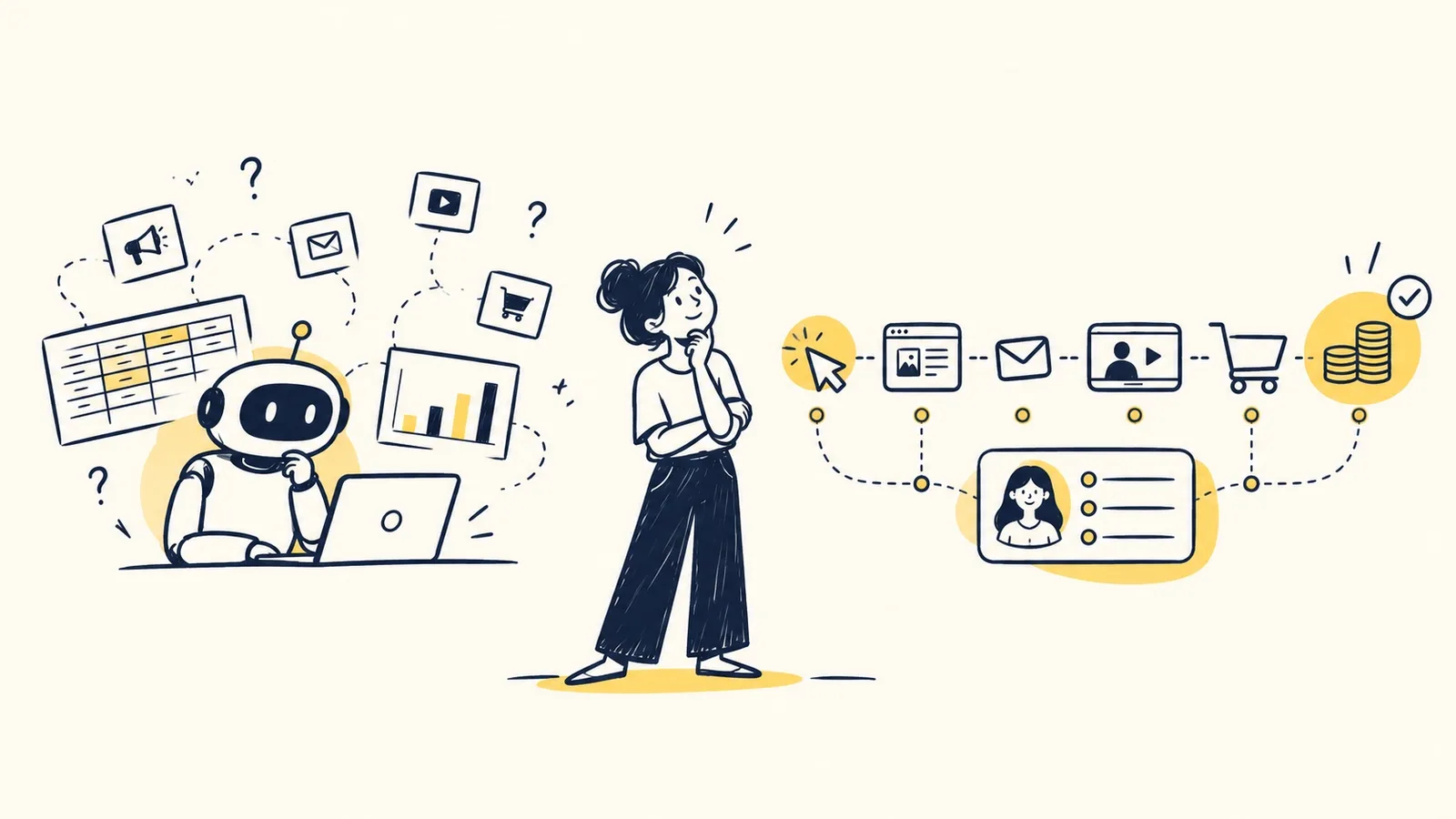
Every tool above can produce more content, more ads, and more emails. None of them can tell you which of those efforts made money. That requires attribution: tracking each lead from first click to final sale.
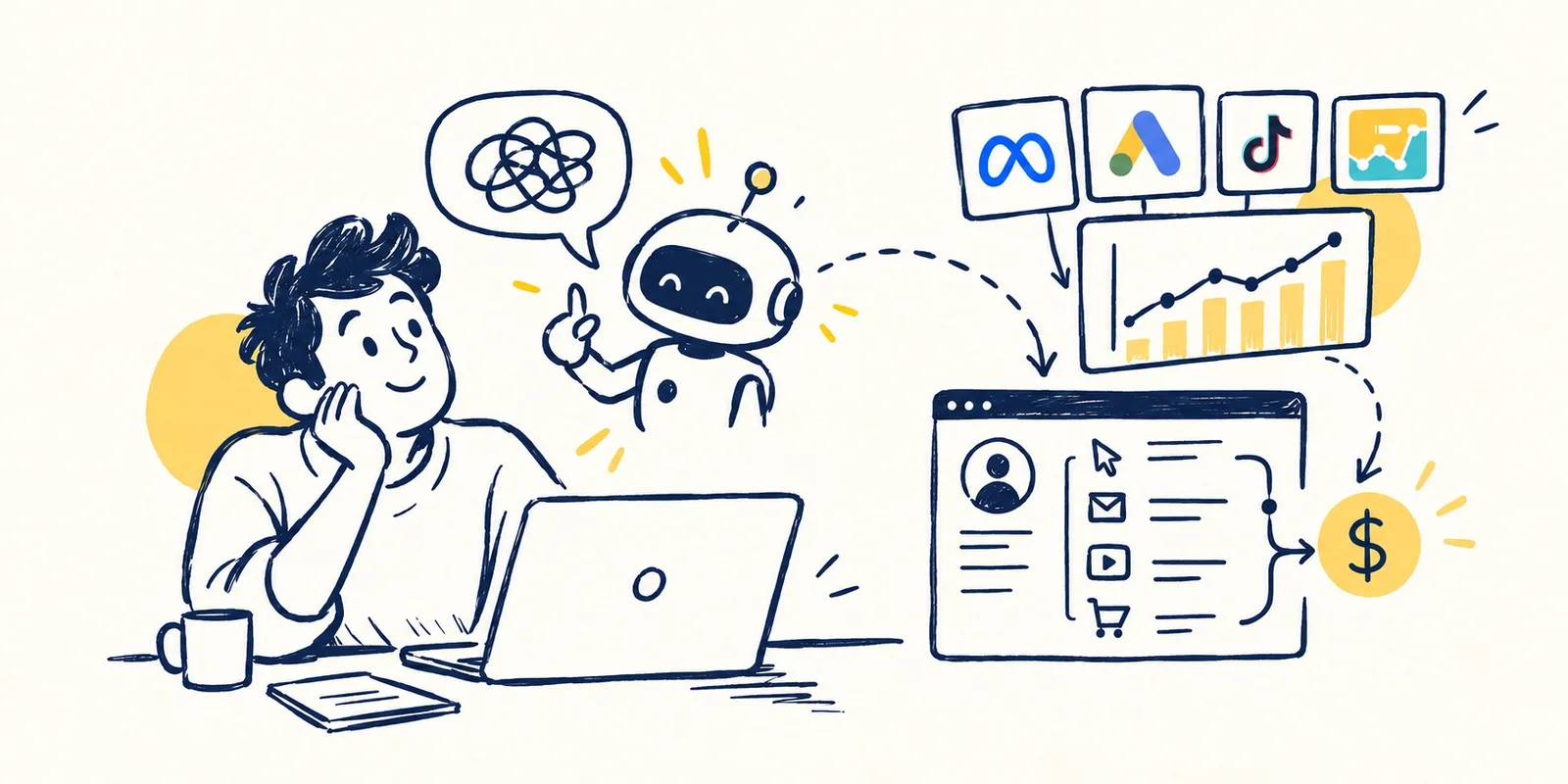
Why it matters: AI can reason about your marketing. It cannot remember the click. Ask ChatGPT or Claude which campaign drove your best customers and it has nothing to go on. It never saw the ad click, the opt-in, the email open, or the purchase. Without that history, AI analysis is a guess dressed up as an answer.
SegMetrics
Full disclosure: we make SegMetrics. Here is what it does and where it fits.
SegMetrics is a marketing attribution and analytics platform. It connects your ad platforms, CRM, email tool, and payment processor. It then tracks every lead across every touchpoint, from first visit to purchase and beyond. You see which ads, emails, funnels, and channels produce revenue, not just clicks.
Two features make it an AI tool in its own right:
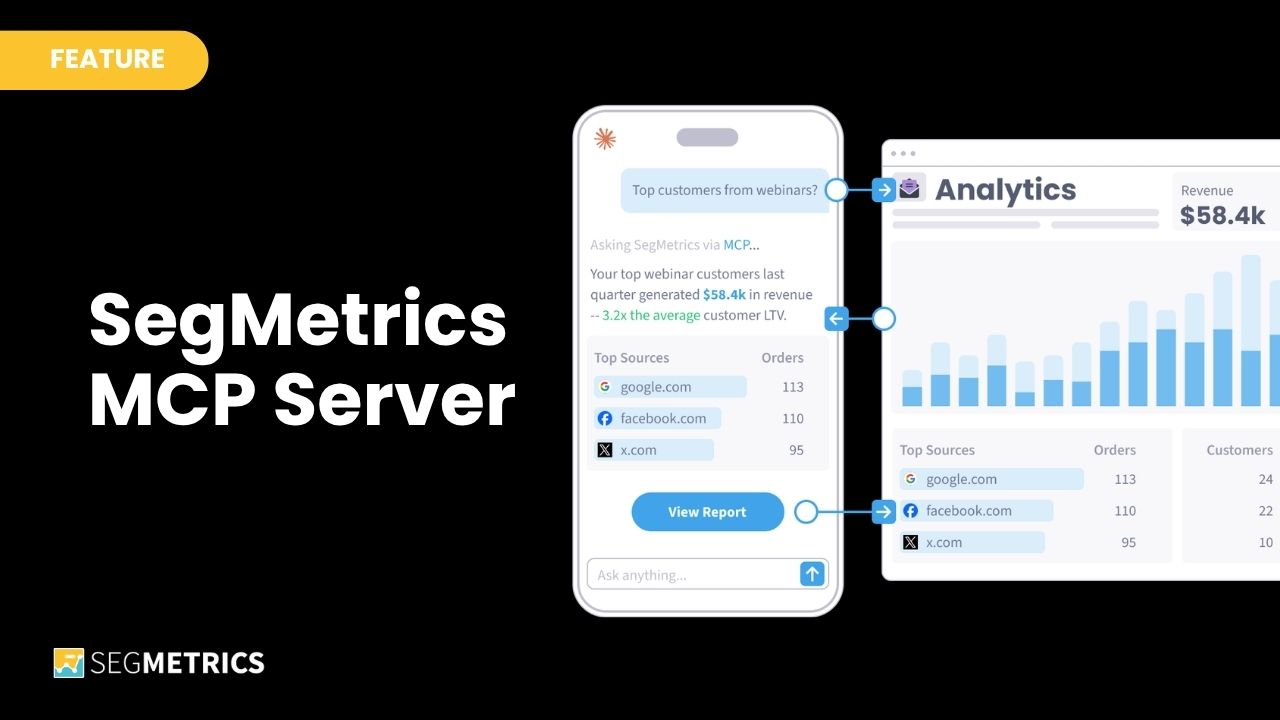
The SegMetrics MCP server connects your attribution data to AI assistants like Claude. You can ask plain-English questions such as “Which traffic source brought in the highest-value customers last quarter?” and get answers grounded in your real data.
SegMetrics AI Builder (in beta) builds SegMetrics reports from natural-language requests. Describe the report you want and it builds it.
The result: your AI assistant stops guessing. It reasons over the actual path each customer took.
Pro Tip: Not sure what to ask your AI about your marketing? The AI Marketing Analyst Prompt Pack gives you ready-to-use prompts for ChatGPT and Claude, pulled from our library of 174 attribution prompts. Each one is graded by how well AI can answer it from a basic data export. You’ll see which questions your AI can handle today, and which ones need real attribution data to get right. Get the free prompt pack.
Best for: Course creators, coaches, agencies, and digital marketers who need to know which marketing produces revenue, and who want their AI tools to know it too.
GA4 is free and widely used. It includes some AI-driven insights and predictive metrics. It tracks website behavior well. It struggles to connect that behavior to revenue that happens later, in a CRM or payment system, especially for businesses with long sales cycles or recurring payments. We cover the gaps in detail in Sick of GA4?
Best for: Website traffic analysis and teams just getting started.
What Are the Best AI Marketing Tools for Small Business?
You do not need twelve tools. Most small teams can cover the core jobs with five or six.
For a course creator or coach: Claude for content and emails. Descript for video and podcast repurposing. Canva for graphics. ActiveCampaign for email automation. SegMetrics for attribution, connected to Claude through MCP. Running ads? Start with these ad platforms for coaching businesses.
For a marketing agency: Claude or ChatGPT for client content. Ahrefs for SEO and AI visibility reporting. AdCreative.ai for ad testing. Zapier to connect client tools. SegMetrics to prove ROI to clients with revenue data, not vanity metrics. See how it compares to AgencyAnalytics.
For a lean ecommerce brand: ChatGPT for product copy and images. Predis.ai for social. Meta Advantage+ for ads. HubSpot or ActiveCampaign for email. SegMetrics to see which channels drive repeat buyers, not just first orders.
Ask yourself: Notice the pattern. Each stack has one tool that measures results. Without it, can you tell which of the other tools earn their cost?
Where Do AI Marketing Tools Fall Short?
AI tools are powerful. They also have clear limits. Know them before you build your stack.
They make things up. AI writing tools can invent stats, quotes, and sources. Always check facts, especially in published content. Tools with citations, like Perplexity, make this easier.
They sound generic without guidance. Out of the box, AI copy often reads like everyone else’s. Feed it your brand guide, past winning content, and customer language. The output improves fast.
They work blind without your data. An AI assistant that cannot see your CRM, ad accounts, or revenue data can only give general advice. Connected tools give specific, useful answers.
Platform AI favors the platform. Ad platforms optimize toward what they can measure and credit themselves for conversions. An independent attribution source keeps them honest.
They do not replace judgment. AI speeds up execution. It does not know your market, your margins, or your customers the way you do. Use it to move faster, not to stop thinking.
How Do You Measure the ROI of AI Marketing Tools?
Measure each tool against the job it was hired to do.
For time-saving tools like Claude, Descript, or Zapier, track hours saved per week. Multiply by your hourly cost. Compare to the subscription.
For revenue-driving tools like AdCreative.ai, Albert, or your email platform, track the leads and sales their output produces. This requires attribution. You need to connect a specific ad, email, or funnel to the revenue it generated.
For visibility tools like Surfer and Ahrefs, track rankings, AI citations, organic traffic, and, most important, the leads and revenue that traffic brings in. Our guide to content marketing reporting covers the metrics that matter.
Why it matters: The common thread is revenue data. Time saved is nice. Revenue earned is the point. If you cannot tie a tool’s output to sales, you cannot know if it pays for itself. A marketing KPI dashboard keeps those numbers in one view.
Frequently Asked Questions
What are the best AI tools for marketing?
The best AI tools for marketing are Claude and ChatGPT for content, Surfer SEO and Ahrefs for search, Perplexity for research, Descript and Predis.ai for video and social, AdCreative.ai for ads, HubSpot and ActiveCampaign for automation, and SegMetrics for attribution. Pick one specialist per job and connect them to your revenue data.
Is Claude or ChatGPT better for marketing?
Many marketers prefer Claude for long-form writing and on-brand copy because its output sounds more natural and follows style rules closely. ChatGPT offers a wider feature set, including image generation and custom GPTs. Plenty of teams use both: Claude for writing, ChatGPT for images and quick tasks.
What is the best all-in-one AI marketing tool?
HubSpot Marketing Hub comes closest, with AI built into its CRM, email, and content tools. Still, most teams get better results from specialist tools for each job, connected through shared data and tools like Zapier.
Are there free AI marketing tools?
Yes. ChatGPT, Claude, and Perplexity all offer free plans. Canva has a free tier with some AI features. Google Analytics 4, Meta Advantage+, and Google Performance Max cost nothing to use beyond your ad spend. Free plans have usage limits, so busy teams usually upgrade.
What are the best AI tools for marketing agencies?
Agencies get the most from Claude or ChatGPT for client content, Ahrefs for SEO and AI visibility reporting, AdCreative.ai for creative testing, Zapier for connecting client tools, and SegMetrics for proving client ROI with revenue data.
Can AI replace a marketing team?
No. AI can draft, design, test, and automate much faster than people. It cannot set strategy, understand your customers deeply, or make judgment calls about your brand. The best results come from skilled marketers using AI to do more with less.
Which AI tool shows which marketing actually drives revenue?
An attribution platform. SegMetrics tracks each lead from first click to purchase across ads, email, and funnels, then shows which sources produce revenue. Its MCP server lets AI assistants like Claude answer questions using that data.
What is MCP and why does it matter for marketers?
MCP stands for Model Context Protocol. It is an open standard that lets AI assistants connect to outside tools and data. For marketers, it means Claude or other assistants can read your CRM, analytics, or attribution data directly. You get answers based on your real numbers instead of generic advice.
What AI tools help with AEO?
Ahrefs tracks how often your brand appears in AI answers and which pages AI tools cite. Claude and ChatGPT help write content structured for AI answers. Perplexity lets you test how AI engines answer questions in your category today. SegMetrics also offers AI search tracking to see which AI-referred visitors turn into revenue.
How many AI marketing tools should a small business use?
Start with three to five. Cover writing, one main channel such as email or social, and measurement. Add tools only when a clear bottleneck appears.
The Bottom Line
The best AI marketing tools are specialists. Claude and ChatGPT for writing. Surfer and Ahrefs for search. Perplexity for research. Descript, Predis.ai, and Canva for content. AdCreative.ai and Albert for ads. HubSpot and ActiveCampaign for automation.
But tools that create more marketing only help if you know which marketing works. Build your stack around a source of truth for revenue. Then connect it to your AI. That’s how you stop guessing and start knowing which tools, channels, and campaigns earn their keep.
Denise Cullom is an innovative and goal-oriented Operations Lead committed to professional development and expert leadership of teams, systems, and profitability. Recognized for repeatedly surpassing business goals, she is a decisive leader and strategic planner known for rallying stakeholders behind new initiatives. Denise is adaptable to changing business needs and market conditions, continuously driving success and growth.
A guide to the best AI marketing tools in 2026 — content creation, SEO, all-in-one platforms — and how to connect them to actual revenue, not just activity.